
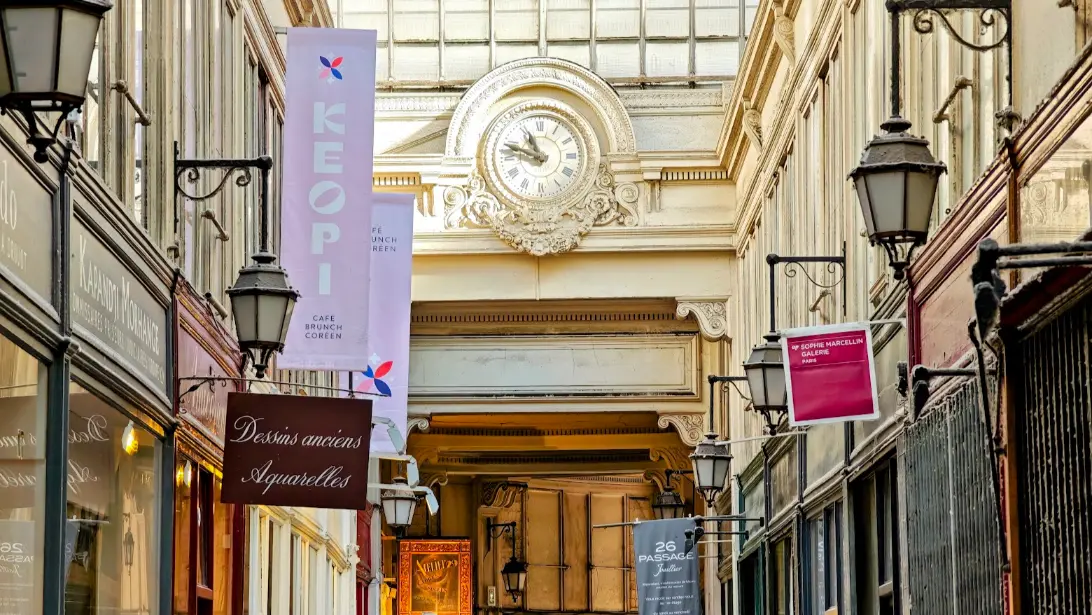
I have a weakness, I admit, for the covered arcades of Paris. There’s something magical about that one step you take from the bustling boulevard inland, into a world frozen in time. The light filtered through the glass ceilings, the antique shop windows, the faded mosaic floors – all of them whisper stories from another era. I’ve wandered through the Passage Jouffroy countless times, and each time I discover a new hidden corner.
True, it is not as famous or as magnificent as its larger and more privileged brother, Passage des Panoramas, which peeks out from across Montmartre Boulevard. But it is precisely in this relative modesty that lies the secret of its charm. It is less commercialized, more intimate, and within its walls are hidden stories of technological innovation, huge scams, forbidden loves, and one mysterious hotel whose door has never been locked. Come with me on a journey through time.
History: The Birth of the Passage and Its Hidden Secrets
Paris before the arcades: a city of mud, darkness and revolution
To understand the miracle that was the arcades, one must first imagine Paris in the first half of the 19th century. It was not the city of lights that we know today. The streets were narrow, dark, dirty and dangerous. Sidewalks, if they existed at all, were a luxury, and pedestrians had to share the road with rushing horse-drawn carriages and the infamous mud that had clung to Paris since the days of the Romans, who called it “Lutetia” – the city of mud.
In this harsh urban reality, a revolutionary idea was born: the creation of private, covered, clean and illuminated streets, intended exclusively for pedestrians. The arcades were the perfect refuge for the rising bourgeoisie, who were looking for a safe and elegant place to stroll, shop and be seen. They were, in fact, the prototypes of modern shopping malls, and they changed the face of consumer culture and urban life in Paris.
The birth of a technological marvel (1846)
The entrepreneurs: a nobleman, a businessman, and a daring architect
Passage Geoffroy was not born in a vacuum. It was the result of brilliant business planning. The developers recognized the dizzying success of Passage de Panorama, and decided to build a new passage that would continue it and take advantage of the shopping traffic that already existed in the area. The project was led by a private company led by two people.
The first was Count Félix de Jouffroy-Gonsans (1791–1863), a nobleman who owned the land and gave the passage his name. His partner was a businessman named Monsieur Verdeau, after whom the next passage in the chain, Passage Verdeau, would be named. They entrusted their vision to the esteemed architect François-Hippolyte Destailleur (1787–1852).
Groundbreaking architecture: iron, glass and underfloor heating
When the arcade was inaugurated in 1846, it was nothing short of a technological marvel. It was the first arcade in Paris to be built entirely of a metal and glass frame; only the decorative elements were made of wood. The magnificent structure of the arched glass ceiling (verrière en ogive) flooded the space with natural light and created an airy and magical atmosphere.
But the really big innovation, the one that attracted the masses of Parisians, was hidden from view. Passage Geoffroy was the first in the city to have an underfloor heating system.
Imagine Parisians freezing in the winter, suddenly entering a warm and cozy place. The anecdote goes that visitors would huddle over the metal grilles in the floor, from which the warm air was emitted, to warm their frozen feet. It was an unparalleled treat at the time.
Spicy stories and scandals behind the glass
Like any self-respecting Parisian place, Passage Geoffroy also has skeletons in the closet and juicy stories that few know about.
The Gold Bullion Scam: When All Paris Dreamed of California (1851)
In 1851, at the height of the California gold rush, a shady company called the Société des lingots d'or was set up in the Passage. In the window of its offices, a huge gold bar was displayed, valued at a fictitious sum of 400,000 francs. The bar was the grand prize in a lottery that was supposedly for a noble purpose: to finance the sending of 5,000 unemployed Parisians to California so they could make a fortune.
Crowds flocked to the arcade to witness the spectacle and buy lottery tickets. But it was all a huge scam. While some 3,000 people were indeed sent to the United States (mostly to an uncertain fate), the grand prize, that gleaming gold bar, turned out to be unwinnable in the first place. The affair became one of the most talked-about scandals of the era, illustrating how the arcade served as a stage not only for elegant commerce, but also for global dreams, the hopes of ordinary people and cynical greed.
“La Buffet Americana”: Was this where Parisian fast food was born? (1853)
After the “Gold Bullion Company” went bankrupt, its store did not remain empty for long. In 1853, an innovative and somewhat scandalous business for its time opened in its place: “Le Buffet Américain.” This was probably the first attempt to import the “fast food” culture from the United States to Paris.
The idea was revolutionary: customers paid a fixed price, chose simple dishes placed on a long counter, and ate them… standing up! In a city that sanctified the rituals of long, leisurely meals, this concept was considered strange, if not barbaric. But it marks a small and amusing historical moment in the history of Parisian gastronomy, which took place right here, in the Passage Geoffroy.
Prince Topakin and his crooked neck
Sometimes, the most interesting stories precede the place itself. Before the passage was built, there was a private hotel on the site, where, around 1820, a wealthy and eccentric Russian prince named Tuffakine lived. The prince suffered from severe torticollis, which caused his head to always be tilted at a sharp angle to his right shoulder.
The amusing story goes that his personal secretary, from trying to tilt his head so much to talk to the prince, eventually developed an identical “tic,” only in the opposite direction – his head always tilted to the left. The result was comical: when they would walk together on the street, side by side, they would be unable to speak. And when they would switch sides, their heads would bump into each other to the sound of laughter from passersby.
The institutions that made the passage a legend
Beyond the spicy stories, the greatness of Passage Geoffroy lies in the iconic institutions that were and still are located there, and have become an integral part of the history of Paris.
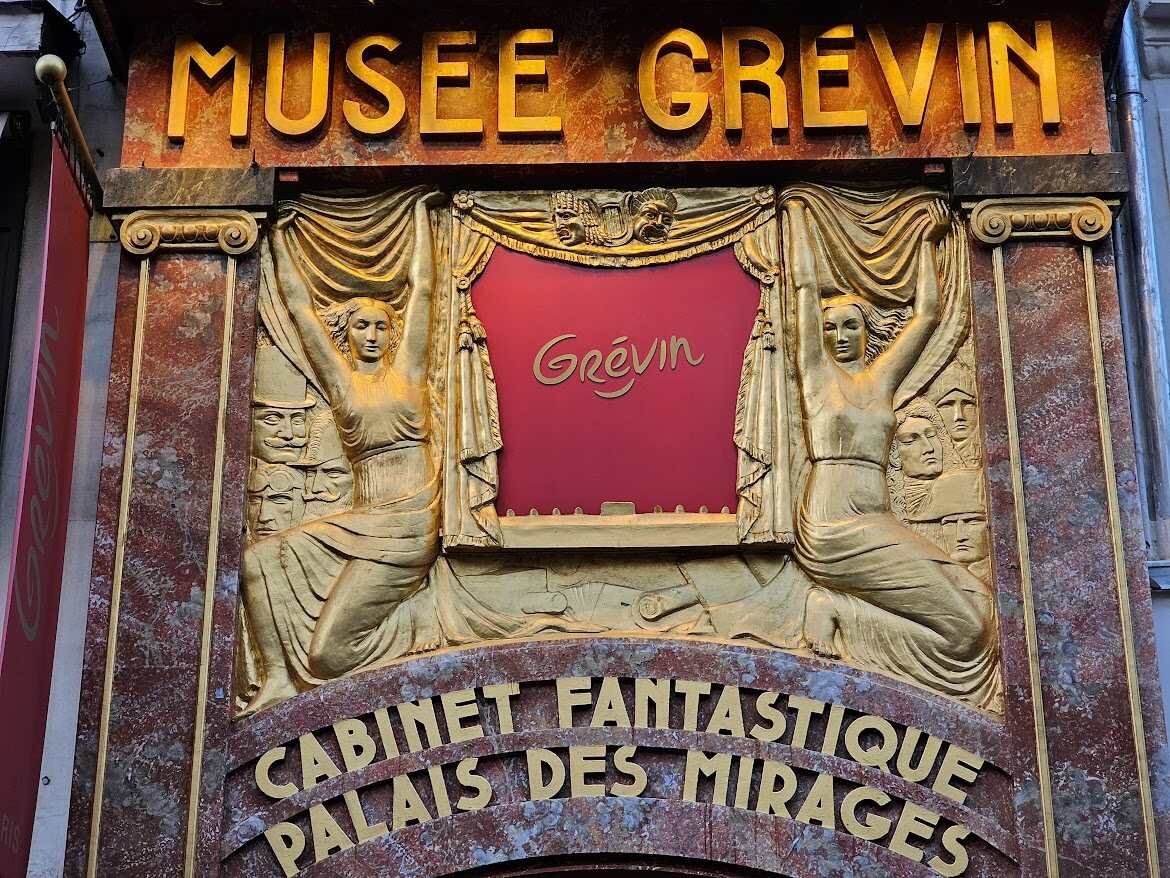
Gervin Museum: The Birth of Celebrities from Wax (1882)
In 1882, the passage received a new “tenant” that would ensure its eternal fame: the Musée Grévin. The idea for a wax museum was born in the mind of Arthur Meyer (1844-1924), a fascinating and contradictory figure. Meyer, who was the editor of the royalist newspaper Le Gaulois, was the grandson of a rabbi who became a passionate anti-Dreyfusser and eventually converted to Catholicism.
Meyer understood that in the 19th century, an era before the advent of newspaper photographs, the public was thirsty to “put faces to the names” of the celebrities and politicians they read about. He was friends with the talented caricaturist and sculptor Alfred Grévin (1827-1892), who gave the museum its name and sculpted the first wax figures. The decision to place the museum’s exit in the heart of the passage was a marketing gimmick, which drew a constant stream of curious visitors and made it one of the most visited passages in Paris.
Chopin Hotel: The legendary hotel that never closed
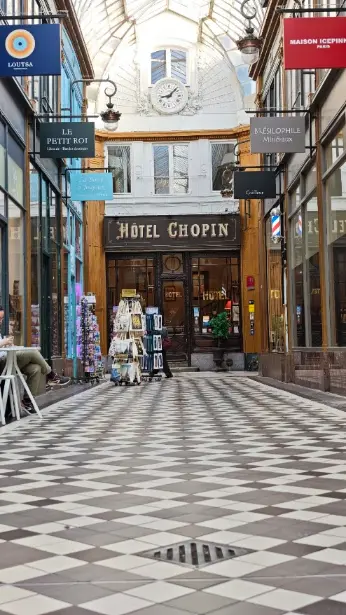
Deep within the passage, a real gem is hidden: the Hôtel Chopin. It is one of the oldest hotels in Paris, having opened its doors along with the passage itself in 1846. Originally called the “Hôtel des Familles,” it was only renamed the Hôtel Chopin in 1970, as a tribute to the great composer.
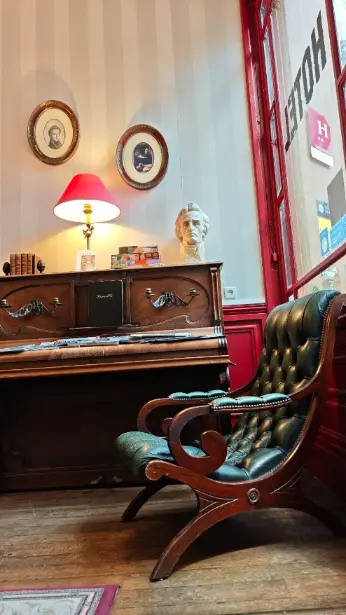
The hotel's most amazing and charming feature is that its front door has no lock, and according to the story, it has never been closed for a moment since 1846. There has been a 24/7 receptionist there for over 175 years. The hotel is an oasis of peace, as no room faces the busy street, but rather the rooftops of Paris or the inner courtyards.
And what about the romantic legend? The story goes that the composer Frédéric Chopin used to meet secretly at the hotel with his lover, the writer George Sand. Unfortunately, this is probably just an urban legend that has never been verified. What is known is that Chopin did indeed frequent the passage often, on his way to the showrooms of the famous piano manufacturer Pleyel.
Want to stay at the Chopin Hotel? Click on this link.
A whole world in small stores: from toys to walking sticks
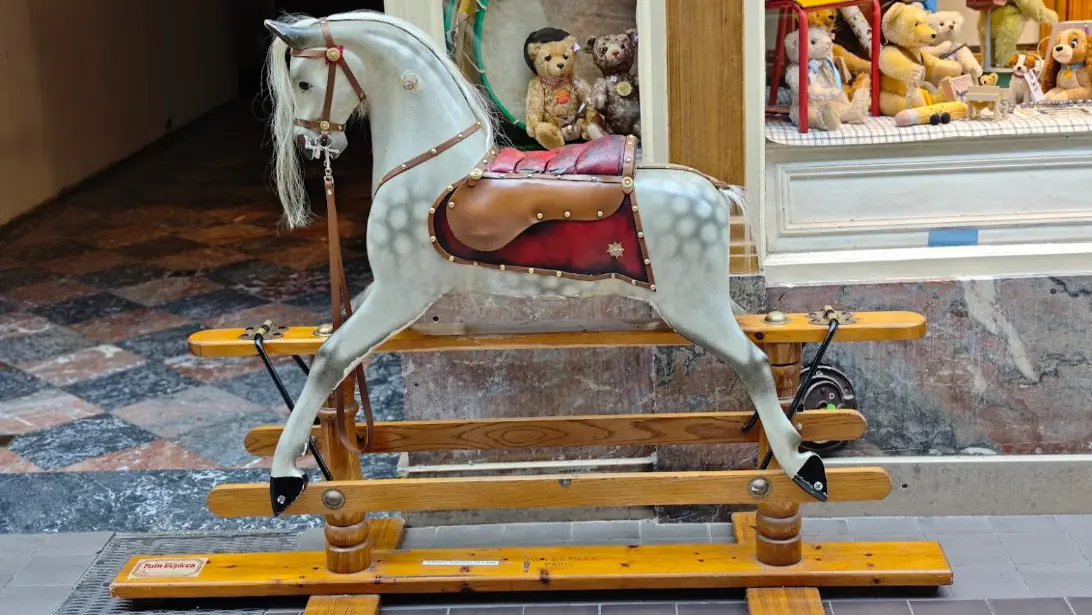
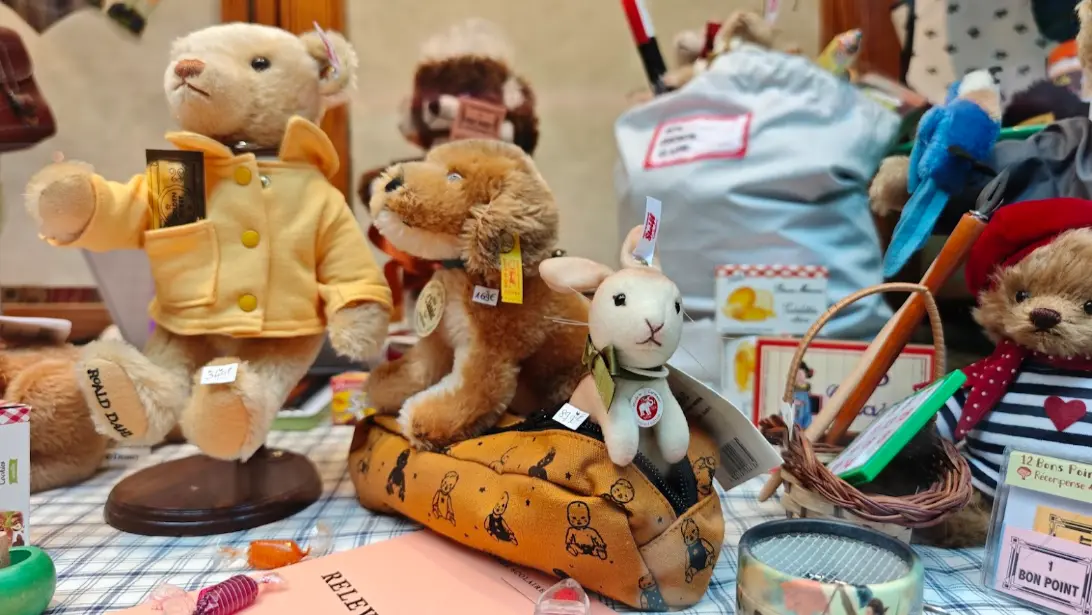
The charm of the passage also lies in its unique shops, many of which retain their old-world character. It is impossible not to stop in front of the window of “Pain d'Épices”, a magical toy shop that has existed in the passage for over 50 years. It is a world of dollhouses, wonderful miniatures and wooden toys that will take any adult back to their childhood.
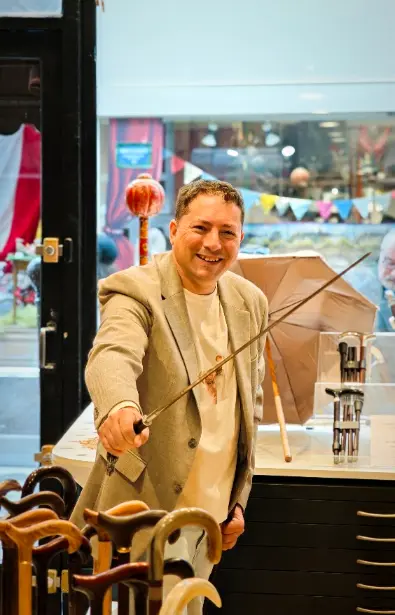
A little further on is Galerie Fayet , a shop that is a small museum in itself, dedicated entirely to the ancient craft of making walking sticks and umbrellas. Originally founded by the Segas brothers in 1975, the shop is now run by the Fayet family, artisan cane makers since 1909, continuing a rare tradition that has almost disappeared from the world.
Another place I really liked was the Valentin Tea House , run by chef-patissier Bruno Collard. All the pastries there are made on site and I can attest that the croissant I had there was exceptionally buttery and fluffy. A great place to grab a light bite and finish with something sweet. By the way, they also have a branch in Galeries Vivienne , in case you’re in the area.
Passage Geoffroy today: useful information for the visitor
Have I convinced you? I really hope so. Here's everything you need to know to visit this hidden gem.
Addresses and opening hours
The Passage Geoffroy has two entrances, making a visit to it part of a natural walking route between the passages.
- The southern entrance: 10-12 Boulevard Montmartre
- The northern entrance: 9 Rue de la Grange-Batelière
The arcade is open to the public every day, from 7:00 a.m. to 21:30 p.m. Please note that the opening hours of the stores themselves may vary.
How to get there?
Getting to the Passage is simple and convenient, thanks to its central location on the Grands Boulevards.
- By metro: The easiest and fastest way. Take the Line 8 או Line 9 Get off at the station. Grands BoulevardsBe sure to go out. Exit number 2 (sortie 2: Boulevard Montmartre – Musée Grévin), which will bring you almost directly to the entrance of the passage.
- by bus: If you prefer to see the city while traveling, many lines stop at Grands Boulevards station, including: 20, 32, 39, 74, and 85At night, you can use the Noctilien lines. N15 and N16.
More on the subject
