
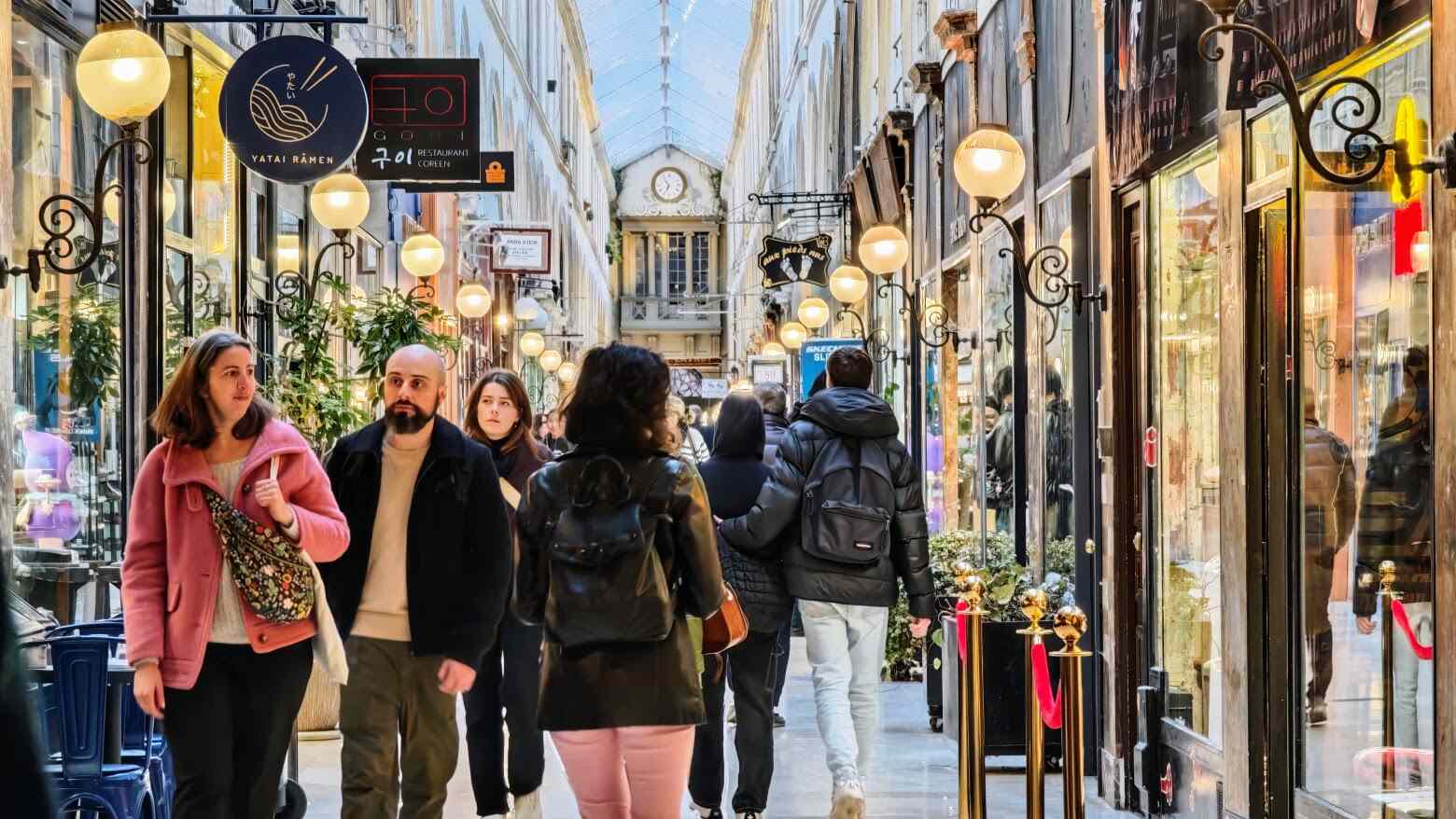
There are some passageways in Paris that are like exquisite jewels, like Galeries Vivienne or Passage Colbert, where every visit feels like entering a museum. And then there’s Passage Choiseul. I admit, every time I walk through it, I feel less of a tourist and more of a Parisian. It doesn’t try to impress with intricate mosaics or lavish decorations; it just… exists. It lives, breathes, and works.
This is the longest passage in Paris, a long, narrow artery that connects Rue des Petits Champs to Rue Saint-Augustin. It is less ornate than its more famous brethren, but its walls are steeped in a different kind of story – tales of great literature, scandalous music, and one unhappy childhood that gave birth to one of France ’s greatest and most controversial writers . Let’s dive into the true soul of this passage.
History: The birth of a giant, his turbulent life and his rebirth
The birth of the longest passage in Paris (1825-1827)
Passage Choiseul was born from a cold business mindset. In the 1820s, Paris was in the throes of the arcade craze, and Mallet, one of the city’s most important private banks, saw an opportunity for a profitable real estate investment. They purchased four old mansions, including part of the 17th-century Hôtel de Gesvres, and tasked the architect François Mazois (1783-1826) with the task.
Mazoua, who sadly died before he could see the project completed, designed a passageway that was different in nature. Instead of focusing on luxury and decoration, he emphasized functionality. The result was a passageway with a record length of 190 meters, consisting of two rows of identical four-story buildings, with the ground floor and gallery intended for commerce, and the upper floors, above the glass ceiling, for residences. It was, in essence, an efficient and well-lit covered commercial street.
A stage for high art and scandals: theater and literature
The true uniqueness of Passage Choiseul did not stem from its architecture, but from the creative souls it attracted. It quickly became a vibrant cultural hub, where masterpieces and resonant scandals were born.
Theater Bouff-Frisian: Offenbach's Kingdom
In 1855, the German-Jewish composer Jacques Offenbach (1819-1880) was looking for a new home for his theater, the Théâtre des Bouffes-Parisiens. He found it here, on the Passage Choiseul, in an old theater called the Théâtre Comte, which had mainly presented children's plays. Offenbach renovated the place and turned it into the nerve center of French operetta.
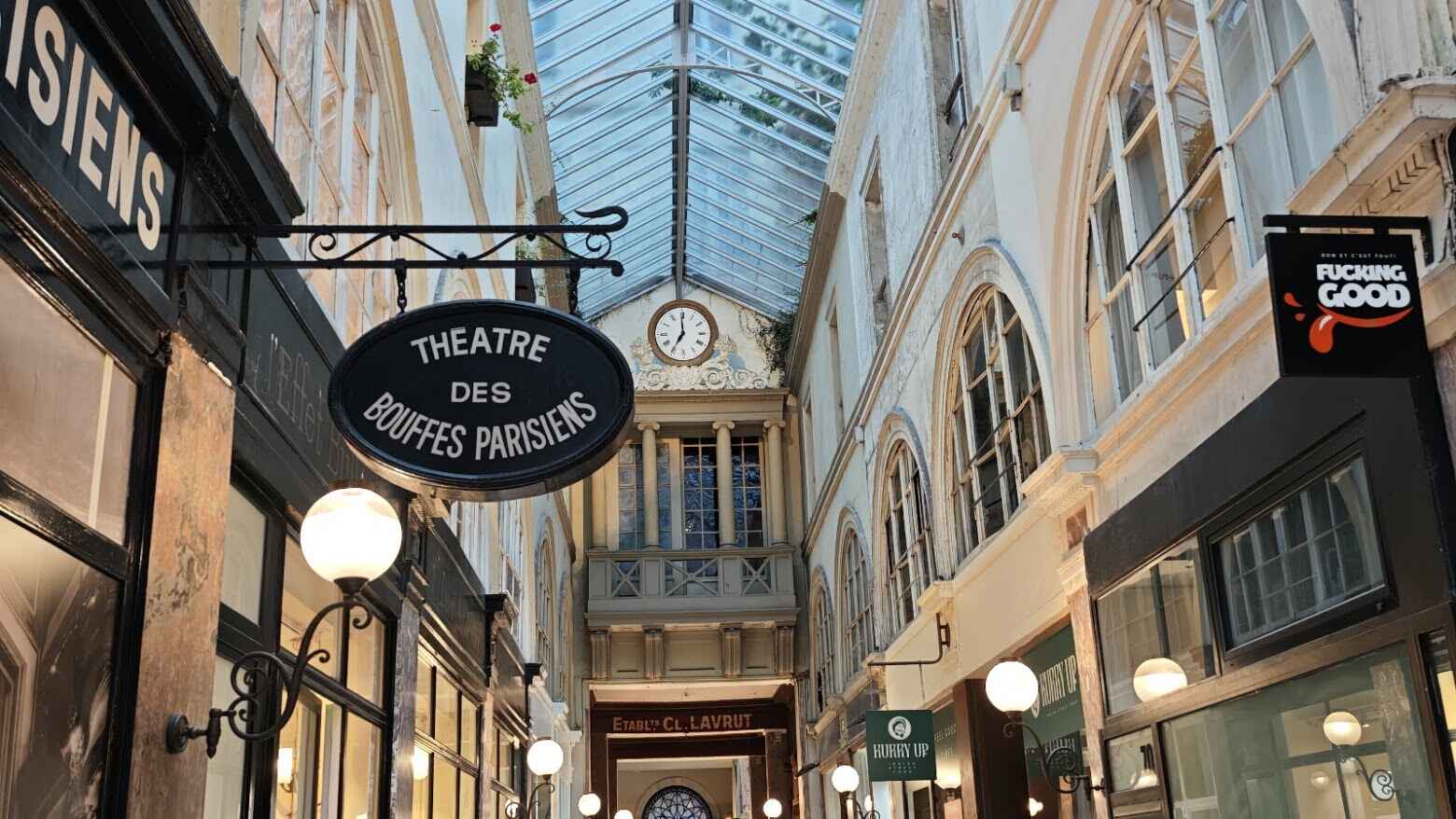
Here, within these walls, his greatest and most scandalous works, such as “Orphée aux Enfers” and “La Belle Hélène” were premiered. All of Paris flocked to the Passage to watch the satirical and daring performances, which featured the famous can-can dance and outraged conservative critics. The Passage became a meeting place for the Parisian elite, and the theater, which still exists today, remains a living testament to this heyday.
And here is the piece, one of the most famous musical works in the world, which was first performed right here:
Louis-Ferdinand Celine: An Unhappy Childhood on the “Berezina Crossing”
But the passage's most fascinating and darkest story undoubtedly belongs to the writer Louis-Ferdinand Céline (1894-1961). Céline, one of the giants of French literature (and also a scorned anti-Semite), spent his childhood here. His mother, Marguerite Detouche, ran a small antique and lace shop, first at number 67 and then at number 64.
Contrary to the romantic image, Céline's memories of the passage were harsh and bitter. In his autobiographical book, Mort à crédit, he described the passage under the name "Passage des Bérésinas", after the river where Napoleon's army suffered a severe defeat.
He remembered it as a dark, stuffy, and smelly place, “the largest gas bell in the entire City of Lights,” where some 300 gas lamps burned nonstop, poisoning the air. His chilling descriptions stand in stark contrast to the idyllic perception of Parisian arcades.
Emile Zola and the bourgeois hypocrisy of “Pot-Bouille”
It was not only Celine who found literary inspiration in the surroundings of the Passage. Émile Zola (1840-1902), in his sharp satire “Pot-Bouille” (loosely translated: “Cauldron of Stew”, an expression for “simple meal”) from 1882, also set the plot of the novel in a new and luxurious apartment building on the Rue Choiseul, right next to the Passage.
The novel follows Octave Mouret, a character who would later appear in “La Paradisain des Femmes,” who arrives in Paris and discovers the hypocrisy and moral decay hidden behind the respectable facade of his bourgeois neighbors. Zola uses the building as a microcosm of Parisian society, revealing the contrast between the magnificent main staircase and the dingy back service staircase—a perfect metaphor for the gap between declared morality and hidden actions.
The home of cursed poets
Before Celine, the Passage was already a literary center. At number 23 was the publishing house of Alphonse Lemerre (1838-1912), who was the publisher of the “Parnassian” poets. This is where the poems of Paul Verlaine (1844-1896) were first published, and here the Nobel Prize-winning writer Anatole France (1844-1924) worked as an editor and reader for years.
Sunset, and a surprising revival with a Japanese scent (70s)
Like many arcades, Passage Choiseul fell into disrepair over time and was abandoned. It was considered outdated, and its stores struggled to compete with the large department stores that opened on nearby boulevards. But in the 1970s, a revival came from an unexpected source.
The young Japanese fashion designer Kenzo Takada (1939-2020) opened his first boutique, “Jungle Jap,” in the passage. His colorful and bold store injected new blood into the veins of the old passage, turning it into a pilgrimage center for fashionistas and bohemians. Although Kenzo later moved to Place Victoire, he had already rekindled the spark, and the passage became a fashionable place again.
Passage Choiseul today: useful information for the visitor
Today, Passage Choiseul is a charming mix of old and new. Alongside old bookstores and art galleries, you'll find small restaurants, clothing stores and one siesta bar. It still serves as a handy shortcut for Parisians on the go, and it's a great opportunity to experience an authentic slice of the city.
Addresses and opening hours
The passage has several entrances, making it extremely accessible.
- The southern entrance: 40 Rue des Petits-Champs
- The northern entrance: 23 St. Augustine Street
- Additional entries: 40 Rue Dalayrac and the nearby Passage Sainte-Anne.
The Passage is open Monday through Saturday, 8:00 a.m. to 20:00 p.m. It is closed on Sundays.
How to get there?
The passage is located in the heart of the second arrondissement, a short walk from the National Library, the Palais Royal and the Opera Garnier.
- By metro: The nearest stations are: Quatre-Septembre (Line 3) andPyramides" (Lines 7 and 14).
- by bus: Many lines stop nearby, including lines 20, 29, 39, 74, and 85.
Want to discover more passages?
If your visit to the Passage Choiseul has left you wanting more, I invite you to join me on a magical journey through the hidden gems of Paris. I have prepared a special itinerary for you, which will take you through the most beautiful and interesting covered passages in the city.
You can find the full route in the article: A tour through the covered arcades of Paris.
More on the subject

Lovely article. I will soon visit Passage Choiseul. I didn't know the place before reading. And I also studied ballet at the Opera Garnier. Thank you
Thank you very much 🙂