
in short
- What's there: Portrait of Lisa Gherardini, which Leonardo began painting in 1503 and worked on until his death in 1519.
- where: Louvre Museum, Danon Wing, 1st floor, room 711 (Hall of States).
- How to get there: Metro lines 1 and 7 to Palais-Royal / Musée du Louvre station, or line 14 to Pyramides station.
- How much does it cost: There is no separate ticket. A ticket to the Louvre costs 32 euros for Israelis and 22 euros for citizens of the European Union, free up to the age of 18.
- When: Every day except Tuesday, 9:00–18:00, and on Wednesdays and Fridays until 21:00.
- How to shorten the queue: Arrive at the opening or in the evening, or book a guided tour or entry with a host.
- Bonus: In 2031, it is scheduled to move to its own dedicated hall.
The Mona Lisa (La Joconde, as the French call her) became a global icon the day she disappeared from the wall. In August 1911, it was stolen from the Louvre, and in the days following its discovery, crowds of curious people flocked to the museum to gaze at the empty spot where it had hung (yes, people lined up to see hooks on the wall). More than a century later, a large portion of visitors to the Louvre still look for her first, and many of them discover, in front of the armored glass, a painting much smaller than they imagined.
In the main article about the Louvre Museum, I wrote that the line in the Mona Lisa hall is perhaps the least enjoyable attraction in Paris, and I still stand by that statement. But that's no reason to give it up. Anyone who arrives at the right time and with the right ticket can stand in front of her at ease, and anyone who knows her story suddenly understands why a portrait of a silk merchant's wife from Florence attracts thousands of people a day.
So before we set off and visit the Mona Lisa, let's talk about what you'll find in this article. In the first chapter, all the practical information: where exactly it hangs, how to get there, which tickets and tours you should book, and how to shorten the line in front of it. After that, what's worth seeing in and around its hall, and then the full history of the painting, from Leonardo's workshop in Florence to the Italian glazier who hid it under his bed for two years. At the end, you'll find three hotels near the Louvre and answers to frequently asked questions about the painting.

Practical information: How to get to the Mona Lisa, what tickets to buy and how to shorten the line
Where exactly does the Mona Lisa hang?
The Mona Lisa hangs in the Salle des États, room 711 in the Denon wing, on the first floor of the Louvre. According to the Louvre itself, this is the largest room in the palace, and it was chosen for exactly that reason: so that as many people as possible could see it. From the entrance under the pyramid, go to the Denon wing and go up one floor, from there signs lead to the hall (and if you miss a sign, just follow the crowd).
The painting hangs alone on a designated wall in the center of the hall, behind armored glass and a railing, and on the wall opposite it stretches the huge painting “The Wedding at the Barge” by Veronese.
It's worth noting that this address is temporary. The Louvre plans to move the Mona Lisa to its own new hall, which will be built under the Cour Carrée and connected to a new entrance from the Colonnade, and is scheduled to open in 2031.
How to get to the Louvre, and which entrance to use
The easiest way is by metro: lines 1 and 7 stop at Palais-Royal / Musée du Louvre, and line 14 stops at Pyramides. Bus lines 21, 27, 39, 67, 68, 69, 72, 74, 85 and 95 also reach the Louvre, and the Batobus, the Seine cruise bus, stops at Quai François-Mitterrand.
The Louvre has four entrances, and each has its own rules:
- The pyramid: The main entrance, with three lines. The green line is for those who hold a ticket or Museum ticket (Paris Museum Pass), the orange one is for those who come without a ticket, and the blue one is for people with disabilities and staff.
- Carousel: At 99 rue de Rivoli, via the underground shopping center. Open to groups, membership card holders and anyone with a card.
- Lions Gate (Porte des Lions): On the Seine side, in the south wing where the Mona Lisa hangs. You can only enter through it with a ticket, it closes every day at 18:00 PM (last admission at 17:00 PM) and is closed on Tuesdays.
- Passage Richelieu: Reserved for groups, groups of up to 6 people with a reservation and a qualified guide, and membership card holders. It closes at 17:30 PM, and on Wednesdays and Fridays at 19:30 PM.
You can read about the advantages and disadvantages of each entrance in the article about the Louvre Museum.

Opening hours and tickets
The Louvre is open Monday, Thursday, Saturday, and Sunday from 9:00 AM to 18:00 PM, and Wednesday and Friday from 9:00 AM to 21:00 PM. It is closed on Tuesday (a mistake that many travelers make). Last admission is one hour before closing, and the guards begin clearing the halls half an hour before closing, so anyone who enters at 17:00 PM on a regular day should go straight to the Mona Lisa.
The museum is closed on January 1, May 1, and December 25, and is open on all other holidays unless they fall on a Tuesday. On the first Friday of each month after 18:00 PM (except July and August) and on July 14, admission is free for everyone.
Since January 14, 2026, the price of a ticket to the Louvre depends on where you come from. Citizens and residents of the European Economic Area pay 22 euros, and everyone else, including us Israelis, pays from 32 euros (depending on the type of ticket and whether it is a guided tour or not). Under 18s enter for free, as do citizens and residents of the European area up to the age of 26. The ticket includes the permanent collections, the changing exhibitions, and admission to the Musée national Eugène-Delacroix on the same day or the next.
There is no separate ticket for the Mona Lisa, and the regular admission ticket gets you into her hall. It is highly recommended to book the ticket in advance with an entry time: the Louvre limits the number of visitors to 30,000 per day, and the box office only sells tickets when the museum is not crowded. The Louvre also warns against websites that impersonate the official website and ticket sellers on the street, so buy only on the official website or a reputable platform.
It is highly recommended to book a ticket in advance using this link.
If you are also including the Eiffel Tower in the same trip, there are packages that combine reserved entry to the Louvre and a ticket to the tower in one booking. These are the two attractions that are the most difficult to get tickets for at the last minute.
Guided tour or entrance with a host who takes you straight to the Mona Lisa
If this is your first time at the Louvre, a guided tour saves you two headaches at once: the entrance line and navigating the museum, where it's very easy to get lost. The tour, which also appears in the article about the Louvre, lasts about two to two and a half hours, and the entrance ticket with an entrance time is included in the price. The guide picks up the group outside the museum, and inside the route passes through Greek and Roman antiquities (Venus of Milo and Nike of Samothrace), continues to the Mona Lisa and ends with the French painting. You can choose a group of up to 20 participants, a group of 6 or a private tour, the guidance is in English or Spanish, and you can cancel for free up to 24 hours in advance.
Find me a guided tour of the Mona Lisa
If you prefer guidance in Hebrew, you can contact Shuki Spector, a veteran guide who specializes in museum tours, including the Louvre. Visit Shuki Spector's website . The other Hebrew-speaking guides I recommend appear on the Tours of Paris in Hebrew page.
For those who don't want two hours of guidance, there is an intermediate option: an entrance ticket with a host who meets you at the Louvre, enters with you, and accompanies you to the Mona Lisa. This is not a guided tour. After the Mona Lisa, you continue on your own and at your own pace, which is especially suitable for those who know what they want to see next and just don't want to waste the morning finding their way.
Find me a hosted entrance to the Mona Lisa.
How to avoid the line in front of the Mona Lisa, how long and when to come
Let's be honest: no ticket will shorten the line inside the hall. The tours and guided entrances save you the line to enter the Louvre and the wandering, but in front of the painting itself everyone stands in the same formation. When the hall is packed, two snake-shaped lines open up in the center, and a museum employee stops the waiting people until the person standing in front of the painting gives up their place. Since the hall's renovation in 2019, there has also been a separate line for children and people with mobility disabilities, which goes directly to the painting (a tip worth gold for families).
What does work is timing:
- Were there at the opening. Book a ticket for 9:00, and once you've passed security, go straight to the Danon wing, before any other work. You'll see Venus de Milo later anyway (pun intended 🙂 ), she's not going anywhere.
- Take advantage of the Arabs. On Wednesdays and Fridays, the Louvre is open until 21:00 PM, and in the evenings it is less crowded.
- Avoid lunch. The busiest hours at the museum are between 11:00 AM and 15:00 PM.
- Take advantage of the wait. While you’re in line, turn to the “Wedding in a Barrel” on the wall opposite. It has 132 figures, enough material for the entire wait.
- Decide in advance what you want. You stay in front of the painting for a short time and the guards make sure the line keeps moving, so it's worth choosing in advance between a picture and a moment of silence.
The Mona Lisa can be seen in a short visit, but it's a shame to come to the Louvre just for her. It's worth reserving at least half a day to visit the museum, and putting your meeting with her at the beginning, at the opening, or on a Wednesday or Friday evening. If you're building an entire trip to Paris, the route generator will fit the Louvre into your schedule on a day that fits in with the rest of your schedule.
What not to miss in the Mona Lisa Hall
The Mona Lisa herself: what to look at
The first thing you’ll notice is the size: 79.4 cm high by 53.4 cm wide, oil on a thin poplar panel. Leonardo chose a relatively large panel to paint Lisa life-size, and the panel was never cut, even though you sometimes hear otherwise.
Notice the smile, and how it is created. Leonardo built the face with very thin layers of almost transparent paint, which blurs the contours and creates a soft transition between light and shadow. This technique is called sfumato, from “smoke,” and it allows him to hint at what Lisa is feeling without revealing why.
Behind Lisa stretches a mountainous landscape with rivers: on the left a winding road, and on the right a bridge over the river. In the lower right corner you can see that some of the ground remains at sketch level, because Leonardo did not finish the painting until his death.
Look for the scars, too. An 11-centimeter crack runs down from the top edge of the panel, crosses the hairline, and stops, almost miraculously, at the forehead. Layers of varnish added after Leonardo’s death have yellowed over the years and now act like a yellow filter: they darken the lower part of the painting and turn the blue sky greenish (yes, Leonardo’s sky was blue).
“The Wedding at Cana”, Titian and more by Leonardo: what else is there around it?
Opposite the Mona Lisa hangs “The Wedding at Cana” (Les Noces de Cana) by Veronese (Paolo Caliari, dit Veronese, 1528–1588), 6.77 meters high and 9.94 meters wide, with 132 life-size figures. The Benedictine monks of the monastery of San Giorgio Maggiore in Venice invited it to their dining room in 1562. In 1797, Napoleon’s army confiscated it, rolled it up, and brought it to Paris. Remember this detail, because as you will see, it will return in the story of the thief of 1911.

The Hall of States houses a large collection of 16th-century Venetian paintings, including several works by Titian (Tiziano Vecellio, died 1576): “The Crowning of Thorns” (Le Couronnement d'épines), “The Man with the Glove” (L'Homme au gant), and “The Country Concert” (Le Concert champêtre). All are just a few steps from the Mona Lisa, and are worth a few minutes before or after your turn.
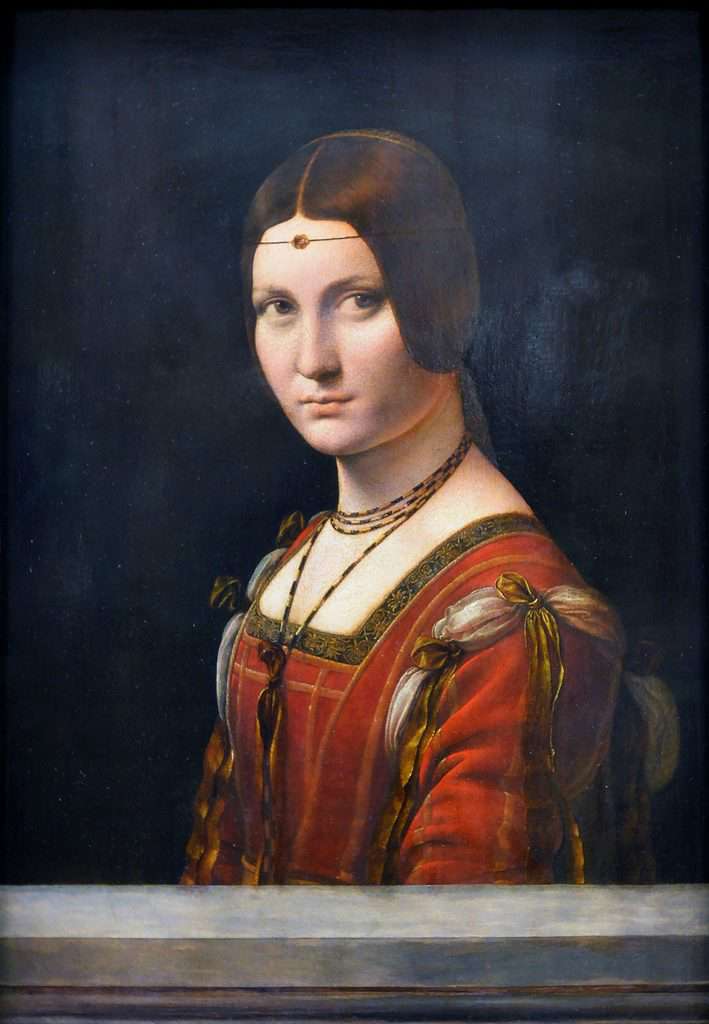
The Mona Lisa is not alone in the Louvre. In the adjacent Grande Galerie hang other paintings by Leonardo, including “The Virgin among the Rocks” (La Vierge aux rochers), “The Virgin and Child with Saint Anne” (Sainte Anne) and “Saint Jean-Baptiste”. The latter two arrived in France with the Mona Lisa, in Leonardo’s own luggage. The small “La Belle Ferronnière” (La Belle Ferronnière) is also worth a stop. You can read about the other must-see works in the article 10 Must-See Works at the Louvre Museum (and Not a Word About the Mona Lisa).
The history of the Mona Lisa
1503: Portrait of an unidentified silk merchant's wife
The story begins with Lisa Gherardini (1479–1542), a daughter of an old noble family that owned land in Chianti. In 1495 she married Francesco del Giocondo (1465–1538), a Florentine silk merchant, and they had six children. Francesco had known Leonardo's father, a notary in Florence, since at least 1497, and it is possible that through this connection he came into contact with Leonardo da Vinci (1452–1519), who returned to the city in 1500.
According to Giorgio Vasari (1511–1574), who published a biography of Leonardo in 1550, it was Francesco who asked the painter to paint his wife. Leonardo worked on the portrait for four years and left it unfinished, and to drive away the melancholy from Lisa's face as she sat before him, he had her played and sung by him and jesters entertained. Vasari never saw the painting, but he lived in Florence, and the Giocondo family was well known in the city's high society.
Hence the names. “Monna” is short for “Madonna,” meaning “my lady,” and the French call her La Joconde after her husband. There’s also a play on words here: “giocondo” means “happy” in Italian, so “La Gioconda” is, quite literally, the happy woman (anyone who has ever stood in line for her on an August afternoon knows that happiness is not always contagious).
In 2005, evidence was found in the Heidelberg University Library that the painting was already in progress in October 1503. Agostino Vespucci, who worked alongside Niccolò Machiavelli (1469–1527) in the Florence State Office, read a book by a Roman author and, where a Greek painter was mentioned who left a painting of Venus unfinished, noted in the margin that Leonardo did so in all his paintings, “like the head of Lisa del Giocondo.” One footnote confirmed what Vasari wrote almost fifty years later.
Francesco del Giocondo apparently never received the portrait. Leonardo continued to work on it for years, taking it with him from place to place. Between 1513 and 1516 he worked in Rome under the patronage of Giuliano de' Medici (1479–1516), the Pope's brother, and after Giuliano's death he received an invitation from the King of France.
In 1516, Leonardo arrived in France at the invitation of Francis I (reigned 1515–1547), who gave him the Clos Lucé estate near the Château de Amboise. He brought with him three unfinished paintings: the Mona Lisa, Saint Anne, and John the Baptist.
On 10 October 1517, the Cardinal of Aragon visited him in Cal Lusa, and his secretary Antonio de Beatis recorded in his travel diary that Leonardo showed them, among other things, a portrait of “a certain Florentine lady” painted at the request of the late Giuliano de’ Medici. There is a version according to which the woman in the painting was actually one of Giuliano’s lovers. The more likely version is much simpler: Leonardo used to change the purpose of paintings he had begun, and probably only reminded the guest that Giuliano, his patron, admired the painting and wanted it.
1518: The Mona Lisa becomes French
A document found in 1999 in the National Archives in Paris explains how the Mona Lisa became French. In 1518, Francis I paid the enormous sum of 2,604 livres to Gian Giacomo Caprotti (1480–1524), a student of Leonardo, nicknamed Salaì, for “some panels” that he had given to the king. The amount indicates that the king had purchased the master’s originals, and the Mona Lisa was probably among them.
Leonardo died in Clos Lousse on 2 May 1519, and was buried in the church of Saint-Florentin in Amboise. Vasari said that he breathed his last in the arms of Francis I, and Ingres (Jean-Auguste-Dominique Ingres, 1780–1867) painted the scene in 1818. However, the king was at that time in Saint-Germain-en-Laye, where the queen gave birth to his son, the future Henry II (reigned 1547–1559), and royal decrees signed there in early May attest to this (a beautiful scene, except that one of the two main actors did not make it).

Francis I placed the Mona Lisa in the Château de Fontainebleau, where, according to Vasari, it was in 1550. In the early 17th century it appeared in the château's drawing room, and in 1646 it hung in the gilded room next to the bedroom of Anne of Austria (Anne d'Autriche, 1601–1666).
Louis XIV returned it to Paris. In 1665–1666 it moved from the Louvre to the Galerie des Ambassadeurs in the Palais des Tuileries, in 1683 it was listed in the king's collection compiled by the painter Charles Le Brun (1619–1690), and in the 1690s it moved to the King's Gallery in the Palace of Versailles.
The 18th century passed relatively quietly in Versailles. In 1793, when the Revolution opened the “Central Museum of Fine Arts” (Muséum central des arts) at the Louvre, the Mona Lisa was not selected for the museum’s first exhibition (it turns out that even the world-famous painting had its days when it didn’t pass the audition). It only entered the museum’s collection in 1797, and was first shown to the public in 1798.
According to the common version, Napoleon , then Premier Consul, took the Mona Lisa to his bedroom in the Tuileries Palace. In fact, it probably hung in the apartment of Joséphine (Joséphine de Beauharnais, 1763–1814), and shortly afterwards returned to the Grand Gallery of the Louvre.
In the mid-19th century, the painting's popularity soared. In 1851, it was moved to the Salon Carré, the small room reserved for masterpieces, and writers such as Théophile Gautier (1811–1872) wrote enthusiastic descriptions of it, creating the myth of a mysterious and fatal beauty.
In 1870, during the Franco-Prussian War, the Mona Lisa was removed from Paris and hidden in the tunnels of the Brest Arsenal, returning to the Louvre when the war ended.
August 21, 1911: The Empty Wall and the Thief Signed “Leonardo”
Vincenzo Peruggia (1881–1925) was an Italian glazier and painter who worked in Paris. A year before the theft, he personally participated in installing the glass around the Mona Lisa, and the police already had an identification card of his from 1909, with a face and profile photograph taken in the style of Alphonse Bertillon (1853–1914).
On Monday, August 21, 1911, the Louvre was closed to the public. According to his later testimony, Peruggia entered the museum in the morning in his work coat, went to the square living room, waited for the moment when he was alone and took the painting down from the wall. On a side staircase, he dismantled the frame and glass, hid the panel under his clothes and left through the Visconti courtyard to the Rue de Rivoli. At one of the locked doors on the way, he said, a plumber who was passing by helped him and opened it for him without suspecting anything.
The next morning, the painter Louis Béroud (1852–1930) arrived to paint the Mona Lisa, as usual, and found only the hooks on the wall. At first, the guards assumed that the painting had been taken for a photograph, and when it turned out that it had not, the museum was closed and the police began a search. The frame and glass were found in the service staircase. Bertillon identified a fingerprint on the glass and compared it to the prints of the 257 people who had been in the museum that day, without result, even though Peruggia’s card had been with the police for two years.
The first to pay the price was Théophile Homolle (1848–1925), director of the National Museums, whose career at the Louvre ended abruptly. Meanwhile, crowds of curious people had arrived at the Louvre to gaze at the empty space, reportedly including Franz Kafka (1883–1924) and his friend Max Brod (1884–1968), who were visiting Paris that September.
The investigation took an unexpected turn. It turned out that one of the poet Guillaume Apollinaire's (1880–1918) acquaintances, a Belgian adventurer named Géry Pieret, had stolen antique statuettes from the Louvre a few years earlier, some of which had ended up with Pablo Picasso (1881–1973). On September 7, 1911, Apollinaire was arrested and remained in custody for about a week, and Picasso was also interrogated. According to the story, Picasso claimed to the investigators that he did not know Apollinaire at all, even though the two were friends. Neither of them had touched the Mona Lisa.
For more than two years, the Mona Lisa lay in Peruggia’s room on the rue de l’Hôpital-Saint-Louis, in a secret compartment at the bottom of a wooden box under the bed. In November 1913, he wrote to a Florentine antiques dealer named Alfredo Geri, signed “Leonardo,” offering to “return to Italy” her masterpiece.
Gerry partnered with Giovanni Poggi (1880–1961), director of the Galleria degli Uffizi, and the two arranged a meeting at the Tripoli-Italia Hotel in Florence. Perugia arrived with a large white box, and inside, wrapped in red cloth, the Mona Lisa was waiting. Fuji and Gerry verified the painting, feigned surprise, and called the Carabinieri, and the thief was arrested on the spot. On December 12, 1913, the world was told that the Mona Lisa had been found (the hotel, incidentally, later changed its name to the “Hotel Gioconda”).
Peruggia claimed that he acted out of patriotism: he was convinced that Napoleon had stolen the Mona Lisa from Italy, and wanted to return it to its homeland. But the Mona Lisa came to France with Leonardo himself and was bought with full money, and what was actually taken from Italy by Napoleon’s army hangs today on the wall opposite, in the form of “The Wedding in a Barrel.” His patriotism was not entirely pure either, because he expected to receive a reward.
Before returning it, Italy exhibited the Mona Lisa in Florence, Rome, and Milan, and on January 4, 1914, it returned to the Louvre, famous throughout the world and not just among art lovers.
In June 1914, Peruggia was tried in Florence and sentenced to one year and 15 days, a sentence reduced to 7 months. He served in the Italian army in World War I, and died in 1925 in Saint-Maur-des-Fossés near Paris of a heart attack on his birthday.
From 1914 to 2031: Shelters, an embassy and its own hall
A few months after its return, the Mona Lisa was on the move again. At the outbreak of World War I, it was moved to safety in Bordeaux and then Toulouse, returning to the Louvre at the end of the war.
In 1938, during the Sudetenland Crisis, the Mona Lisa was sent to the Musée Ingres in Montauban, and quickly returned to Paris.
As World War II approached, Jacques Jaujard (1895–1967), a senior director of the National Museums, prepared an evacuation plan. On August 25, 1939, the Louvre was closed, and the works were packed in boxes and taken in convoys to the Château de Chambord, which became the sorting station for Paris’ treasures. The list of 50 important paintings marked for immediate evacuation was supplemented by two red dots on the frame. The Mona Lisa had three. It was packed in red velvet, inside a box, inside a double poplar crate, and was given the number MNLP 0.
On November 14, 1939, she was transferred to the Château de Louvigny in western France, where she remained for seven months under close guard. In June 1940, as the Germans advanced, she stopped for two days in Chambord, and from there she wandered between the Abbey of Loc-Dieu in Aveyron, the Musée d'Engers in Montauban, and the Château de Montal in the Lot region. At Montal, her coffin was placed next to a window that had been turned into a door, so that in case of danger she would be the first to leave. After the war, she returned to the Louvre.
On December 30, 1956, a young Bolivian named Ugo Ungaza Villegas threw a rock at the Mona Lisa. The glass broke, and Lisa's left elbow was slightly injured.
In 1963, the Mona Lisa went on a diplomatic tour to the United States: it was exhibited at the National Gallery in Washington from January 10 to February 3, and at the Metropolitan Museum in New York from February 7 to March 4, during the reigns of Charles de Gaulle (1890–1970) and John F. Kennedy (1917–1963). The exhibition in Washington was opened in the presence of the French Minister of Culture, André Malraux (1901–1976).
In 1974, she arrived in Tokyo, where a disabled woman sprayed her with red paint in protest of the exhibition's poor accessibility, and on the way back, she was exhibited at the Pushkin Museum in Moscow. This was her last trip: due to her frailty, she no longer leaves the Louvre.
It hardly moved inside the Louvre either. Between 1992 and 1995 it was displayed in the Grand Gallery, and between 2001 and 2005 in the Salle Rosa, while the Hall of States was being renovated, to which it returned in 2005. In the summer of 2019, during another renovation, it moved to the Galerie Médicis from July 17 to October 7.
In the 21st century, armored glass worked overtime:
- In 2009, a Russian critic threw a mug at the glass, protesting that her application for French citizenship was rejected.
- In 2022, a man, dressed as an old woman in a wheelchair, spread a cake on the glass.
- On January 28, 2024, two activists from the Riposte Alimentaire group threw soup they had smuggled in a coffee thermos, in protest for the “right to healthy and sustainable food.” The painting was not damaged, and the hall was closed for an hour for cleaning.
On January 28, 2025, President Emmanuel Macron stood in front of the Mona Lisa and presented “Louvre Nouvelle Renaissance,” a renovation and expansion plan for the museum, shortly after Louvre President Laurence des Cars (born 1966) warned of water leaks and failing infrastructure. At the center of the plan are a second entrance from the colonnade built by Claude Perrault (1613–1688), and a hall dedicated to the Mona Lisa beneath the square courtyard, which will be entered with a separate ticket, the price of which has not yet been determined.
In May 2026, the architects, STUDIOS Architecture Paris, together with Selldorf Architects from New York, were selected, and the opening is scheduled for 2031. Until then, the Mona Lisa remains in Hall 711, behind the same glass and in front of the same Venetian wedding. What do you think, in her own hall and with her own ticket, will she be more or less mysterious?
Where to sleep near the Mona Lisa
If you want to be the first in the hall at 9:00, staying near the Louvre saves you the morning commute. Here are three hotels in the 1st arrondissement, two of which I stayed in myself. You can find more options in the article about the Louvre Museum and the page on hotels in the 1st arrondissement in Paris.
Hotel Brighton
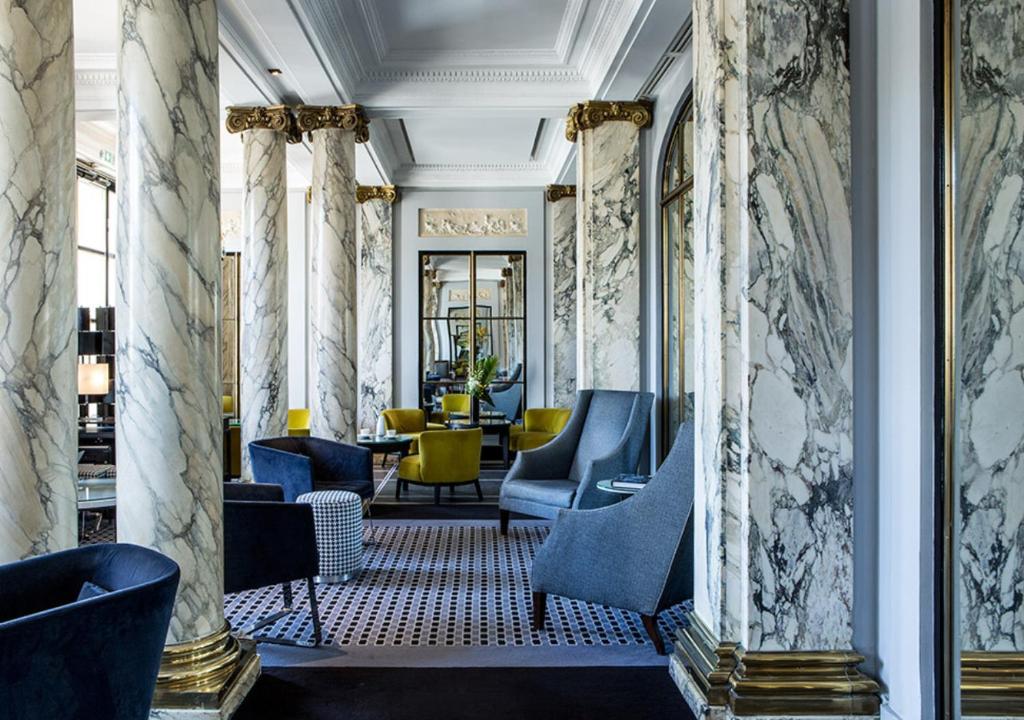
4-star hotel opposite the Jardin des Tuileries, a short walk from the Louvre. I have stayed there before and I recommend asking for a room with a view of the gardens. Prices start at around €222 per night.
For more information and to book a room
Hotel Moliere

A 4-star boutique hotel, upgraded and luxurious, between the Louvre and the Palais-Royal, where I also stayed (and for those who love Molière like me, the name is a little bonus). Prices start at around 252 euros per night.
For more information and to book a room
Hotel Regina Louvre
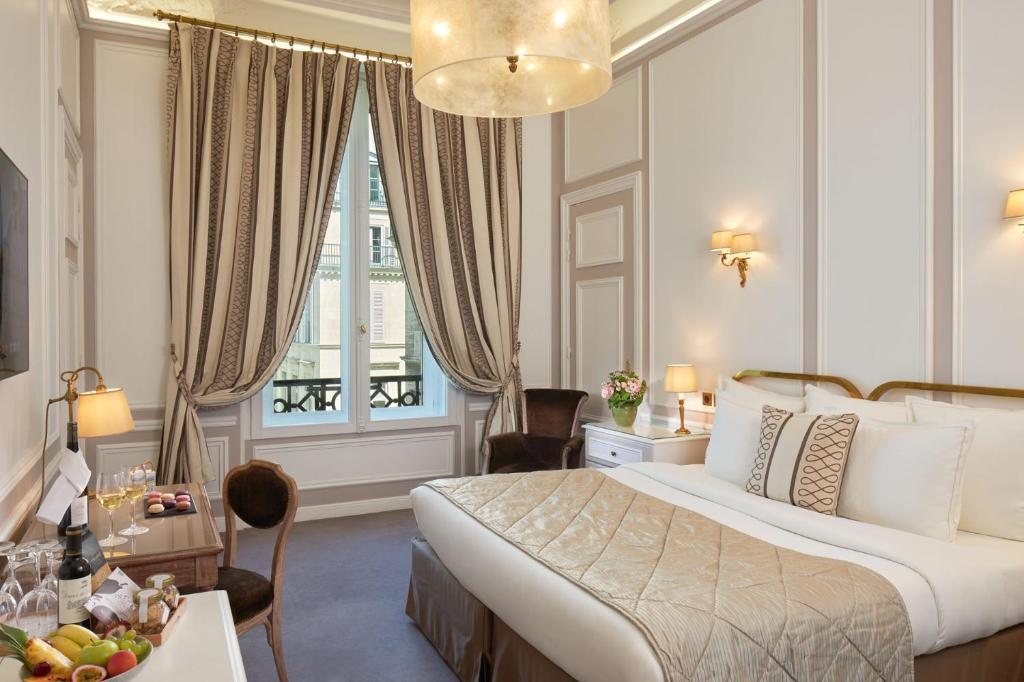
A 5-star hotel on Place des Pyramides, right across from the Louvre, built for the 1900 World's Fair and preserving the original mosaics and antique furniture. Some rooms offer a view of the gardens, the Seine and the Eiffel Tower at once. This is a hotel for celebration, not for the budget.
For more information and to book a room
Questions and Answers about the Mona Lisa
Where is the Mona Lisa?
The Mona Lisa is located in the Louvre Museum in Paris, in the Hall of States (Salle des États), Hall 711 in the Denon Wing on the 1st floor. From the entrance under the pyramid, head towards the Denon Wing and go up one floor, and the signage leads to the hall. The Louvre plans to move it to its own dedicated hall, and the opening is scheduled for 2031.
How much does it cost to see the Mona Lisa?
There is no separate ticket for the Mona Lisa, and the Louvre entrance ticket is sufficient. Since January 14, 2026, the ticket costs €32 for visitors outside the European Economic Area, including Israelis, and €22 for citizens and residents of the area. Under-18s enter for free, and it is recommended to book a ticket with an entry time in advance.
What is the size of the Mona Lisa?
The Mona Lisa is smaller than most people imagine: 79.4 cm high by 53.4 cm wide, oil on poplar wood panel. The panel has never been cut, but over the years it has warped and cracked slightly. On the wall opposite, in the same hall, hangs Veronese’s “Wedding in a Barrel,” which is 9.94 meters wide.
Why is the Mona Lisa so famous?
The Mona Lisa has been a prized work since 1550, when Giorgio Vasari described it in his biography of Leonardo, and 19th-century writers transformed it into a mysterious beauty. It gained worldwide and popular fame after it was stolen from the Louvre on August 21, 1911, and was missing for more than two years, until it was found in Florence in December 1913.
Was the Mona Lisa stolen in the Louvre robbery in 2025?
No. In the robbery of October 19, 2025, jewels were stolen from the French Crown Jewels collection displayed in the Galerie d'Apollon, including items attributed to Napoleon and Empress Josephine. The Mona Lisa was not damaged. The only time it had been stolen was in 1911, by the Italian glazier Vincenzo Peruggia.
When will the Mona Lisa move to a new hall?
According to the “Louvre, a New Renaissance” plan presented by President Macron in January 2025, the Mona Lisa will move to a dedicated hall under the square courtyard, with a new entrance from the colonnade and a separate ticket. In May 2026, the architects were chosen, and the opening is scheduled for 2031. Until then, it will remain in Hall 711.
Planning to include another museum in your trip? I've compiled all the museums in Paris into one guide, divided by type and with links to tickets.
More on the subject
