
The Jacquemart-André Museum of Fine and Decorative Arts is located in the 158th arrondissement of Paris, at 19 Boulevard Haussmann. The municipal mansion, which is now a museum open to the public, was the private residence of a wealthy upper-bourgeois art collector couple, Mr. André and Mrs. Jacquemart, in the XNUMXth century.
Visit to the Jacquemart-André Museum
The visitor first enters the “Painting Room,” a foyer that gradually leads to the “Grand Salon” and the other wings of the house. François Boucher, Jean Siméon Chardin, Canaletto, and Jean-Marc Nattier are among the prestigious artists whose works are gathered in the “Painting Room.”
They welcome the visitor as they welcomed the guests of Mr. André and Mrs. Jacquemart nearly 150 years ago. In their hosts' unique gallery, bourgeois contemporaries rediscovered 18th-century painters who had long been considered of little value.

The portrait of Mathilde de Canisy, the Marquise d'Antin, aged 14, all tenderness and innocence, against a backdrop of an oak tree, sky and river, stands out for its grace. The painter, Jean-Marc Nattier, was greatly loved by Louis XV's wife, Maria Leszczynska, and her daughters for the grace and lightness that characterized the royal portraits he painted.
These qualities are evident in the painting of Mathilde de Canisy, which is now highly valued in the collection of Edouard Vannelly but which attracted no attention at all in their time. Ten years after painting Mathilde de Canisy, Tenthia was appointed official portraitist to the king's court.
A portrait that is completely innocent, did we say? The girl has already been married for two years, as was the custom of those days, she was married off to a son of her rank when she reached the age of 12. The pose in which she is depicted conveys, at the same time, control and lordship. Her two upturned arms create a diagonal line that crosses the space and dominates it. Under her downward-facing arm is a black puppy, above her upward-facing arm is a parrot, which appears to be owned by her.
The girl tames nature and, as it were, creates it. Her pose reminds me of the pose of the Creator of the world in the Bible:
My [left] hand laid the foundation of the earth, and my right hand spread out the heavens. I call to them, and they stand together.
(Isaiah 40:13)
The picture is completed by a bouquet of flowers that flows out of the Marquise's lap as a victor's prize. The hue of her dress blends with the color of the sky, her hair blends harmoniously with the waves of the river, and all this means tenderness, on the one hand, expressed in young and graceful femininity, and lordship, on the other, expressed in control of the surrounding background, right and left, up and down, in all directions.

Portrait of Mathilde de Canizy, 1738. Photo source: Museum website
After crossing the “Painting Salon,” the guests moved to the “Grand Salon,” where Edouard André received his guests. When he held a particularly important reception, he would raise the partitions using hydraulic lifts to connect the “Painting Salon,” the “Grand Salon,” and the “Music Salon” into one hall. Edouard and his wife Nelly could host about a thousand guests there for the luxurious balls that the entire elite of Paris rushed to attend.
The uniqueness of the “Grand Salon” lies in its shape, a semicircle, in keeping with the taste of the 18th century, which preferred the curved to the straight line. The design of the hall blends antique furniture and art objects from the 18th century with high-quality imitations from the period in which the house was built. This is a harmonious fusion, what is called eclecticism, which characterizes the decorative arts that are beginning to take hold. The “Grand Salon” contains no paintings, but rather 18th-century marble statues, busts of politicians and artists.

Impressive in its curling movement is the bust sculpted by Antoine Coysevox, the greatest sculptor at the end of Louis XIV 's reign , who knew how to bring life to his works. The king's first architect, Jacques Gabriel, his face tilted to the right, wearing a long wig, a wide cloak over a pleated shirt, is sculpted in all the grandeur of his authority.

Protome of the architect Jacques Gabriel, 1711. Photo source: Museum website
The third room, the “Music Room,” with its walls covered in red fabrics and dark wood furniture, is decorated in the Second Empire style. The paintings hanging there, by Hubert Robert, Jean-Honoré Fragonard, and Jean-Baptiste Perronneau, take the visitor back to the 18th century. The ceiling painting is signed by the most sought-after painter-designer of the time, Pierre-Victor Galland, and depicts the patron of the arts and music, Apollo, who patronized the house.

The portrait of an old man with a wild beard and an open shirt, found in the “Music Salon,” illustrates the pleasure Jean-Honoré Fragonard felt when playing with colors, light, and shadow to emphasize a facial expression, almost a grimace (reproach? anger? disgust?).
The motif of the bearded old man was beloved by 18th-century painters, and Fragonard devoted himself to it when he returned from Rome in 1760. A medallion of the Rechise family with the letter F engraved on it, this is how Fragonard's name begins, as if to say: "The old man is me."

Old Penny, 1765. Photo source: Museum website
The couple's dining room is now used as a tea room-restaurant, open to the public, one of the most beautiful in Paris. Its dimensions and design testify to its importance in the daily life of the house. Five tapestries, woven in the 18th century in Brussels, tell the adventures of Achilles, hero of the Trojan War. Their colors are surprising in their freshness.

The couple's dining room, now a tea room-restaurant. Photo source: Museum website
Tiepolo's ceiling painting, depicting the announcement of Henry III's arrival as he passed through Venice on his way from Poland to Paris to ascend the throne in place of his brother, Charles IX, is linked to the staircase mural. Both originate from the Villa Contrini, in the Veneto region. Henry III was the son of the Italian, Caterina de' Medici, and is welcomed by the Doge Contrini, a historical episode chosen by an Italian painter, a work that finds a place, ultimately, in Paris - what joy!
An atmosphere of joy also pervades the ceiling painting, and the painter himself is forever found within his work, among those blessing the king.
This is where the visit to the grand salons ends.
I recommend ending the entire visit in the tea room-restaurant, a rare moment of relaxation and pleasure. Be one of the people and feel like a rich collector! You can browse the menu on the museum's website, a link to which is at the end of the article.
The winter garden and the staircase
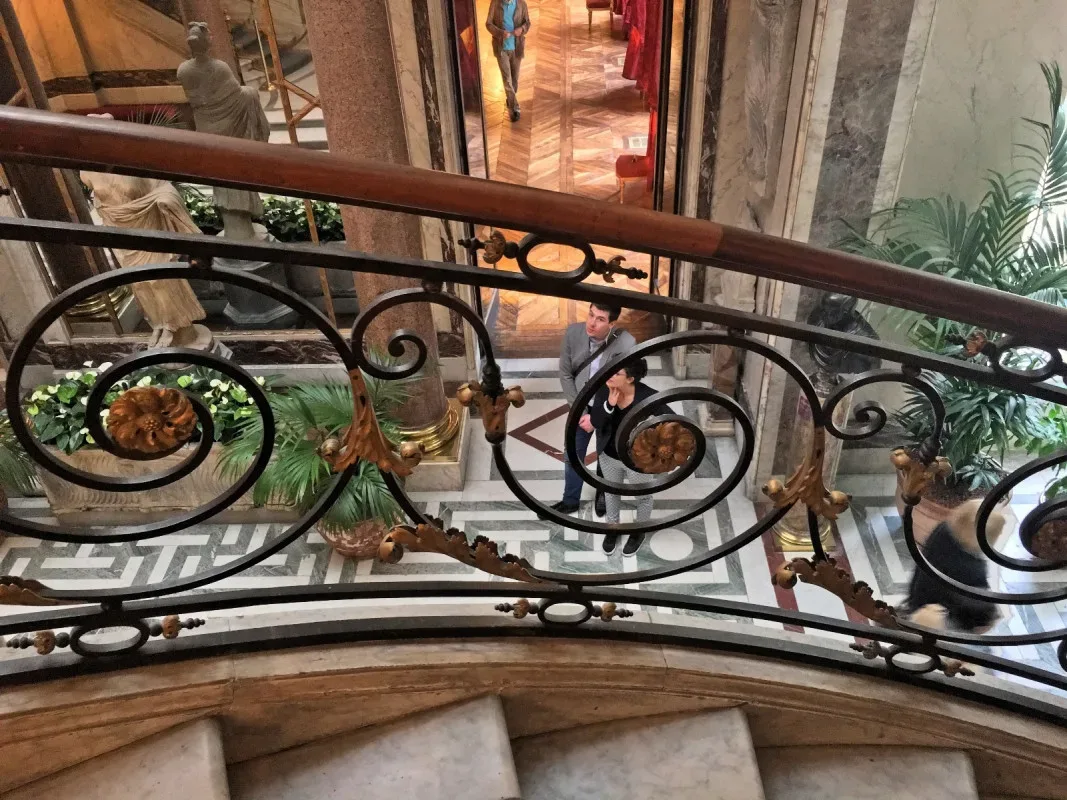
The refreshing and soothing winter garden and the royal staircase, light despite its design of marble, stone, iron and bronze, aroused, above all, the admiration of the couple's contemporaries. Only a ruler or a banker could afford such splendor, it was written and said about them. The fresco depicting the reception given by the Doge Contrini to Henry III is particularly impressive.
In 1893, the couple bought the two Tiepolo frescoes depicting the same scene. Dismantling them and bringing them to the house in Paris was a delicate and complex business that took eight months. They also had to be reassembled in the Parisian residence, of course. The work was completed before Edouard's death.
The couple decided to separate the two murals, one in the dining room, the other up the staircase. Like Henri III climbing the stairs in the Italian villa, so does the visitor ascending the stairs of the French couple's home. To be one person and feel like a king!
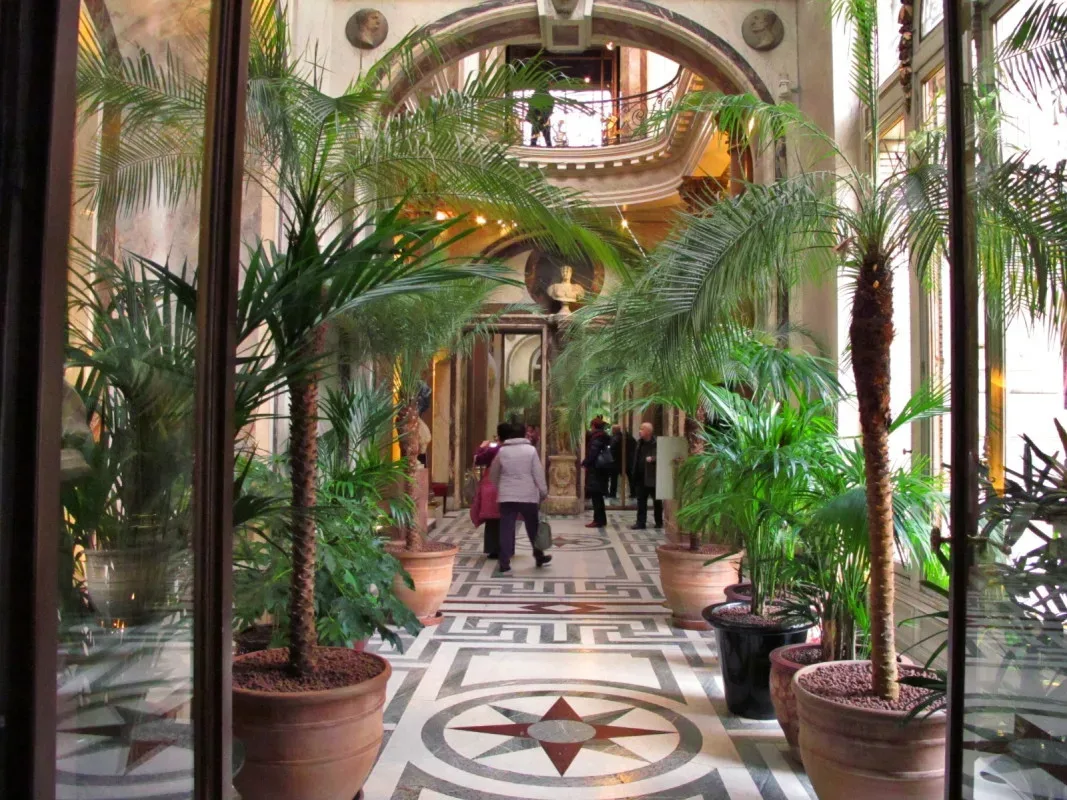
The visitor who has crossed the large salons enters the private salons. The “Tapestry Salon” serves as a foyer to a series of more intimate rooms designed by the couple for their private lives, work, and receiving their close friends: the study, Nellie’s private salon, the library, and the smoking room.

The smoking room. Photo source: Museum website
In the smoking room, Edouard André received his male friends after lunch in front of a Venetian fireplace while Nelly chatted with her friends in her private salon. The walls of the smoking room are covered in imitation Cordoba leather made of papier-mâché and decorated with oriental ornaments and English portraits.
The ceiling of the smoking room is decorated with a painting by a student of Tintoretto, depicting the quarrel between Neptune and Minerva. Neptune (Poseidon, in Greek) and Minerva (Athena, in Greek) competed for the title of patron god of the city of Athens. Poseidon gave the city a spring of water that was too salty and Athena gave it a sacred olive tree. The Athenians preferred the gift of Athena, who thus became the patron goddess of the city.
Standing out in the smoking room is an enameled glass menorah, decorated with Quranic verses interwoven with symbols and palm leaves, commissioned by rulers in the 14th century:

Mosque lamp, 1325. Photo source: Museum website
Don't forget to go up to the Italian Museum, which includes a hall of sculptures, a hall dedicated to Florentine art, and a hall dedicated to Venetian art. Feel privileged! This floor of the house was initially empty until the couple came up with the idea of placing the Italian works they had acquired there. The couple's guests flooded the luxurious reception halls, but the Italian part was Edoardo Vanelli's secret garden. Only intimate friends or connoisseurs, who specifically wanted to admire the works, were allowed to view it.
Nelly and Edouard traveled a lot to Italy and each time brought back new acquisitions. Nelly infected Edouard with a passion for Italian art and he soon formed personal preferences for himself that were foreshadowed. The sculpture hall, which was abandoned, was filled by Nelly after Edouard's idea. The Florentine hall was designed according to Nelly's taste, the Venetian hall was designed according to Edouard's taste. It should be noted that at that time not many emphasized the art of Venice, eyes were fixed on Florence, so Edouard was a pioneer in this issue as well. Edouard and Nelly were both ahead of their time.
The Italian museum includes treasures, most of which are religious, but there are some secular. A prominent one in the Florentine hall is a panel by Pietro Perugino that depicts the Virgin and Child in a realistic manner, a real mother (note her jewelry, especially the pendant) and a real child (note the folds of his body) against a backdrop of landscape, trees, and hills:

The Virgin and Child, 1470. Photo source: Museum website
In the Venetian Hall, a panel by Vittore Carpaccio stands out, showing Theseus, King of Athens, receiving a delegation from Hippolyta, Queen of the Amazons. Carpaccio freely adapts the mythological scene and presents Theseus as a bearded old man. The four young men seen in the panel are taken more from the court life of 15th-century Venice than from Greek mythology. This is one of the non-religious works in the Italian museum:
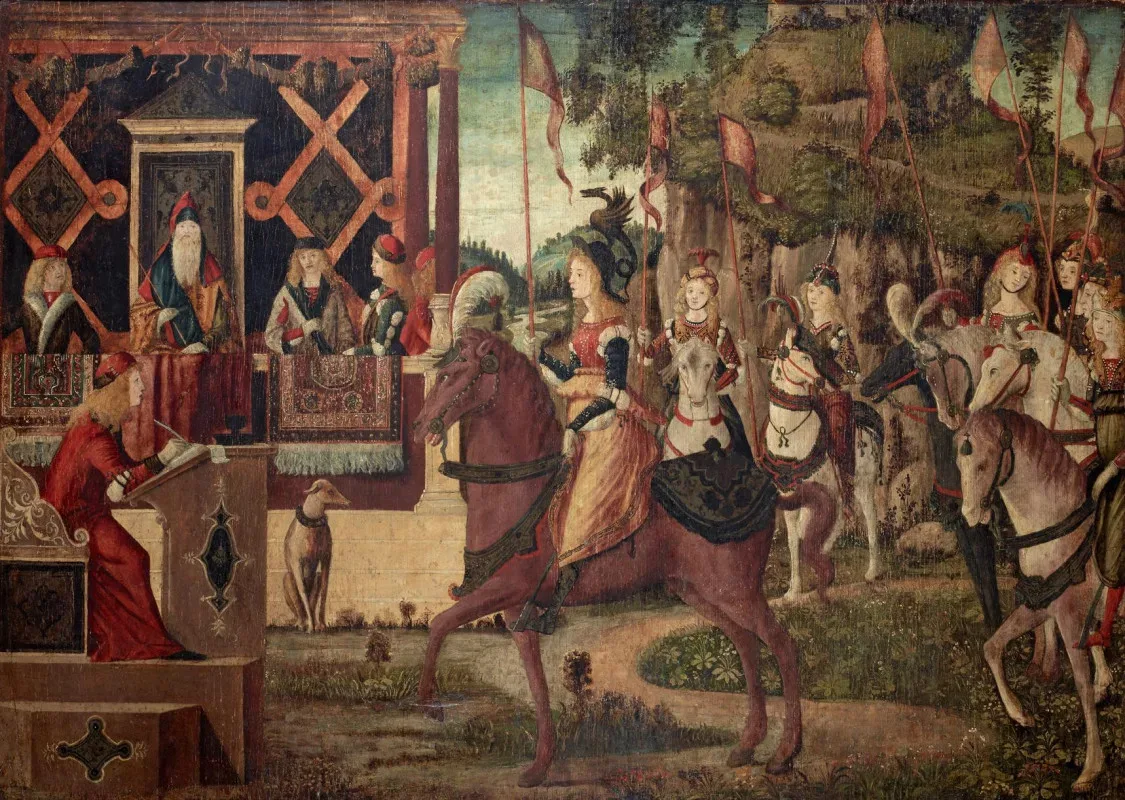
Theseus receives Hippolyta's delegation, 1495. Photo source: Museum website
On the ground floor are the couple's private apartments, which include Edouard's bedroom, Nellie's bedroom, and the connecting room. This room houses family portraits, as well as the portrait of Edouard that Nellie painted when she first met him in 1872, a meeting that led to their marriage. This is where Edouard and Nellie ate breakfast and where they loved to meet face to face, above all else.
Who were Edouard Andre and his wife Nelly Jacquemart?
Édouard André was born in 1833 in Paris to a Protestant banking family from the south of France , one of the richest in the country along with the Rothschild family. The family, supporters of Napoleon III, participated in the great projects of the imperial regime. Édouard was destined for a military future and after a brilliant career as an officer in which he participated, among other things, in the campaigns in Italy and Mexico, he left Napoleon III's army at the age of 30.

His passion for art finds expression in the collection he begins to build, but his time is also devoted, following his father, to political activity. The collection is in his house on Rue Roquepin, but he plans to move it to a new home on Boulevard Haussmann. The village of Monceau is annexed to Paris as part of Baron Haussmann's urban renewal work. The imperial aristocracy builds ostentatious luxury homes in the Monceau district and settles there.
In 1868, Édouard André bought a 5700-square-meter plot of land on the newly surveyed Boulevard Haussmann, paying more than one and a half million francs for it. He lived in the meantime in a private mansion, that is, a townhouse, in the same eighth arrondissement, called L'Hôtel de Saint Paul (3 rue Roquépine, VIIIe arrondissement de Paris), which was built, at his request, by the architect Henri Parent (1819-1895) between 1861 and 1864.
He again appointed the same architect to build him a new city mansion on Boulevard Haussmann, a mansion with a garden, a courtyard, a stable for 14 horses and a garage for 13 cars. The work was completed in 1875 and produced a house of modern dimensions, beautifully symmetrical according to the classical model, equipped with all the modern innovations of the period, theatrically designed and suitable for receptions and balls.
Henri Faran, a classical architect who was removed by his rival Charles Granier from the design of the new opera house , surpassed himself in the construction of Edouard Andre's house. Its facade, which is not in line with the facades of the other buildings on the street, but is slightly raised and set back from them, breaks the order and attracts the eye.
The inauguration of the house in 1876 was described in the newspapers of the time as an event equal in splendor to that of the inauguration of the Opera House. All the elegant women of the city, all the who's who of Paris, were present. The walls of the entrance halls disappeared behind fragrant carpets of camellias and cyclamens, the glitter of the gold decorations of the ballroom shone in the light of a thousand candles.
After purchasing the land intended for the construction of a museum, Édouard André left politics, which he no longer found interesting, and devoted himself entirely to the love of his life, art. In 1872, he even bought the leading journal in the field of art history, La Gazette des Beaux-Arts, which in 1928 would pass into the hands of the renowned art dealer family, the Wildsteins.
Edouard Andre will also serve as president of the Central Union of Decorative Arts, whose mission is to promote culture, art and design, combining the beautiful and the useful, while connecting people from industry and the economy with artists. Edouard believes that collectors have an important role in shaping public taste and in his plan to open a museum of decorative arts. Since the state is not interested in supporting the project, Edouard decides to implement it in his own home.

1872 was probably the lucky year in Edouard André's life when he approached the high society portrait painter, Nellie Jacquemart, to commission his portrait. Nellie was one of the few women of her time who had studied painting and had acquired a great reputation in her field. She asked Edouard not to come to her alone, and he asked his cousin to accompany him.
It was the cousin who came up with the idea of the matchmaking. Nellie came from a small, not wealthy bourgeois family, devout Catholic, royalist. Edouard came from a wealthy Protestant family, members of Napoleon III's security forces. The couple were very different in background, but they were close in spirit, taste, and life goals. Edouard, 48, and Nellie, 40, were married in a civil ceremony at the town hall of the 29th arrondissement in Paris, on June 1881, XNUMX. They would have no children.
This marriage was not a love marriage at first, but the couple's 13 years together were happy and fruitful. Edouard could not have found a better helper. Nelly, a practical, active and energetic woman, helped him with expertise and a firm hand to achieve his goals. Although her husband assigned her a spacious studio so that she could continue painting, Nelly preferred to abandon the brushes, become a collector and open new horizons for Edouard. Nelly transformed the room that had been intended for the studio into the sculpture hall in the Italian Museum.
Together they systematically built an impressive art collection and displayed it in the best possible way in their huge house, which served as a magical setting. Edouard was particularly keen on paintings, sculptures, wall paintings and art objects from the 18th century. Nellie was particularly keen on Italian paintings from the 14th century to the Renaissance and managed to acquire, a magnificent achievement, 124 works of them.
Together, the two traveled to Italy to buy works of art. While the couple was busy visiting antique dealers and auction houses, renovations were made to their house to enlarge it and accommodate the pictures, sculptures, tapestries, furniture, and other objects that would be added to the existing collection. In 1888, they traveled to St. Petersburg, but the trip was cut short by Eduard's health.
Edouard André died in 1894 at the age of 60 and left all his property to his “dear wife.” His cousins sued her but lost: the husband’s will was explicit. That same year, Nelly set out on a journey to purchase art objects in the Near East, Egypt, Syria and Persia. From there, she brought back ceramics decorated with Arabic patterns, mosque lamps and manuscripts.
In 1902, she embarked on a long, distant, and even more daring purchasing journey, intending to reach Japan and continue to the USA and Canada. However, while in India, she learned that part of the Shali estate, in the Armanville forest, about 45 km northeast of Paris, where she had spent her childhood, was being offered for sale.
She hurries back to France and, while on the ship, she sketches the room in which she will live in the royal mansion of Challis. After some hardships, she manages to purchase the coveted mansion and establishes her residence there, transfers half of the treasures of the house in Paris to it and continues to tirelessly buy works of art to enrich the collection.
In 1912, when she died, she was buried in the Chapel of the Shalley, according to her wishes. Nellie also expressed her wish that the remains of her late husband be brought to be buried next to her, in the chapel, even though he was a Protestant, “he who showered so much good on everyone and on Catholics,” she said.
The legacy of Édouard André and Nellie Jacquemart
After her husband's death, Nelly continued his work and became solely responsible not only for the acquisitions but also for the renovations that could already be defined as museographic. In 1900, she even turned to art experts with a request to produce a catalog of the museum, which would not be published until 1913 and would serve as a valuable working tool. Starting in 1902, the date on which she purchased the former royal monastery of Chalais, Nelly established a second museum there, in a format similar to the first museum in Paris.
Shortly before her death, she sorted and organized all the documents related to the collections. Nelly fulfilled the plan she had conceived with her beloved husband – to bequeath their house, with its breathtaking architectural design, with all its contents and treasures, to the Institut de France so that it could become a museum, open to the general public. And not only that.
She also bequeathed the Challis Monastery to the Institut de France to be turned into a museum, along with a financial grant to enable the maintenance of both sites and the cultivation of the collections. Nelly planned everything and left precise instructions not only regarding the location of the exhibits and their description but also regarding the management arrangements, the safety and comfort of visitors. No detail was omitted.
On May 15, 1912, Nelly died alone in her home on Boulevard Haussmann. On December 8, 1913, the André-Jacques-Marie Museum was inaugurated with great pomp and ceremony by the then President of the French Republic, Raymond Poincaré, in his own person. Nothing changed in the house, gardens and courtyard of Édouard and Nelly, everything remained in place, in accordance with the wishes of the great philanthropist.
It should be noted, however, that those responsible for the museum are careful to preserve and nurture it. Thus, it was closed for more than a year, thirteen months, for extensive renovations and reopened to the public on September 6, 2024. The renovations were carried out with the utmost respect for the original, the place as designed by Edouard Vanelli.
The video on the museum's website about the renovation of the smoking room, for example, tells how those responsible for the work dug through the archives and found two rare photos from 1913. One, in color, shows that the walls of the smoking room were painted red. The other, in black and white, shows heavy curtains on its windows. Fortunately, a sheet of the fabric from which the curtains were sewn at the time was found in the museum's warehouse, the same prominent and dense floral motifs, as in the photograph, on red-purple silk velvet. The smoking room was renovated, therefore, according to the original, thanks to the two photographs.
The filth was cleaned away. Ornaments and decorations, which had disappeared beneath it, were rediscovered and their luster was restored. Paintings, whose details had become blurred, were sharpened. Colors, which had disappeared under a gray-brown layer, burst and sparkled. The place was renewed in all its details and entirety, the gems and their surroundings, the treasures and the treasures.
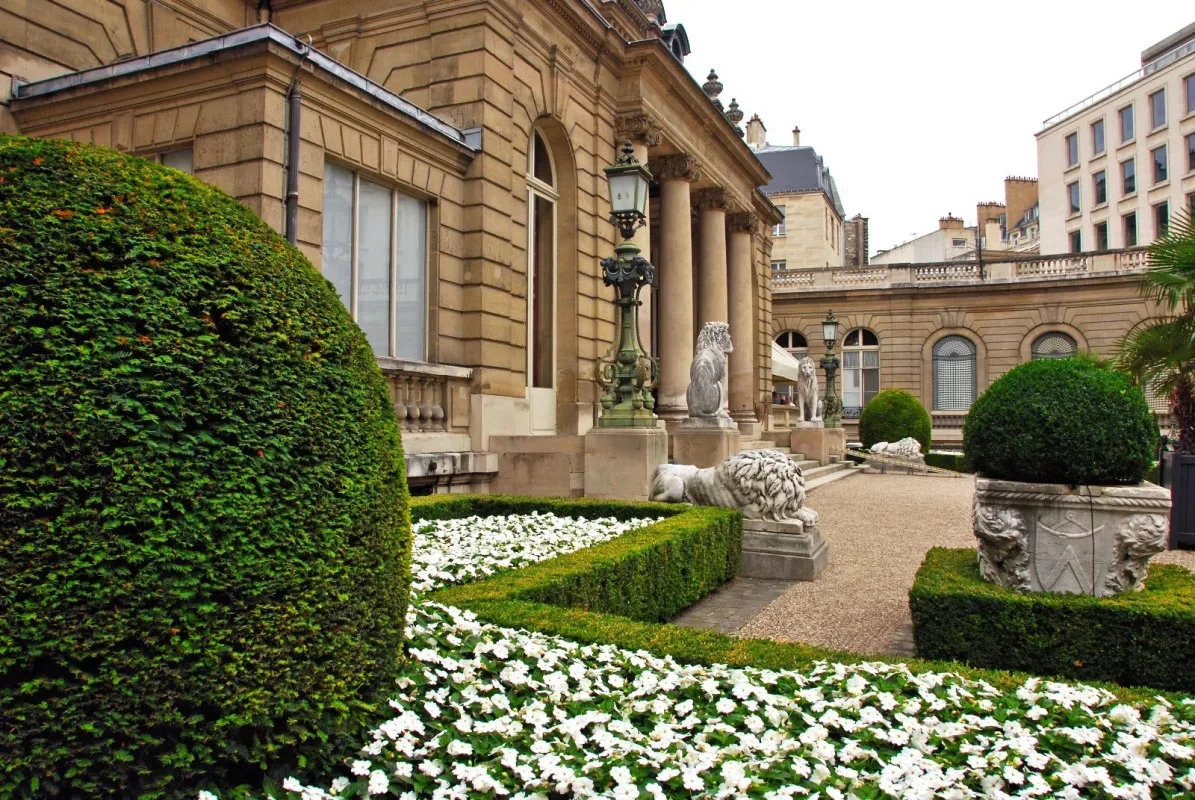
The royal courtyard, which was originally sandy, was paved – a slight but necessary deviation for the comfort of visitors, the green surfaces, the statues and the lanterns returned to their former freshness. Cleaning, filling, painting, polishing, as much as possible, while accepting the irreparable ravages of time – the museum is ready!
Success is at hand, as always. The museum has not stopped attracting visitors since its inauguration until today. The public is invited to enjoy both visiting and viewing the permanent collection and changing exhibitions. The museum is now equipped with diverse digital innovations for the visit and is suitable for all ages, including children.
Important information and ticket purchase
The address of the museum
Musée Jacquemart-André
158 boulevard Haussmann 75008 Paris
01 45 62 11 59
How do we get there?
The simplest and easiest way is to get there by metro. The fastest way is to take line 9 and get off at the Saint-Philippe du Roule station, which is a 2-minute walk from the museum. Another option is to take line 13 and get off at the Miromesnil station, which is a 5-minute walk from the museum.
If you want to get there by bus, take one of the following lines: 22, 28, 43, 52, 80, 83, 84 93. Each of them stops at a stop located a few minutes walk from the museum.
Opening Hours
The museum is open all week:
- Monday-Thursday: 10:00-18:00
- Friday: 10: 00-22: 00
- Saturday-Sunday: 10:00-19:00
Tickets to the Jacquemart-André Museum
Note from the author of the article, Dr. Orna Lieberman: I would be very happy if you would order the tickets through the following links in order to financially support the site that provided the accommodation for this article as well as all my other articles. Thank you very much!!!
Here are several types of tickets that will allow you to enter the museum without waiting in line:
- Ticket to the Jacquemart-André Museum
- Combined ticket to the Jacquemart-André Museum and the Orangerie
- Combined ticket to the Jacquemart André and Marmottan Monet Museum
- Combined ticket to the Jacquemart-André Museum and the Rodin Museum
- Combined ticket to the Jacquemart-André Museum and the Opéra Garnier
Link to the museum's official website
Address of the Jacquemart-André Museum in Challis
Le Musée Jacquemart-André à Chaalis
Musée Jacquemart-André – Abbaye Royale de Chaalis
60300 Fontaine-Chaalis
Phone: 03 44 54 04 02
His official unofficial link
Planning to include another museum in your trip? I've compiled all the museums in Paris into one guide, divided by type and with links to tickets.
FAQ
Where is the Jacquemart-André Museum located?
Who were the owners of the house that founded the museum?
Which prominent artists can be seen in the works purchased by the couple?
Who was Mathilde de Canisy and what is her connection to the work in the museum?
More on the subject

Excellent article, I was in this museum 15 years ago… You made me want to go back again… soon.
A collection of the thanks and comments I received on Facebook:
Thank you for a great and intriguing article.
I enjoyed reading about the story behind the museum.
Simply magic.
Even though I've visited the museum many times, you've been innovative and enlightening.
It was a pleasure to read the article with the rain in the background. A kind of peace.
Something doesn't add up for me. The 13-car garage and the house were inaugurated in 1876. As far as I know, the world's first car was not produced by Karl Benz until 1886, ten years later.
I guess the garage was used for carriages at first.
not. In 1770 the first automobile was invented. On peut attribuer l'invention du premier véhicule automobile à Joseph Cugnot. Cet ingénieur français invente en effet en 1770 un engin denommé le fardier. Ce véhicule était mu par une chaudière à vapeur de grande dimension, le rendant peu fonctionnel.
https://www.aramisauto.com/guide-pratique/occasion/premiere-voiture/
Ruth Shimoni:
A wonderful and in-depth article about one of the most beautiful, exciting, and fascinating house-museums in Paris – in my opinion.
Life stories,
Periodic background,
The charms of architecture and design,
The works of art…
How beautiful, how magnificent, how glorious!
The family's abundance of resources, combined with the good taste of the landlady, Nelly, is reflected from every angle.
And create a fascinating visiting experience.
And Orna Lieberman, who dives into the intricacies of every subject she deals with with virtuoso talent –
Provides us with in-depth, enriching, impressive, and accurate documentation
And soul-expanding –
Of all this goodness.
Great!!!
Hannah Sadan:
Sorry. These days it's hard for me to escape to these regions. I don't have the patience.
Orna Lieberman:
I understand. I have days when I can't do anything, but when I found out that this museum was reopening after renovations, I decided to recycle an old article of mine and immersed myself in a few days of intense work that provided me with a welcome escapism. I renovated the article and made it twice as big. During the work, I forgot about everything and regained some sanity. I hope it helps with escapism for readers.
I would like to add that there is a message in the article, hidden indeed, but perhaps some readers have noticed it. The couple brought home two frescoes by Tiepolo in which we see Henry III, who was the son of Catherine de Medici. The latter is related to the St. Bartholomew's Day massacre in which Catholics massacred Protestants, August 24, 1572. A dark period of religious wars.
And so, in the 19th century, Nellie, who comes from a devout Catholic family, marries Edouard, who comes from a Protestant family, and the two live happily and dedicate their lives to the same goal - establishing an art collection and making it accessible to the public, to everyone, regardless of religion, nationality, etc.
At the end of her life, Nellie expressed her wish that her late husband’s remains be brought to be buried next to her, in the chapel on the estate she had purchased, even though he was a Protestant, “he was the one who showered so much good on everyone and on Catholics,” she said. A message of tolerance and hope for peace that seems very far away now, but I will do everything I can to spread what I stand for. And this article is a part of that, small and tiny, but it is what I can do.
Daphne Scaggio Samo:
Orna ♥️
Thank you very much for the information.
I love reading your articles.
Aliza Gutman:
I was there last May, right before the renovation, and I didn't stop admiring it long after I left. Thanks for the in-depth and fascinating article.
Shirley Tocker:
A charming and different museum. I was there two years ago and loved it. It will be interesting to visit there again after the renovation. Thanks for the enriching article!
Dror Tal:
I enjoyed reading your fascinating article about the Jacquemart-André Museum. I learned a lot from the article and now I love it twice as much!
I received great feedback from a virtual friend who visited the renovated museum today, September 20, 2024, and it is:
Today we visited the museum. There were many visitors, so it is more than recommended to book tickets in advance.
The conservation work did not in the least harm the authenticity and extraordinary beauty of the house.
To mark the reopening, a temporary exhibition of artworks from the Borghese Gallery, which was closed for renovations, is being presented. The tour and display are simply therapy for the soul,
Especially for our souls in these terrible days.
A wonderful place.
Nira Uzrad:
I love reading what you write, you write beautifully! Could you show us around the museum?
Orna Lieberman:
Thank you very much. This museum does not require a guide. You will be fine on your own, everything is there for the convenience of visitors!