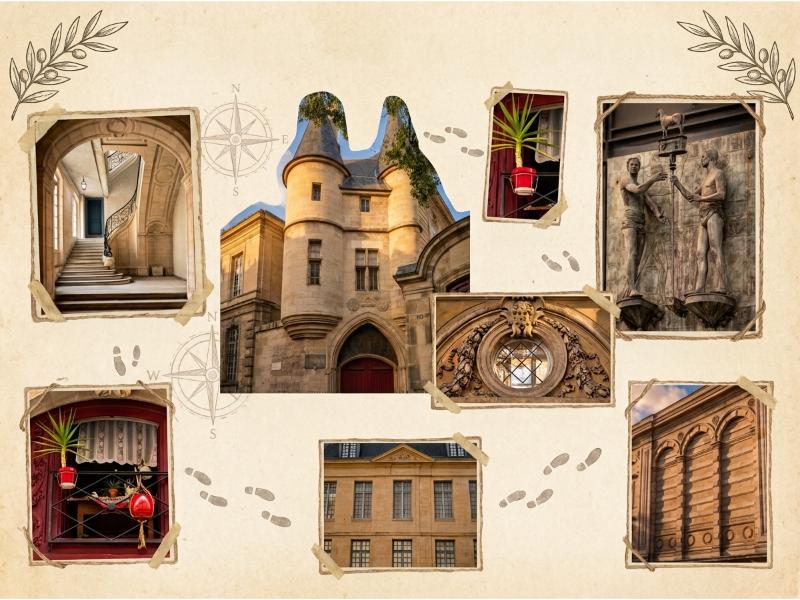
in short
- What's there: A neoclassical fountain from 1764, the only surviving Hôtel de la République in Paris by François Mansard, the bas-relief of the Sun Horses, a private alley from 1620 with a central drainage canal, and an Armenian cathedral that was a Capuchin monastery.
- How to get there: Metro Rambuteau (line 11) to the starting point, and end near Filles du Calvaire (line 8) or Temple (line 3).
- How long: Only an hour and a half walk, three to four hours with stops, a museum and a meal.
- When: Every day except Monday, when the Hunting and Nature Museum and the Marché des Enfants Rouges market are closed.
- cost: The route is free. The only payment is a ticket to the Hunting and Nature Museum.
- Who is it for: For those who have already visited the Marais and are looking for its lesser-known parts.
- And bonus: The route ends at the oldest covered market in Paris, founded in 1615.
The 3rd arrondissement, the northern part of the Marais, hides between rue des Archives and rue Charlot things that most travelers pass by without stopping: a neoclassical fountain born from a story about a crusader who returned home too late, a private alley from 1620 that preserved the central drainage canal and its paving stones, the only hotel by the great 17th-century architect to survive in Paris, and a completely sealed wall that Napoleon III built so that sunlight would not destroy French documents.
On my previous visit to Paris, I lived in Audi's apartment on rue Simon le Franc, and almost every morning I would go up north to buy bread. At first I did it because of the bakery, but then I discovered that every turn there led to a carved gate, a courtyard whose gate remained open for a moment, or a memorial plaque that told a whole story. From there, a five-minute walk away, our trip begins.
This route has 16 stops, and it passes almost entirely through places I haven't touched on my other Marais routes . You'll meet four cardinals from the House of Rohan, orphans wearing red, a royal square that was never built because the king was murdered two years after he decided on it, and a covered market that has been operating here since 1615.
Practical information for the Northern Mara itinerary
How to get to the starting point
The starting point is the intersection of rue des Archives with rue des Haudriettes, a two-minute walk from the Rambuteau metro station (line 11). If you live in the apartments I recommend on rue Simon le Franc, rue Beaubourg or Sainte-Croix-de-la-Bretonnerie, you are right there and can get there on foot. The route ends on rue de Bretagne, near the Filles du Calvaire (line 8) and Temple (line 3) stations, so you can return from there to anywhere in the city. Everything you need to know about the metro can be found in my article on public transport in Paris.
What days to go?
Not on Monday. The Museum of Hunting and Nature is closed on Mondays and holidays, and the Marché des Enfants Rouges, where the trail ends, is also closed on Mondays. Tuesdays through Saturdays are ideal. On Sundays the market closes at 17:00 PM, and on Thursdays it is open until 21:30 PM, so Thursday is the best day for those who like to end their trip with dinner.
How long, and when to come?
The walk itself is about two and a half kilometers, and without stopping you can finish it in an hour and a half. In fact, with a peek at the courtyards and a visit to the museum, you will need at least three hours, and four if you plan to eat in the market. The area is especially beautiful in the fall and spring, when the low light enters the narrow courtyards, and less pleasant in the middle of August, when some of the businesses in the neighborhood are closed for vacation.
The 3rd arrondissement itinerary: 16 stops between rue des Archives and rue Charlot
The route goes roughly from south to north, and there's a reason for that. The southern part is adjacent to my route in the Western Marais and the apartments where I'm staying, and the northern part, the Haut Marais, is where lunch and the shops await. So the direction of the walk is also the direction of hunger.
The Fountain of the Crusader Who Returned Too Late
1 rue des Haudriettes , at the corner of rue des Archives
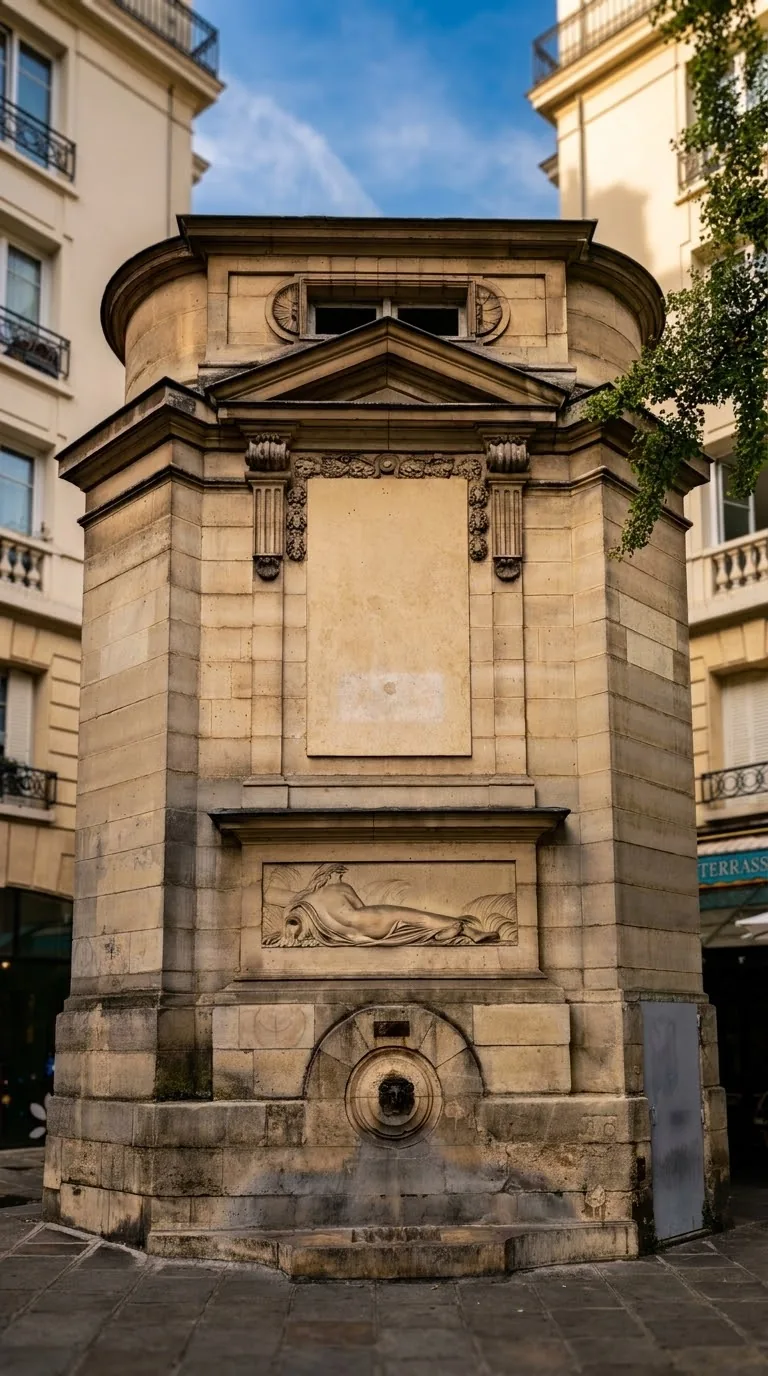
This intersection is your gateway to the 3rd arrondissement, and at its center stands a trapezoidal stone fountain, heavy and closed, looking more like a tombstone than a fountain. It was built in 1764 by the architect Pierre-Louis Moreau-Desproux (1727–1794), who was in charge of the city of Paris’ buildings, and it replaced an older fountain from 1636. The funding was provided by the Rohan family, the same family we will meet later in the route in their own palace.
What saves this block from respectability is the relief in its center. Pierre-Philippe Mignot (1715–1770) carved a water nymph there, reclining among the reeds, leaning on a jug from which water flowed. Below her is a carved lion's face, from which water from Belleville and later the canal de l'Ourcq once flowed. The plaster model of the nymph was exhibited at the Salon of the Royal Academy in 1765, and this was Mignot's last participation in the exhibition.
The name Haudriettes comes from a particularly good story. Étienne Haudri was the baker at the court of Philip IV, “the Fair” (reigned 1285–1314). According to tradition, he went on a pilgrimage to Santiago de Compostela and was absent for so long that his wife assumed he had died. She gathered a group of pious women into her home, took a vow of celibacy with them, and dedicated her life to the poor. Haudri returned to find that his wife was no longer exactly available. He obtained permission for her to break her vow, and in return, he left his house to the women and established a fund to support 12 poor widows. These women were called les haudriettes, from whom the street and fountain took their names.
Two Rococo palaces that were converted into public housing
Now we will make a short detour west to rue de Braque and return to the same point. This small street was called rue des Boucheries-du-Temple in the Middle Ages, after a butcher shop established there by the Knights Templar in 1182, and only in the 14th century did it receive its current name from the Braque family who owned land in the area.
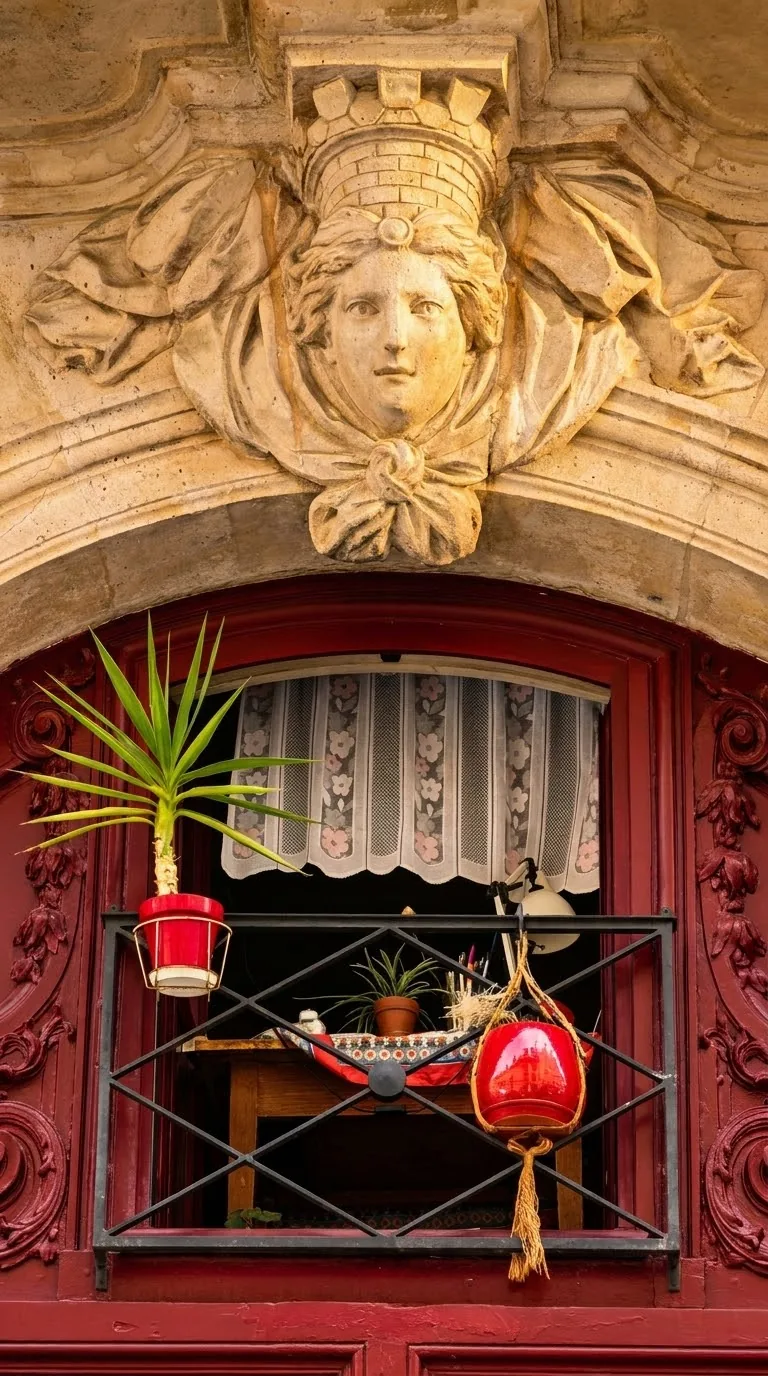
At numbers 4 and 6 stand two twin, perfectly symmetrical mansions, built in 1731–1734 according to plans by architect Victor-Thierry Dailly (born 1676, year of death unknown) for the Le Lièvre de La Grange family. When they demolished the building that stood here before, the workers found a treasure, and this is certainly a good start for a real estate project. What is worth looking at are the two rounded balconies above the carriage gates, which rest on stone supports carved in the shape of ram's and human heads. The style is the French rococo of the era of Louis XV (reigned 1715–1774), and the houses were originally built for rental purposes, not for the owners to live in.
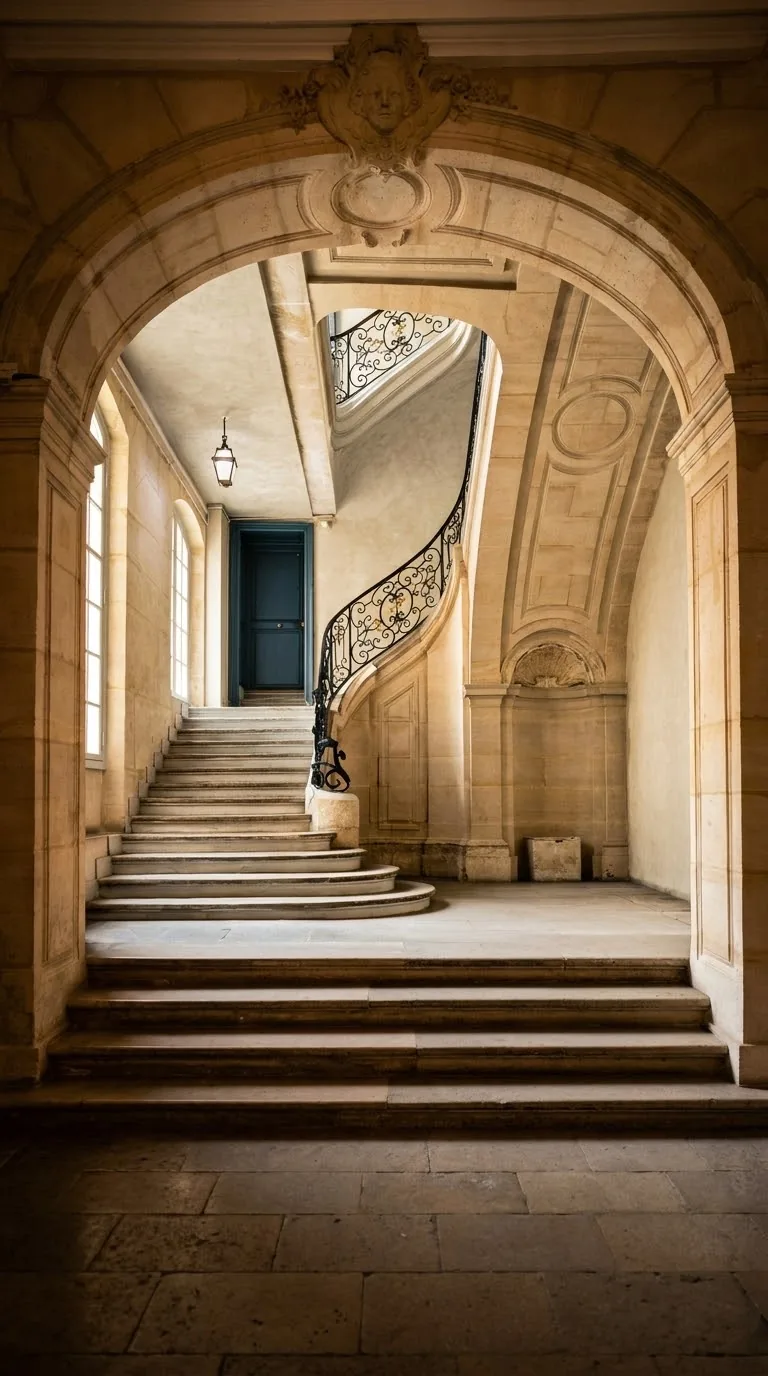
On my visit, the gate to number 4 was open and I entered without any problem. Behind it is a wide foyer decorated with carved masks, and on the right wing rises a staircase with a wrought-iron railing decorated with floral ornaments. A statue once stood in the shell-shaped niche below the stairs, but it is now empty. In 1833, the botanist and physiologist Henri Dutrochet (1776–1847), who became famous for his research on osmosis, married a widow and moved into this house with her. The widow was Angélique-Ambroise Germain (1779–1875), the younger sister of the mathematician Sophie Germain (1776–1831), who had sent her works to the greatest mathematicians of her time under a man’s name.
I particularly like the ending of this story: In 2001, the city of Paris purchased the entire complex, and today these two palaces serve as affordable housing. Two Rococo-style carriage gates, and behind them are public housing tenants.
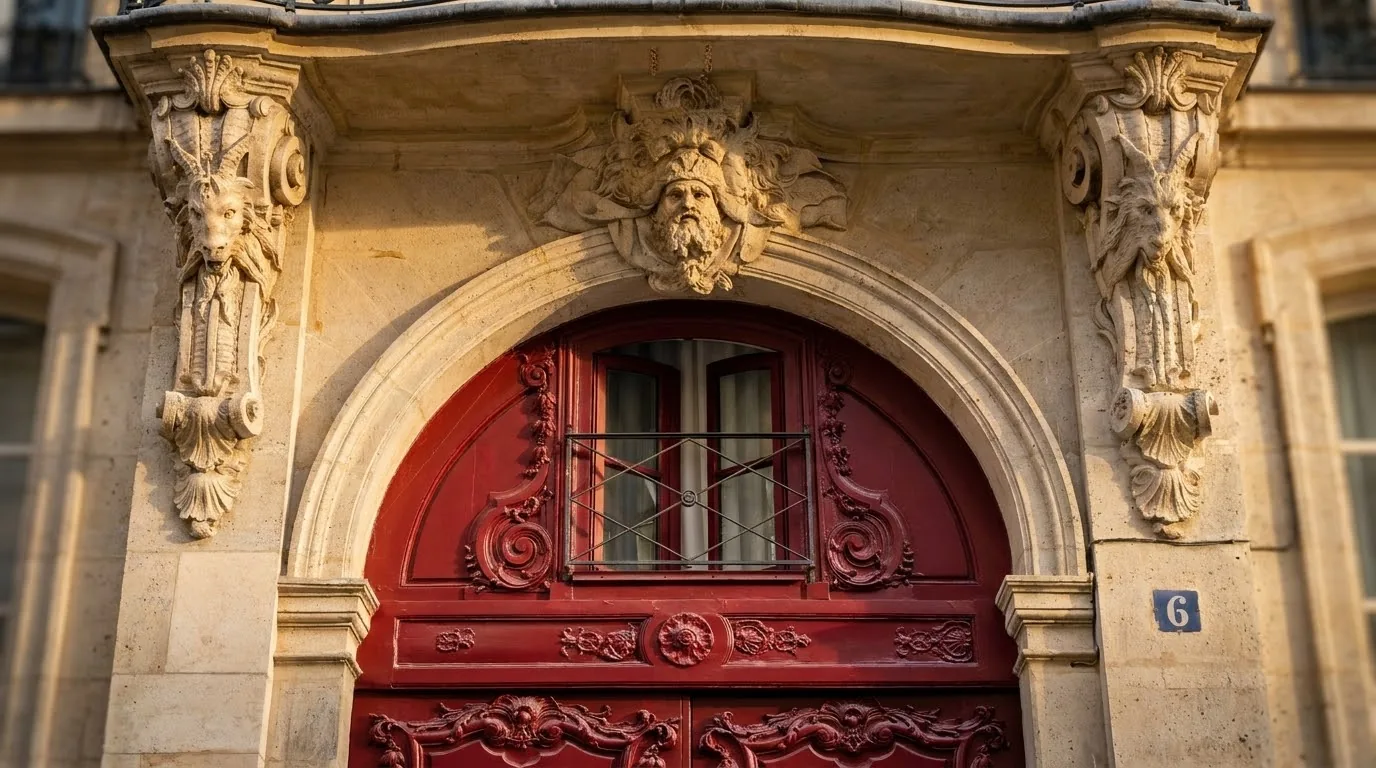
Before you return, also pay attention to two neighbors: at number 5, hidden deep in the courtyard is a 17th-century wooden pavilion that has been very generously restored, and at number 8 stands the small Hôtel de Chaulnes from the Louis XIV era, on the doors of its carriage gate are carved beautiful lion heads.
Hercules guarding the gate
Returning to the main street, right next to the fountain stands the Hôtel de Mailly. According to its style, it was built in the late 16th century, and during the 17th century it passed to the Maupeou family, a dynasty of parliamentarians, following a marriage. It took its name from the Mailly family, who owned it in the 18th century.
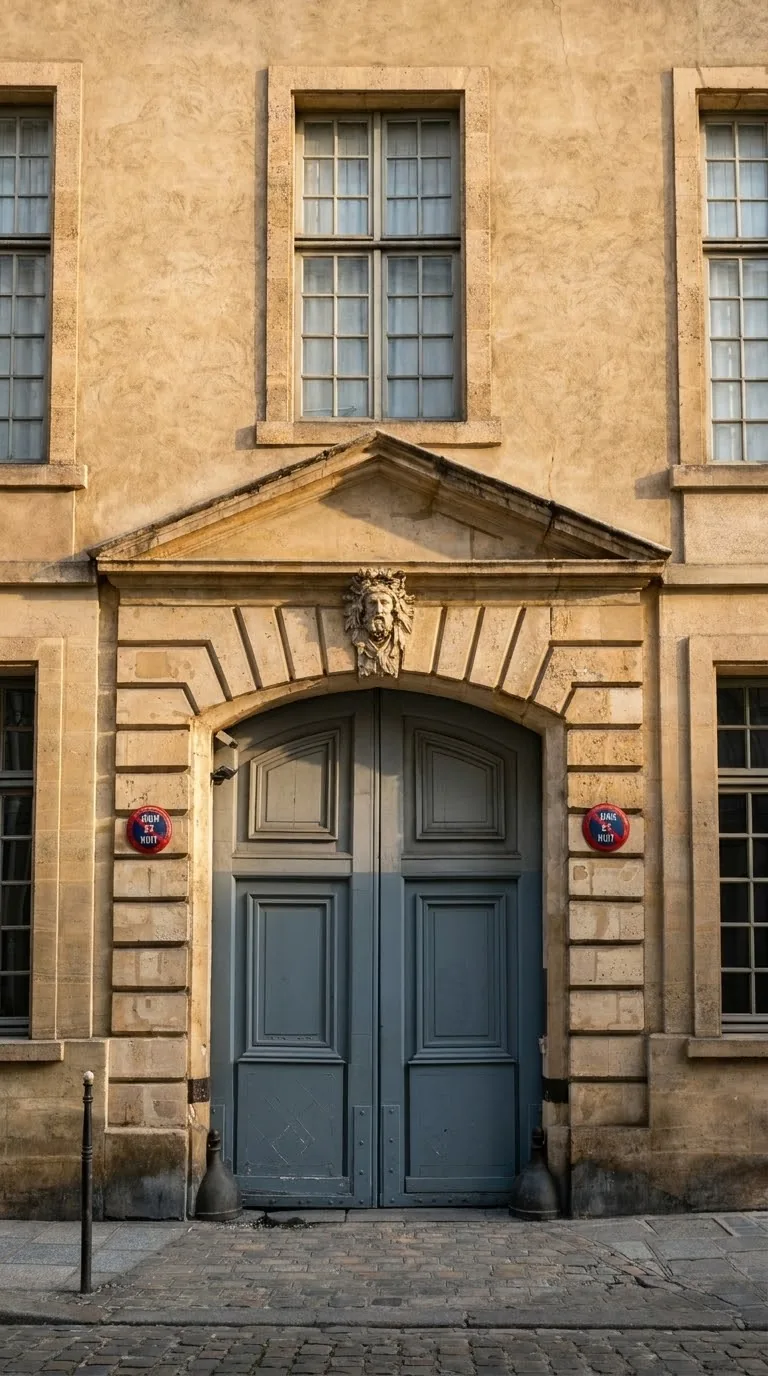
The gate itself was rebuilt in the 18th century, and above it is a beautifully carved face: Hercules dressed in the skin of a Nemean lion, the creature he strangled in the first of his twelve labors. Look up at the tiled roof and you will see six original stone dormer windows, which betray the true age of the house.
The last two spires of medieval Paris
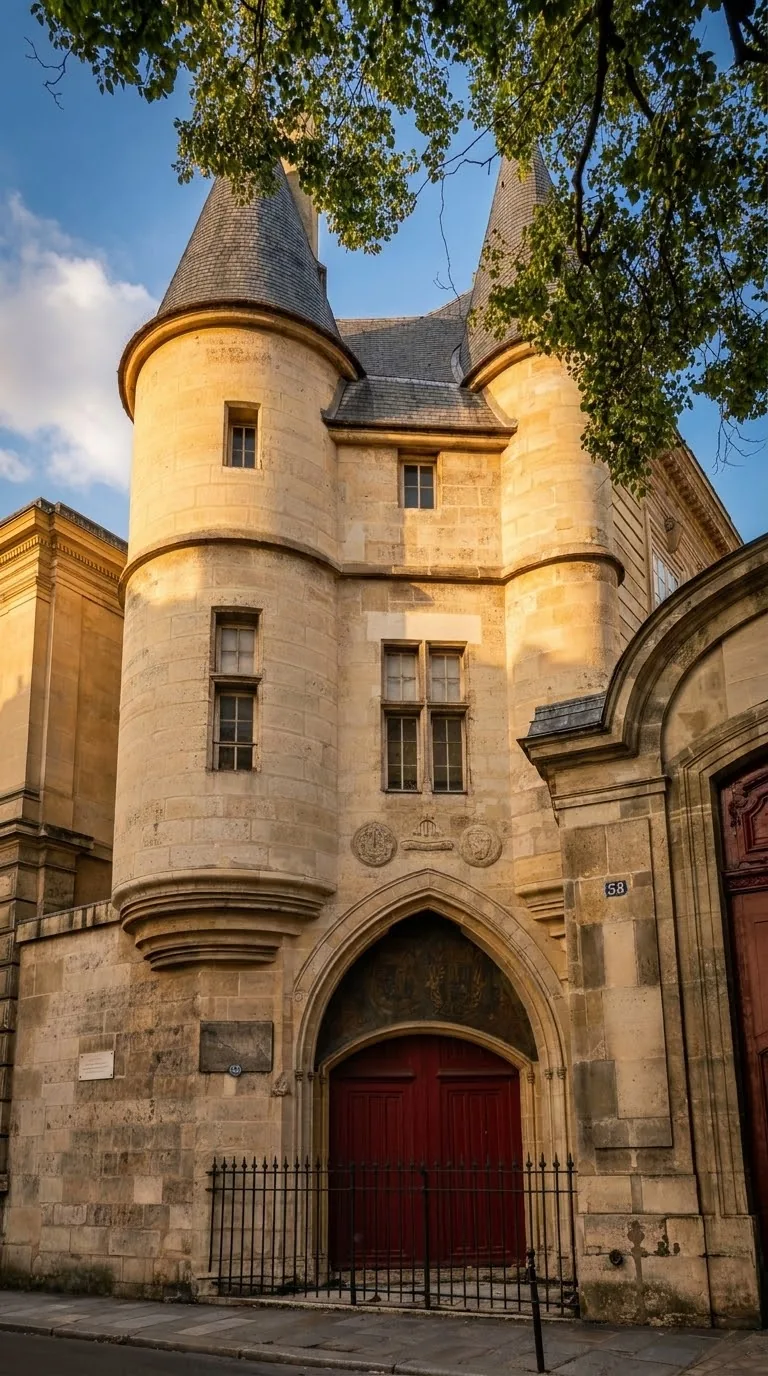
Cross the street and look up. The two small turrets that protrude above the Gothic arch are the last Parisian remnant of defensive civil architecture, dating from the late 14th century. This was the entrance to the Hôtel de Clisson, built for himself by Olivier de Clisson (1336–1407), the war minister of Charles VI (reigned 1380–1422).
In 1553, the house came into the hands of the powerful Guise family, and this is where the story gets dark. The Guise family were deeply involved in the Catholic League and the Wars of Religion, and it is likely that the house was the setting for the St. Bartholomew's Day Massacre of 1572. In the 17th century, the house calmed down, and among its residents was the playwright Pierre Corneille (1606–1684).
By the way, you can read about the town the family came from in my article about Clisson , and about the magnificent palace that was built here in the 18th century on its ruins in the article about Hôtel de Sauvage.
The Four Sons of Aemon
From 3 to 18 rue des Quatre-Fils
Turn east and enter rue des Quatre-Fils, a street that opened in the late 13th century and is named after the four sons of Aemon, the heroes of a French ballad from the late 12th century that told of four brothers who fled on one horse from the wrath of Charlemagne (reigned between 768–814).
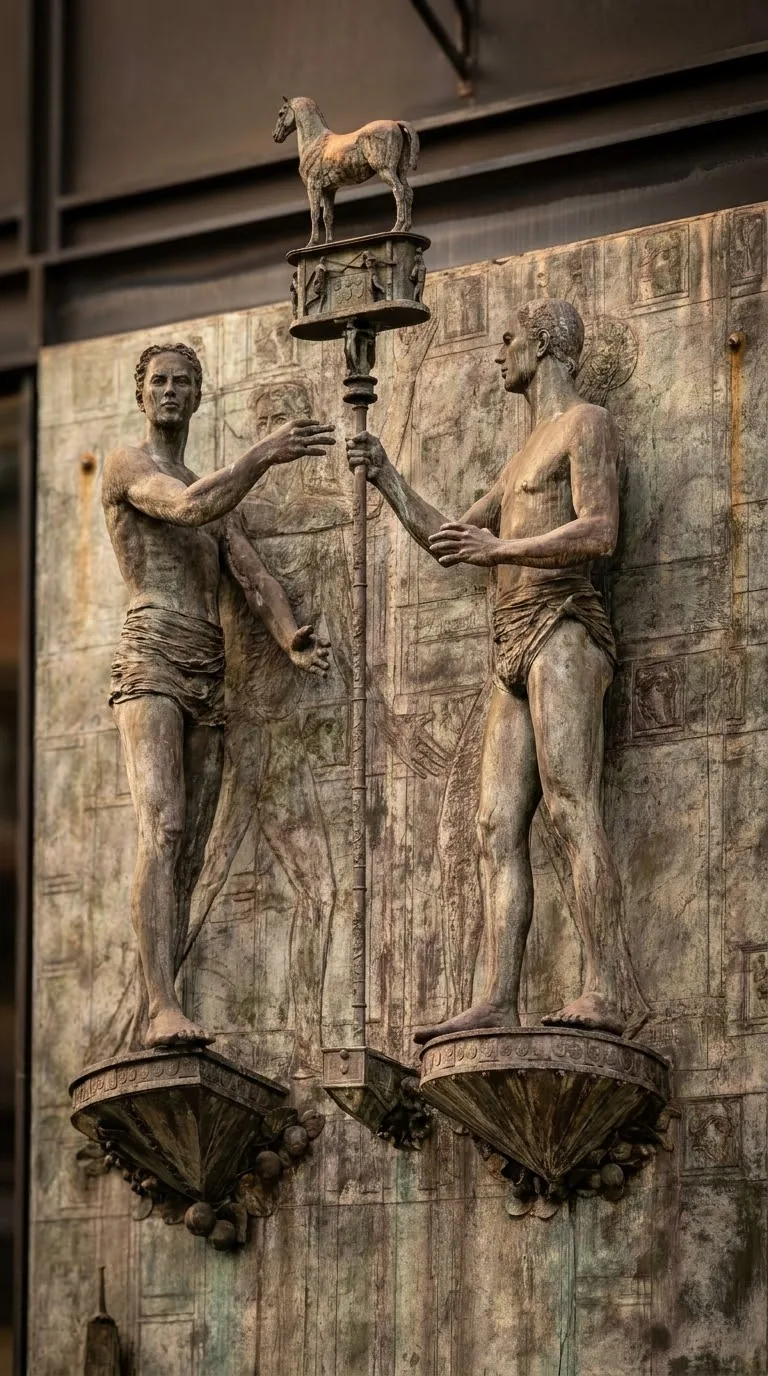
Between numbers 3 and 11 lies the CARAN, the reception and research center of the National Archives, a contemporary building by architect Stanislas Fiszer (1935–2019) that caused quite a stir at the time. I’m not a fan of it, but it’s worth stopping in front of the facade for the bronze relief of the four sons of Eamon by Yvan Theimer (born 1944). From the CARAN’s hall, which is free to enter, there is a beautiful view of the gardens and the back facade of the Hôtel de Rohan.
At number 16 stands the hotel that once belonged to the Aymeret family, from the time of Louis XIII (reigned 1610–1643). When the street was widened, it was badly damaged, but the beautiful Louis XV gate was dismantled and reassembled a few meters back, and an 18th-century staircase also survives inside. Its neighbor at number 18 lost the gate but kept the facades: the tiled roof, with its dormer windows and round stone windows, is a good example of the Louis XIII style. The house was built around 1634 for a wealthy widow.
The house of Louis XVI's defense attorney
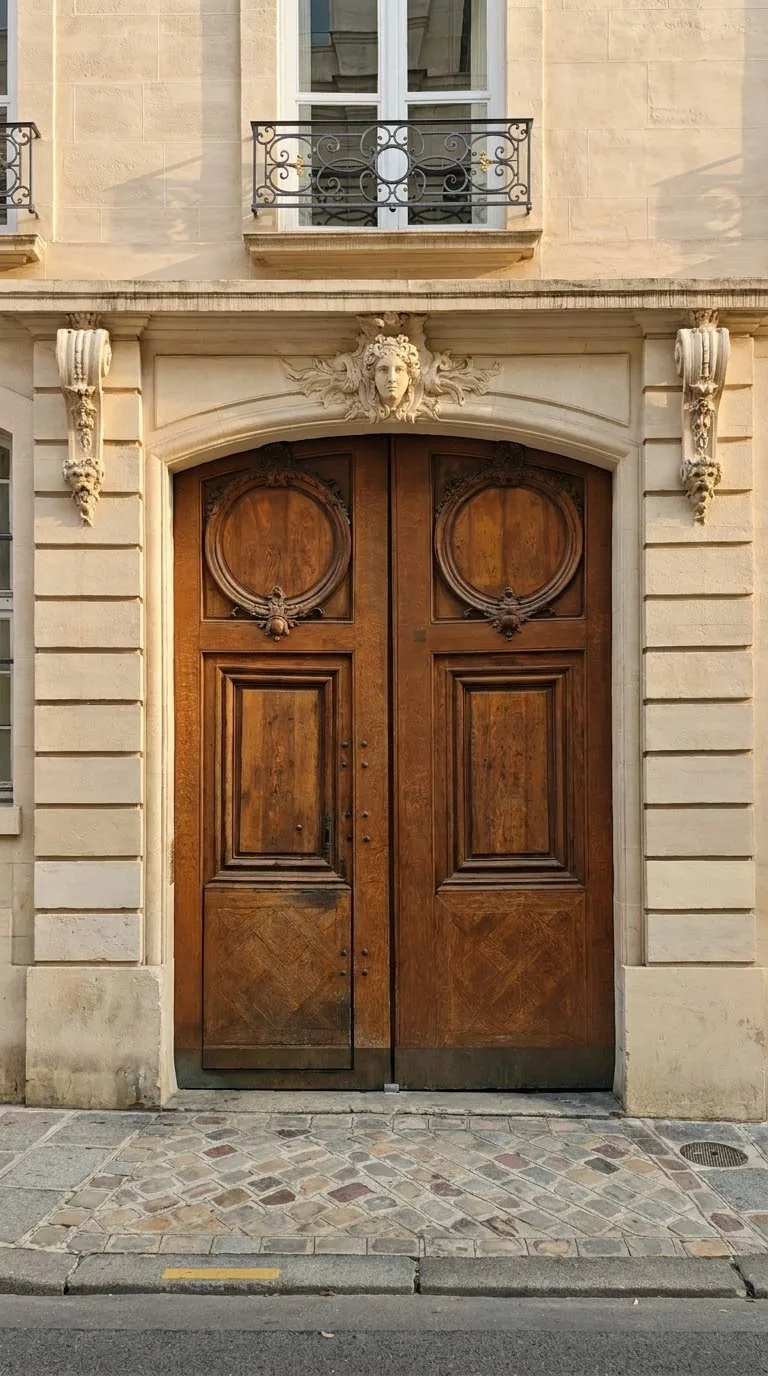
The house at number 20 was saved from the street levelling, so it still stands in its original location. It is a handsome Louis XV-style apartment, built around 1730–1735 for the president of the first Chamber of Inquiry of the Paris Parliament. Note the gate with its delicately carved wings and the two surviving dormer windows in the roof, through which hay was once brought up to the attic. Inside the passage, on the right, enclosed behind joinery and two columns, is a grand staircase with a gilded iron railing.
Here, in this house, Raymond de Sèze (1748–1828) died. In January 1793, de Sèze stood before the Convention and defended Louis XVI (reigned 1774–1792) at his trial, in a speech that everyone knew would not save the client and might kill the lawyer. He purchased the house in 1800 and lived there until his last day. The plaque that hangs there, by the way, is not accurate in the details.
And speaking of this house, “Three Men and a Basket” (Trois hommes et un couffin), the 1985 comedy by Coline Serreau (born 1947) that sold ten million tickets and spawned an American remake, was also filmed here. The neighboring house, at number 22, is mistakenly thought to be the place where Madame du Deffand’s (1697–1780) salon was held, but is actually a wing of another hotel built on part of its garden in 1769–1770.
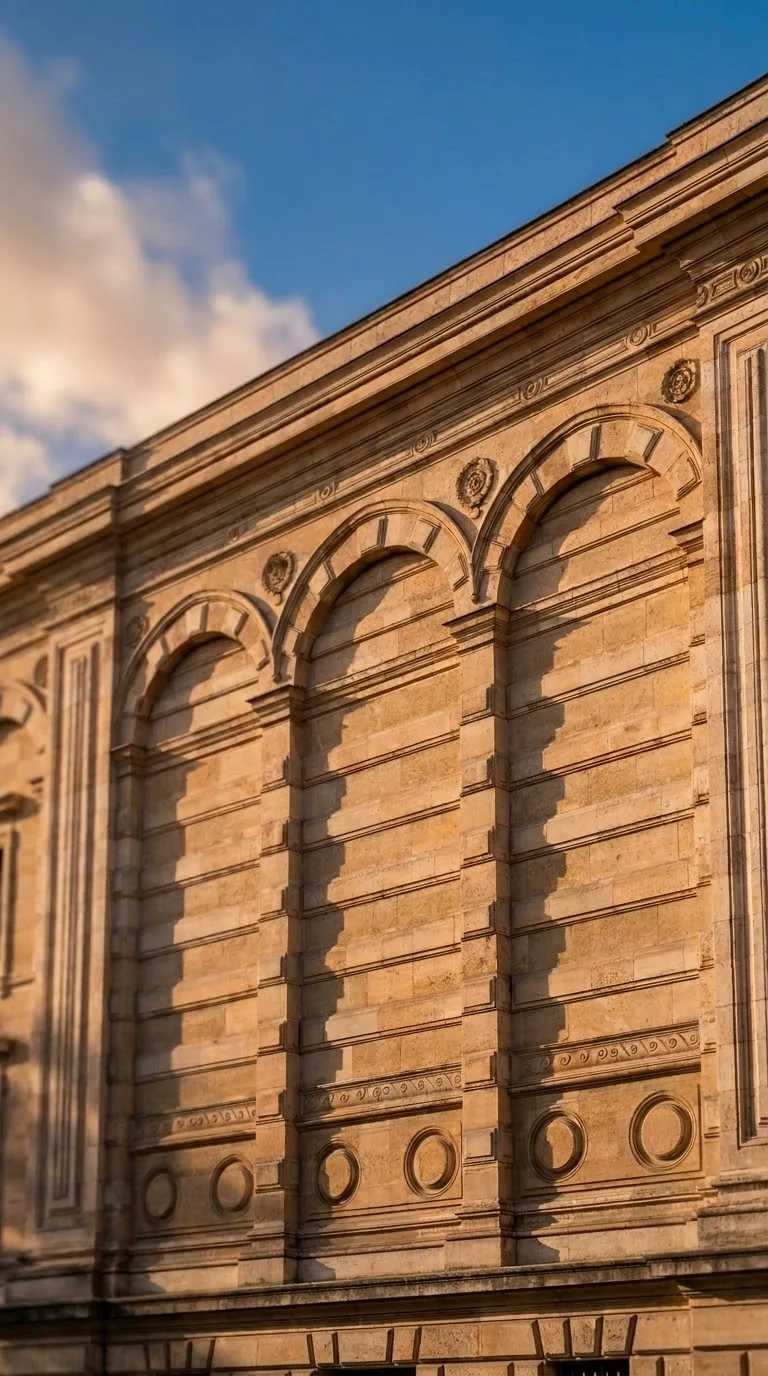
Across the street, high, windowless walls, adorned with Florentine-style arches, enclose the street. These are the warehouses of the National Archives from the time of Napoleon III, and the reason for their opaqueness is simple: sunlight destroys documents. The architecture here is pure function, and I admit that this is precisely what impresses me.
The Sun Horses
Another short detour, this time to the end of the street and back. At number 87 stands the Hôtel de Rohan, built between 1705 and 1708 by the architect Pierre-Alexis Delamair (1676–1745) for Armand-Gaston de Rohan (1674–1749), the fifth son of the Sauvage family, who was a cardinal. Its facade is narrow and vertical and it juts out at the end of a courtyard surrounded by low buildings. Compared to the parents' palace on the next street, it is much more modest, and the explanation for this is probably the ecclesiastical status of the client.
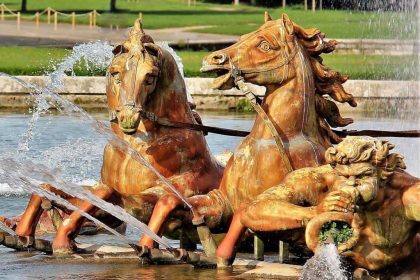
Hidden in the stable yard is the work that people come here for: “The Horses of the Sun” (Les Chevaux du Soleil), a huge relief carved by Robert Le Lorrain (1666–1743) in 1736–1737. The horses emerge from the stone towards the manger in a moment of complete movement, and the cardinal, who kept a backyard here and about fifty stalls, knew exactly what he was buying.
After the cardinal's death in 1749, he was succeeded by three relatives, also cardinals. The last of these, Louis-René-Édouard de Rohan (1734–1803), became embroiled in the "Queen's Necklace Affair" in 1785, when the swindler Jeanne de la Motte (1756–1791) convinced him that Marie-Antoinette (1755–1793) was asking him to buy her an overly expensive diamond necklace. The cardinal paid, the necklace disappeared, and the queen emerged from the affair with a ruined reputation that would cost her dearly four years later.
The palace was captured and looted during the revolution, sold to the state in 1808, and Napoleon installed the National Printing House in it, which did not do any good to the original interior. It was not until 1938 that the house passed into the hands of the National Archives. Here is the practical caveat: the area is undergoing renovation work. The Court of Honor and the Court of the Sun Horses are currently closed to visitors, and the Cardinals' Floor above, with the famous Monkey Cabin by Christophe Huet (1700–1759), is also closed. The decorations of the Chancellery d'Orléans on the ground floor can only be seen on guided tours, free of charge and with advance registration. You can read about the strange story of these salons in my article on the Chancellery d'Orléans.
The only surviving hotel from François Mansard
62 rue des Archives , and the entrance to the club is at number 60
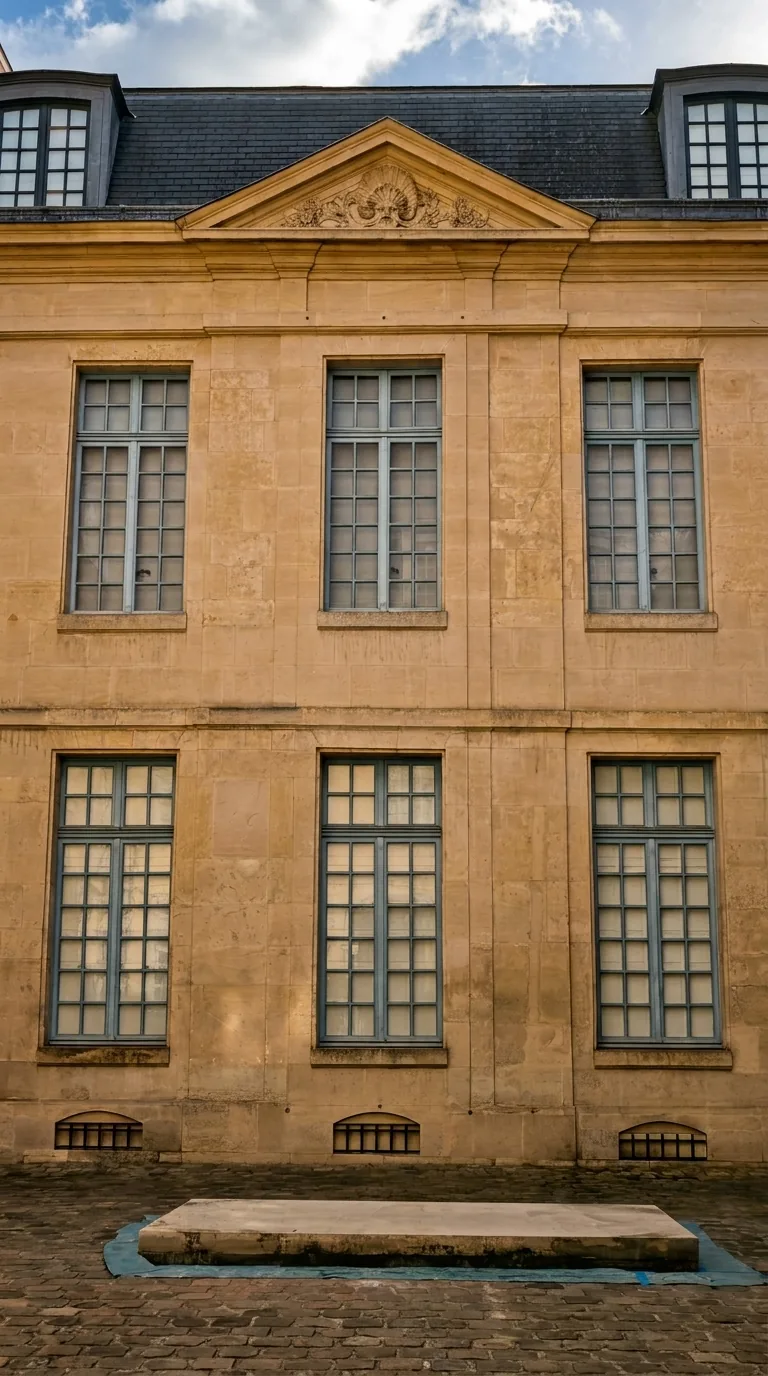
Return west to rue des Archives and turn north. On the corner stands the Hôtel Guénégaud des Brosses, the only surviving private hotel of François Mansart (1598–1666) in Paris. It was built between 1652 and 1655 for a wealthy financier after whom it is named, on the site of two medieval houses, and in the early 18th century passed into the hands of a tax collector who invested a fortune in the interior decoration.
In 1766, it was bought by a wealthy collector who gathered a collection of sculptures by Étienne Maurice Falconet (1716–1791) on the ground floor. Out of modesty, he covered the nudes in the sculptures with scarves, an act that drove Denis Diderot (1713–1784) crazy. The family owned the house until 1895, and from the mid-19th century it was occupied by small-scale commerce and industry and deteriorated to a terrible state.
In the late 1950s, the owner considered demolishing it, but in 1962 it was declared a protected heritage site and the city of Paris bought it. It was restored, and since 1967 it has housed the Hunting and Nature Museum, founded here by François Sommer (1904–1973) and his wife. In 2007, the museum also expanded to the neighboring Hôtel de Mongelas at number 62, which was rebuilt between 1704 and 1707. Anyone expecting a hall of stacked deer antlers will be surprised: it is a modern wonderland, combining stuffed animals, weapons, paintings and contemporary art in wood-paneled rooms. I have compiled all the museums in Paris in a separate article.
If you've come this far, I highly recommend going to this museum, even for those who don't like hunting. The museum is open Tuesday through Sunday from 11:00 AM to 18:00 PM, Wednesdays until 21:30 PM (except July and August), closed on Mondays and holidays, and admission is free on the first Sunday of the month. You can find everything you need to know before visiting, and the rooms you shouldn't miss, in my article about the Hunting and Nature Museum 🙂
Twin gates and a corner tower
From 68 to 78 rue des Archives
The eastern side of this street is almost entirely private 17th-century mansions, and it's worth walking slowly and looking up. At number 68, don't let the 1930s building fool you: deep in the courtyard is what remains of the Hôtel de Refuge, built in 1645, with a restrained, self-assured facade.
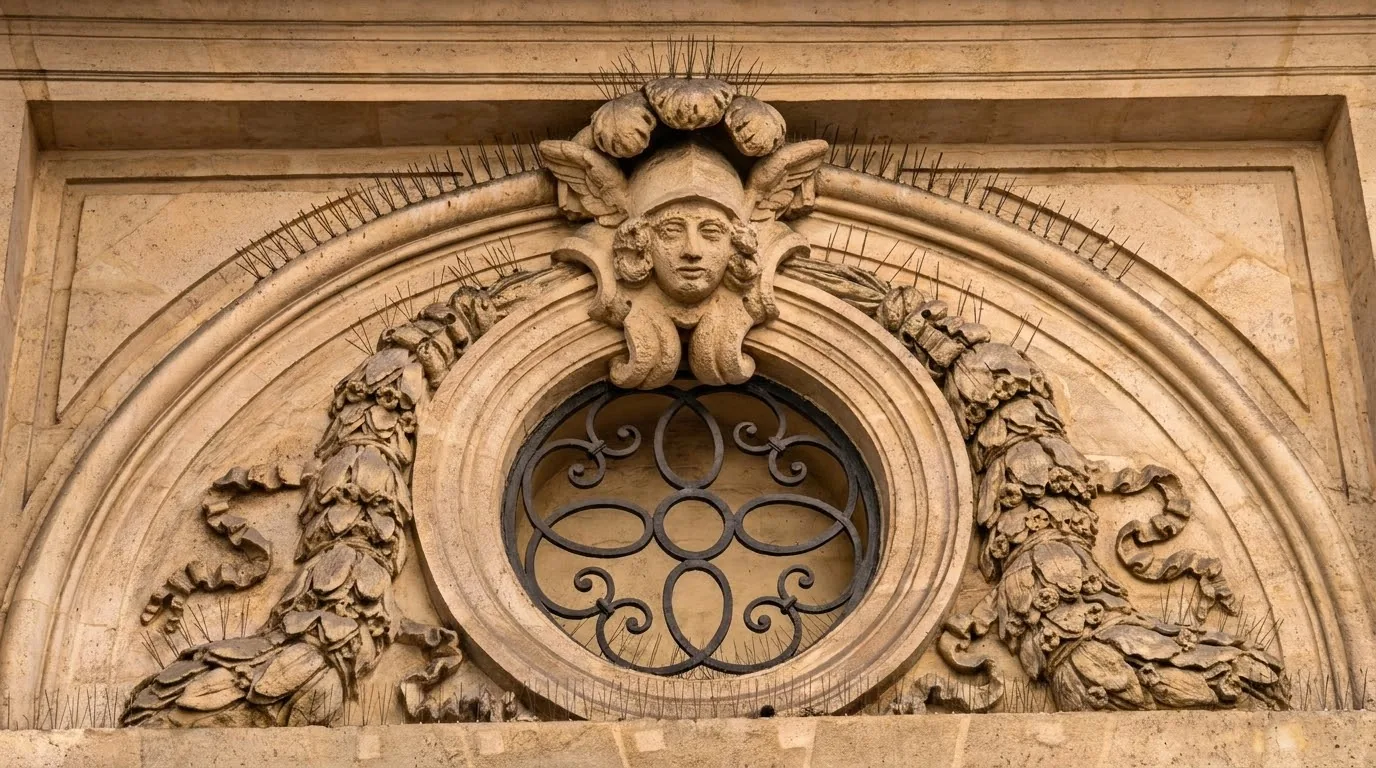
At numbers 70 and 72 stand a pair of palaces built around 1647 for a wealthy financier. Number 70 has retained a condition close to its original, and number 72 has been very much altered in the 19th century. What is not to be missed here are the two identical gates, especially that of number 72: during the reign of Louis XV it was raised a storey with a gable, and a magnificent door joinery was installed on which Asclepius is carved on the right and Justice on the left. At number 70 a magnificent staircase has been preserved, which was redone around 1750.
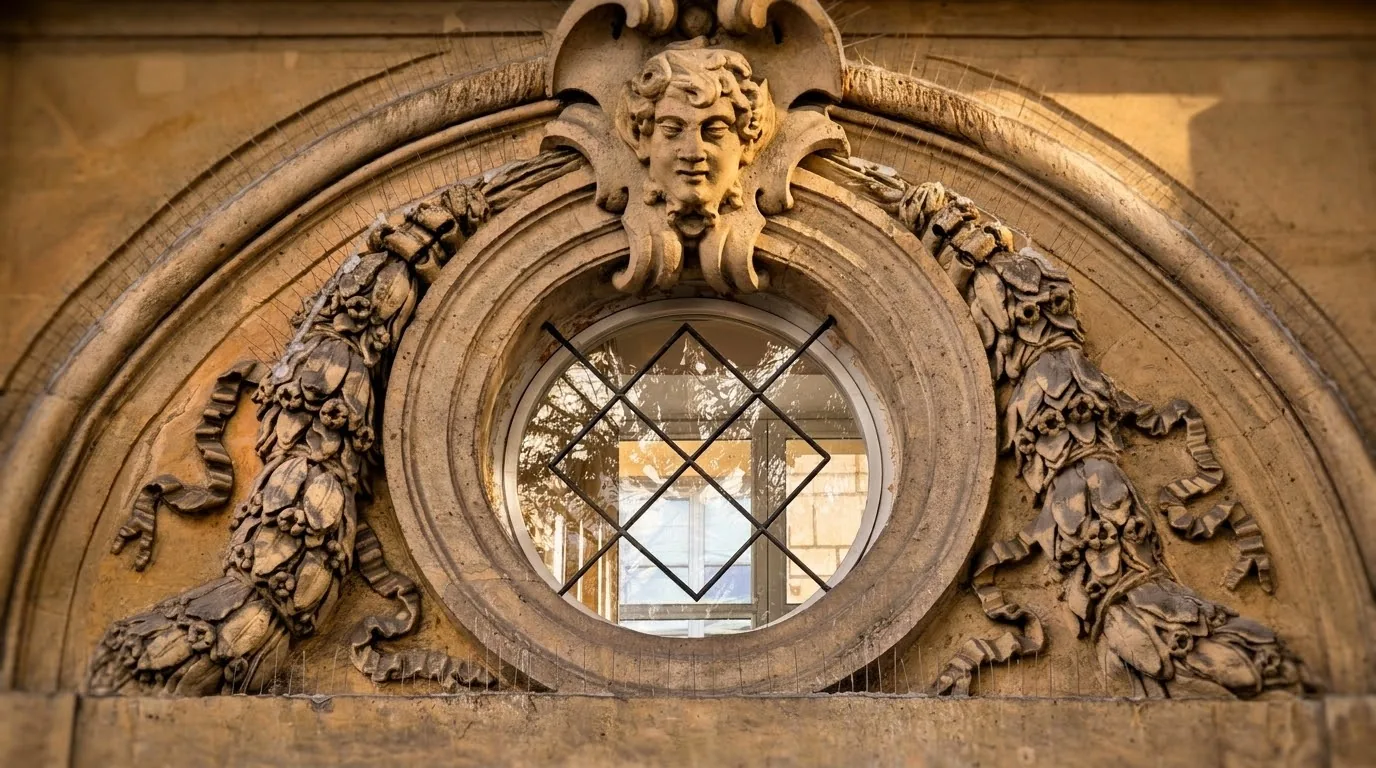
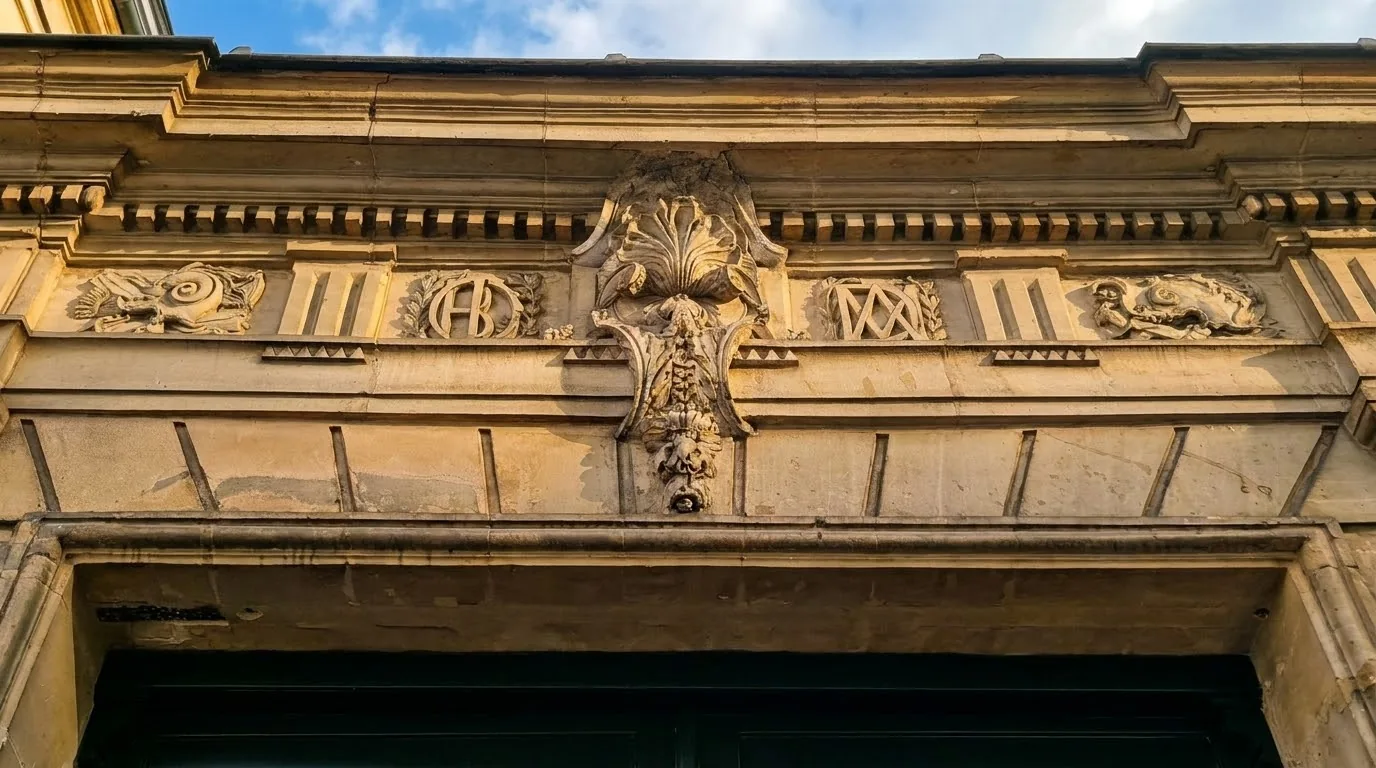
Nos. 74 and 76 were built on the same principle as twin palaces, in 1642–1644, on an old garden. The gate of No. 76, which dates from the 1640s, has the monogram of the owner and his wife engraved within the ornament. Deep in the courtyard on the left stands a corner tower with its own roof, which the ancients called “the donjon,” and inside it is a beautiful staircase: a cast-iron railing to the first floor, and above it a tree.
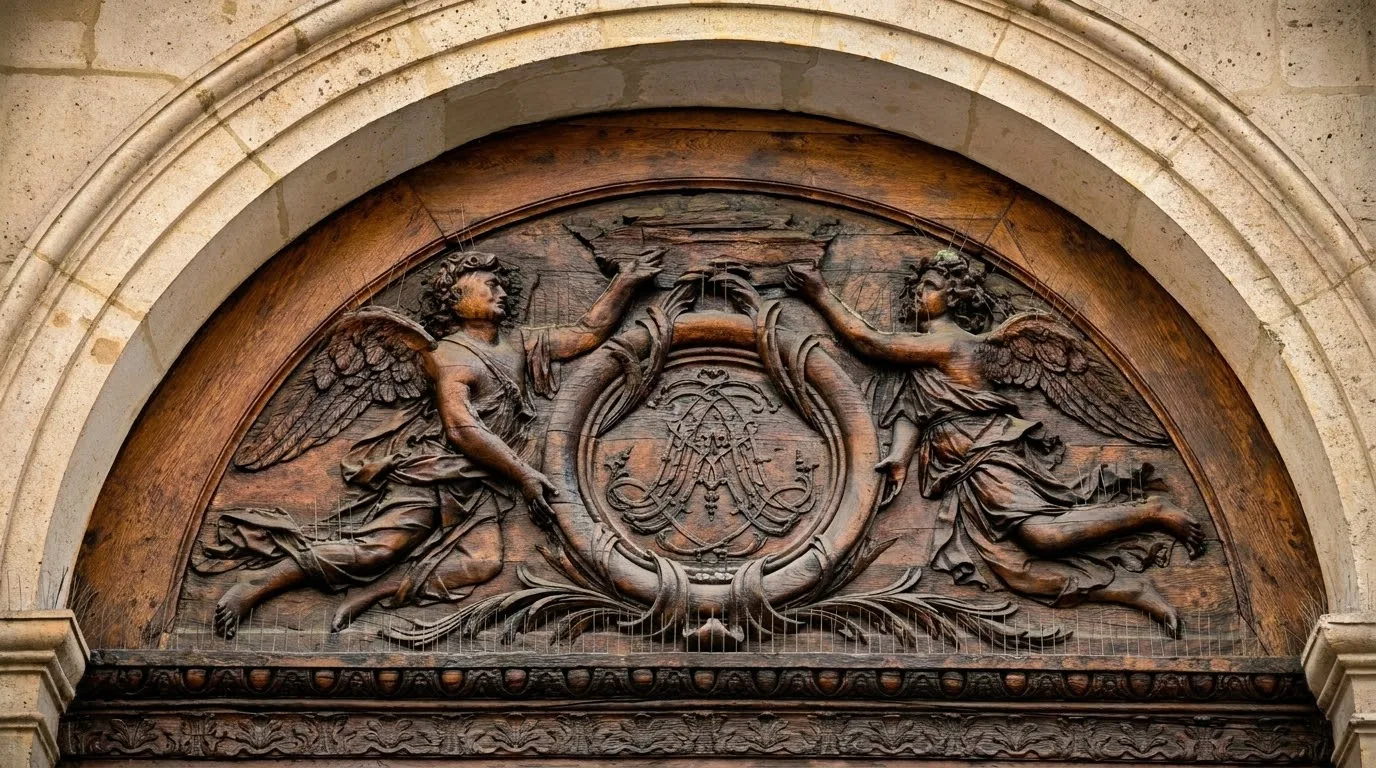
The most impressive building in this sequence is the Hôtel Amelot de Chaillou at number 78, built by the architect Pierre Bullet (1639–1716) in 1702–1704 for a member of parliament from the Amelot family. In 1722, it was purchased by Marshal Camille d'Hostun de Tallard (1652–1728), and then it went through the familiar course: commerce, neglect, deterioration, and a major renovation that began in 1978. Look at the closed gate: the carpentry is ancient, and in the window above it, two wooden angels holding a medallion with a monogram have survived.
The remains of the red children
2 and 14 rue Portefoin , then 85, 90 and 79 rue des Archives
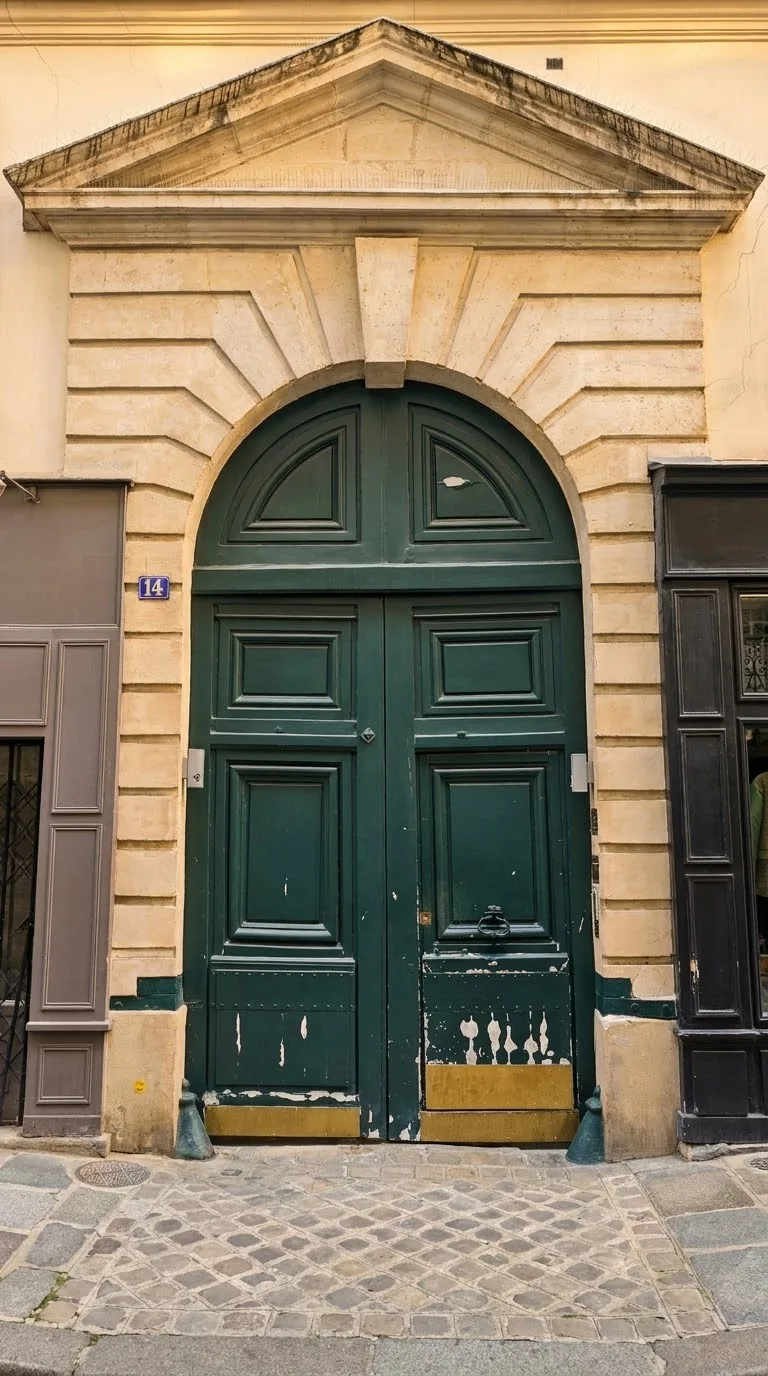
Here we make a small loop: turn west on rue Pastourelle to rue du Temple, turn right, then enter rue Portefoin and return east. This street was also opened by the Templars, and its rustic name is probably a corruption of the name of a wealthy medieval resident. At number 19, a restrained neoclassical house marks the corner, and at number 14, a small hotel from the Louis XIV era survives with a gate and a picturesque courtyard.
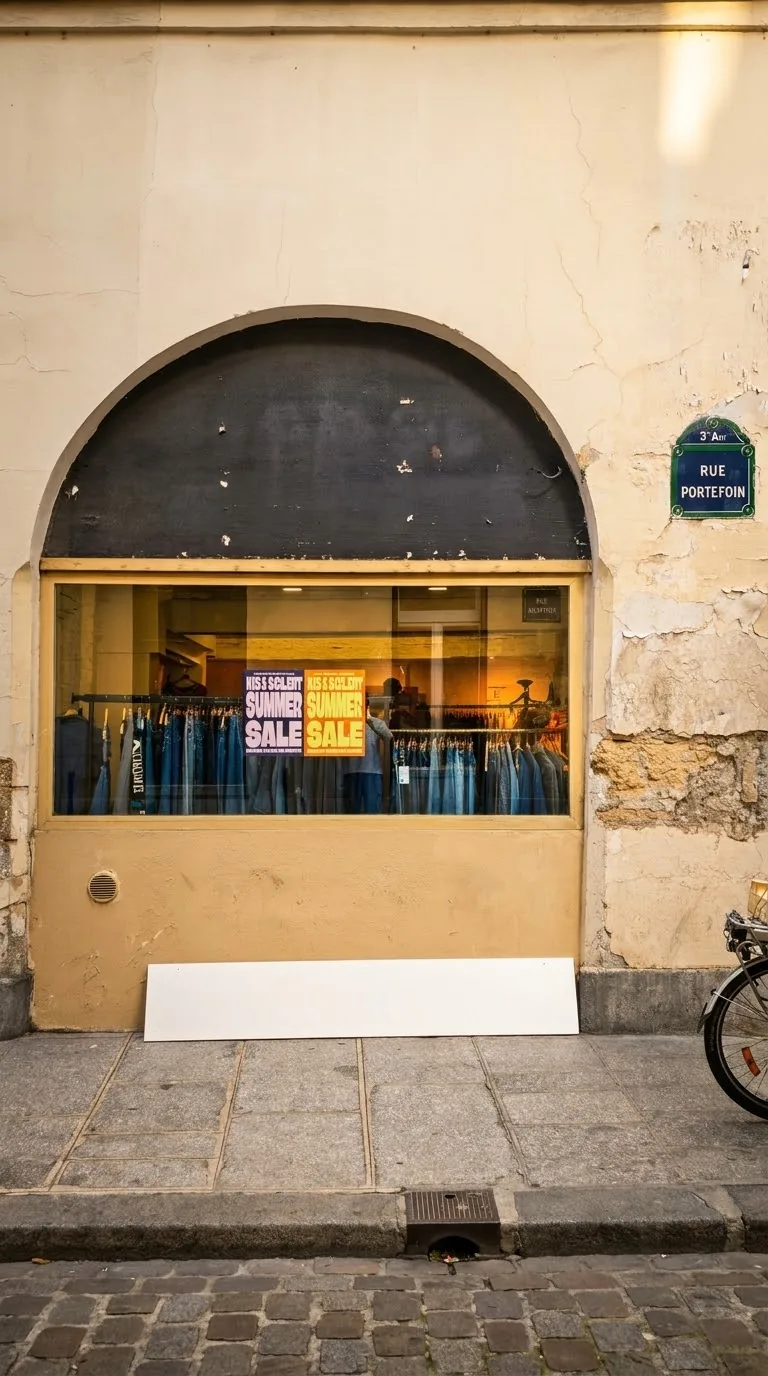
At number 2, an arch remains inside a remnant of a wall, and that’s exactly what we came to see. It was the gate of the Hospital for Red Children, founded in 1536 on the initiative of Marguerite de Navarre (1492–1549), sister of François I (reigned 1515–1547), to collect and educate orphaned children. The children wore red cloth clothes, the color that symbolized Christian charity, hence the nickname that stuck to them. The institution closed in 1772, but its name survived in the neighborhood, and we will meet it again at the end of the route.
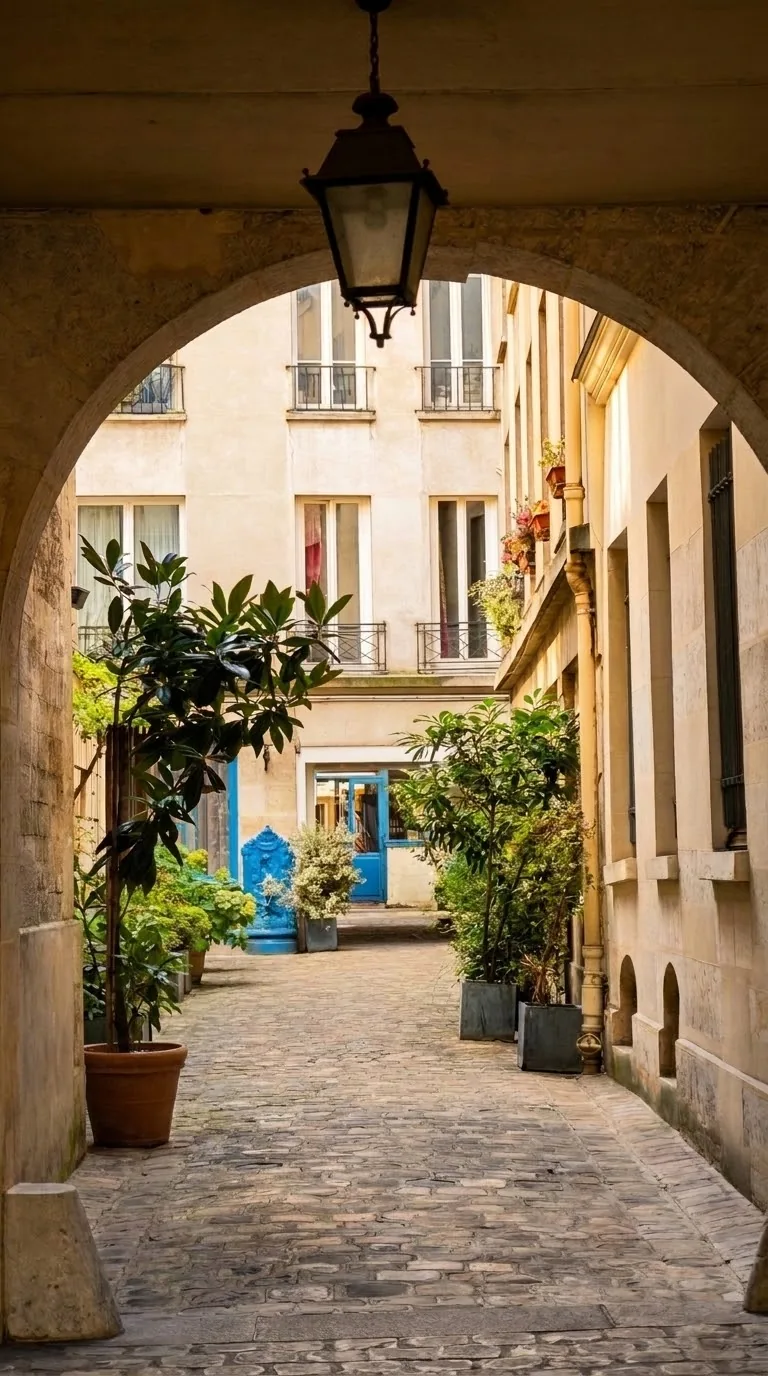
Return to rue des Archives. At number 85 stands another house from the time of Louis XIII, and at number 90 hides the strangest thing about this station: in the courtyard, on the left, is the back of the old Saint-Julien Chapel. It is immediately recognizable by its tall, arched windows, whose stained glass was considered beautiful, and it survived thanks to a very practical solution: it was converted into residential apartments. A plaque on the back wall commemorates the charitable institution that closed.
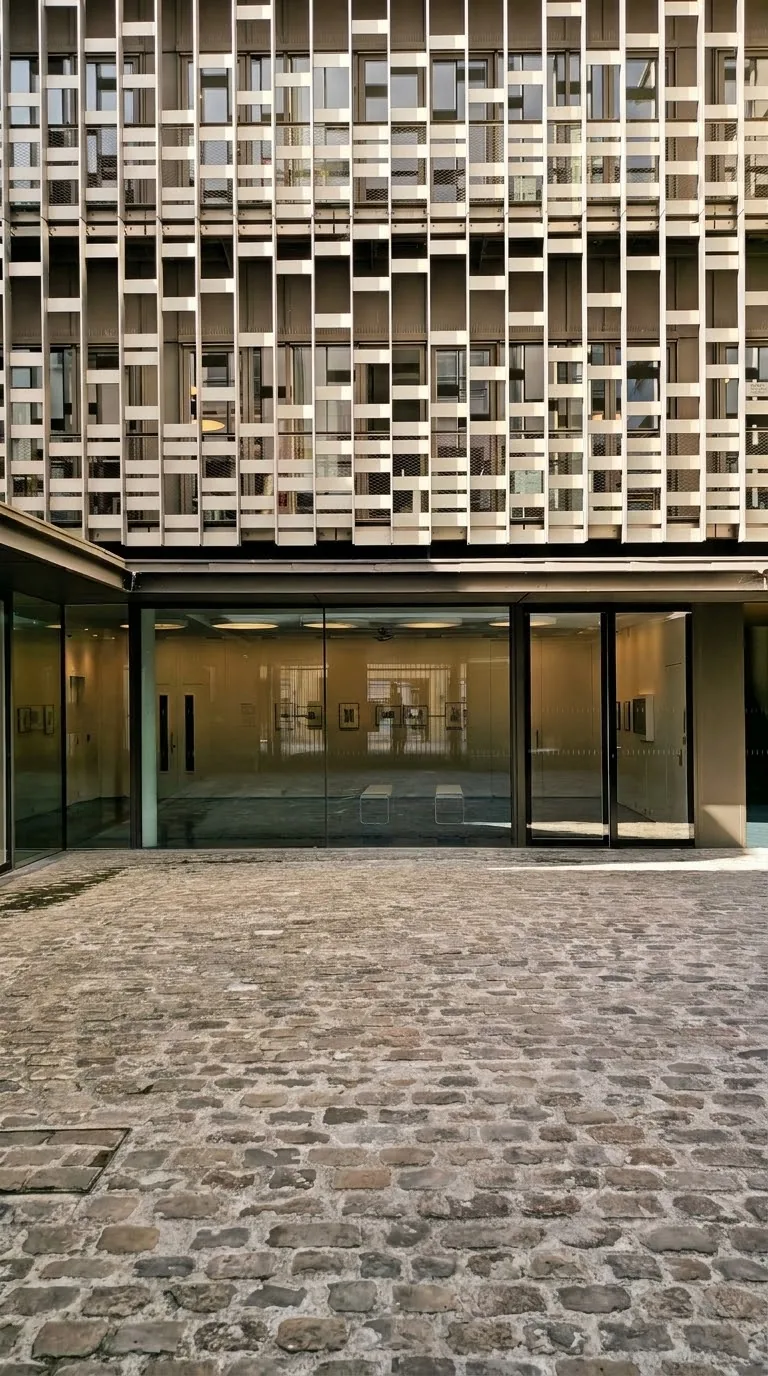
Before continuing, at number 79 note the façade dating from 1610 and the beautiful stone dormer windows, each with a triangular gable above them. They do not sit on the roof but cut into the cornice at the top of the façade and rise from within the wall itself, a distinct hallmark of construction from that period.
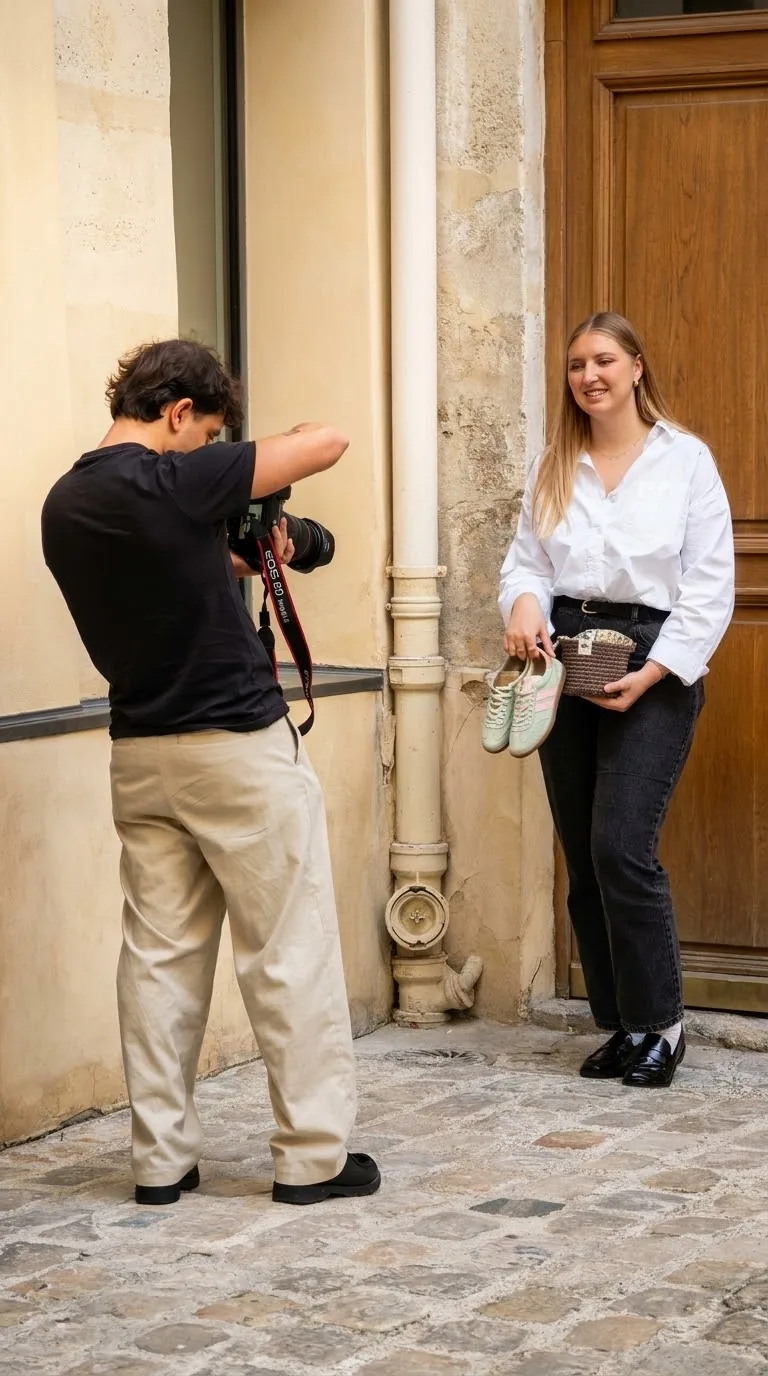
The same address has housed the Fondation Henri Cartier-Bresson since the fall of 2018. The foundation was founded in 2003 by photographer Henri Cartier-Bresson (1908–2004), one of the founders of the Magnum photo agency, his wife, photographer Martine Franck (1938–2012), and their daughter, and moved here from the 14th arrondissement to an old garage that was converted into an exhibition space. Note that there is no permanent exhibition of Cartier-Bresson's own photographs here, but rather changing photography exhibitions. The foundation is open Tuesday through Sunday from 11:00 AM to 19:00 PM, and closed on Mondays.
The alley that stopped in the 17th century
Entrance at rue Pastourelle, after number 17 , and exit near 5 rue Charlot
Rue Pastourelle itself is worth a look. Its western section dates from the late 13th century, and its entire northern side is ancient and built on the medieval lot division, so the facades there are modest and narrow. Note the small Louis XV facade at number 22, and the rare iron railings from the Louis XIV era at number 44. The eastern section was only opened in 1636, under the name rue d'Anjou, to connect rue Charlot to rue des Archives.
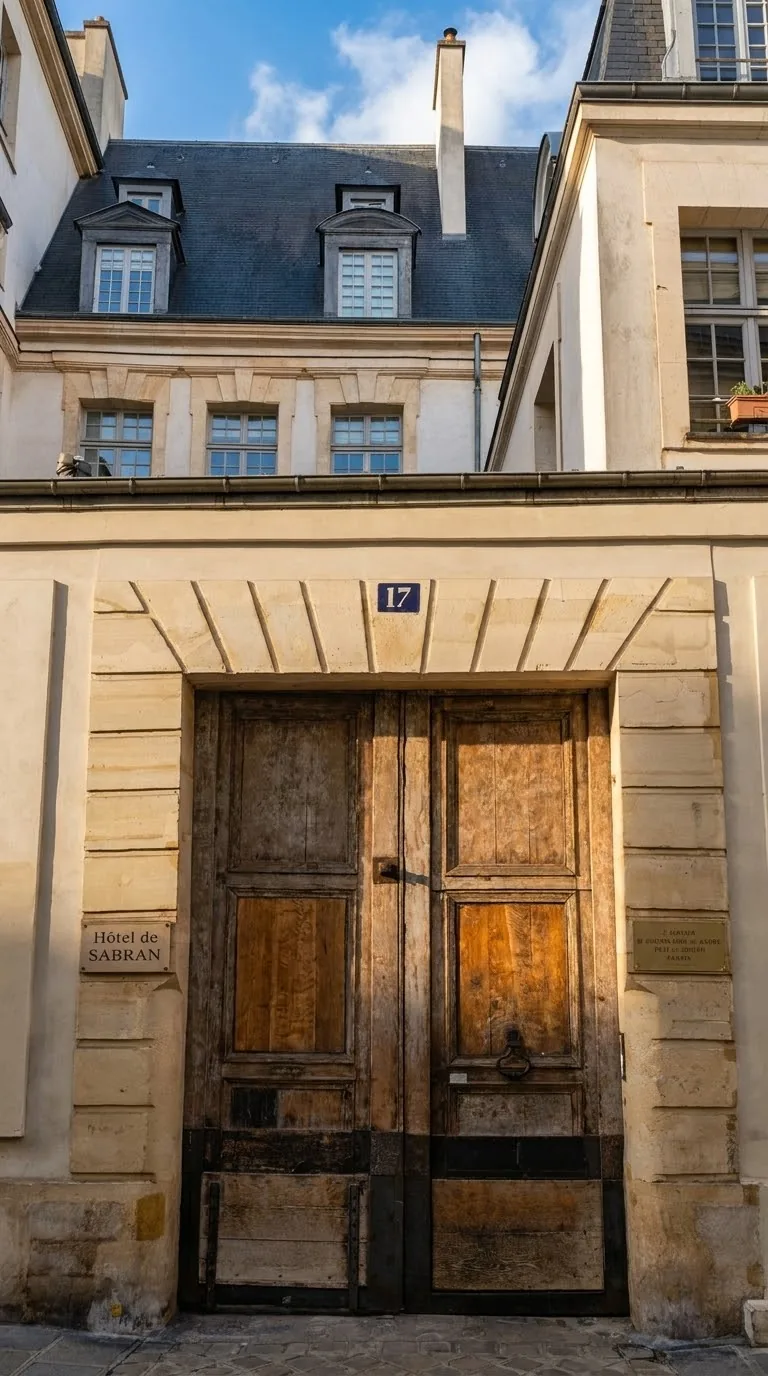
At number 17 stands the Hôtel de Sabran. It was built around 1643 for a tax collector from Bordeaux, and was named after the Marquis Louis-François de Sabran, an officer in the king's army who bought it in 1778. In the 19th century, commerce entered it, the right wing was demolished, and from 1840, metal workshops operated on the ground floor. Inside, a staircase with an open space in the center and an iron railing from the mid-17th century survives, and its turrets and prominent structure above ruelle Sourdis are immediately visible as you enter the alley.
Immediately after number 17, ruelle Sourdis opens up, and in my opinion it is the pearl of this route. A private alley created in 1620, without sidewalks, the middle part of which has long since been cut off. What remains is exactly what has been lost in the rest of Paris: a central drainage canal running down the middle of the road, uneven paving stones and corner stones that protected the walls from carriage wheels.
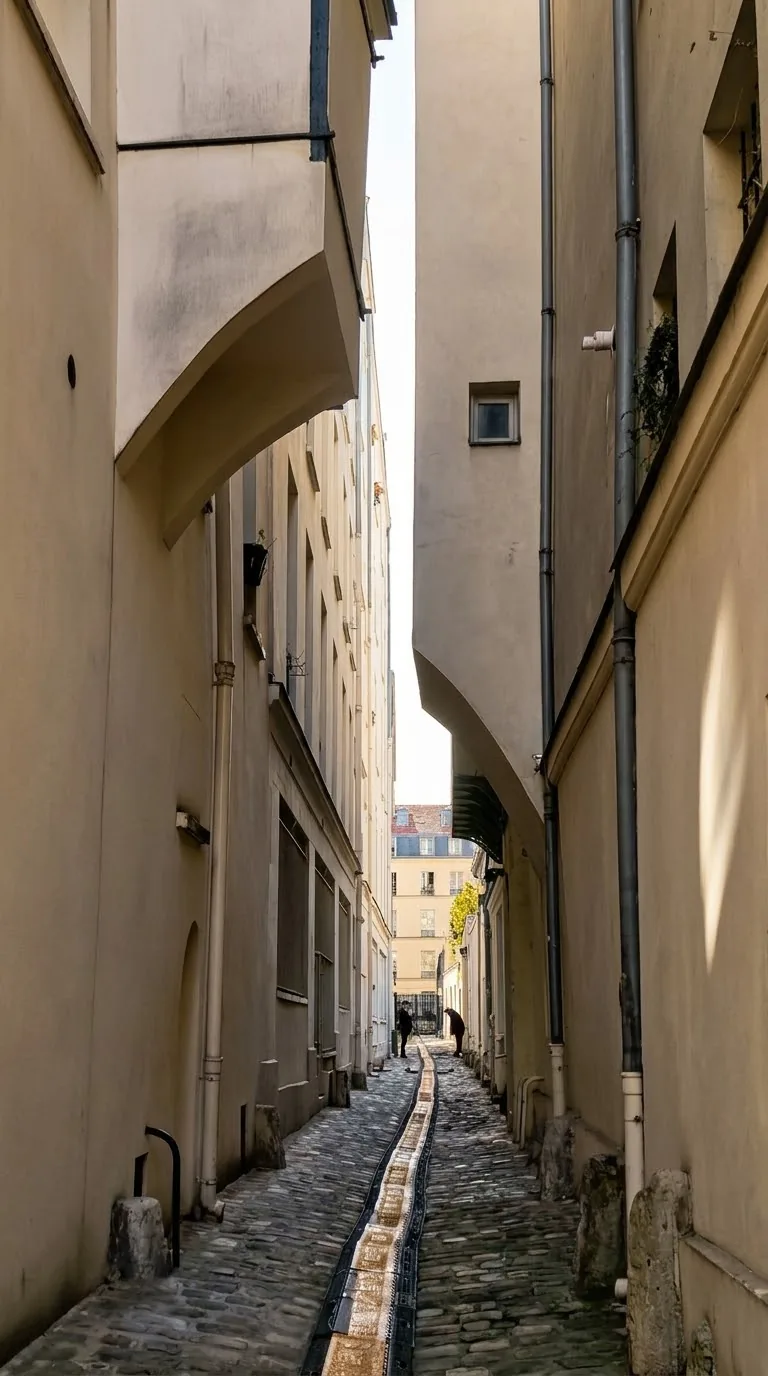
On the shared walls hang small structures called privés, toilet towers attached to the outside of the houses. The sight is funny today, but it tells exactly how people lived here. The central drainage canal is also the explanation why those who walked down a Parisian street in the 17th century preferred to walk close to the wall rather than in the middle.
Important note for those coming: There are gates at both ends of the alley, and they are closed quite a bit. If you find a locked gate, the peek through the bars is still worth the stop.
The square that Henry IV did not have time to build
rue de Beauce , at the corner of rue Pastourelle
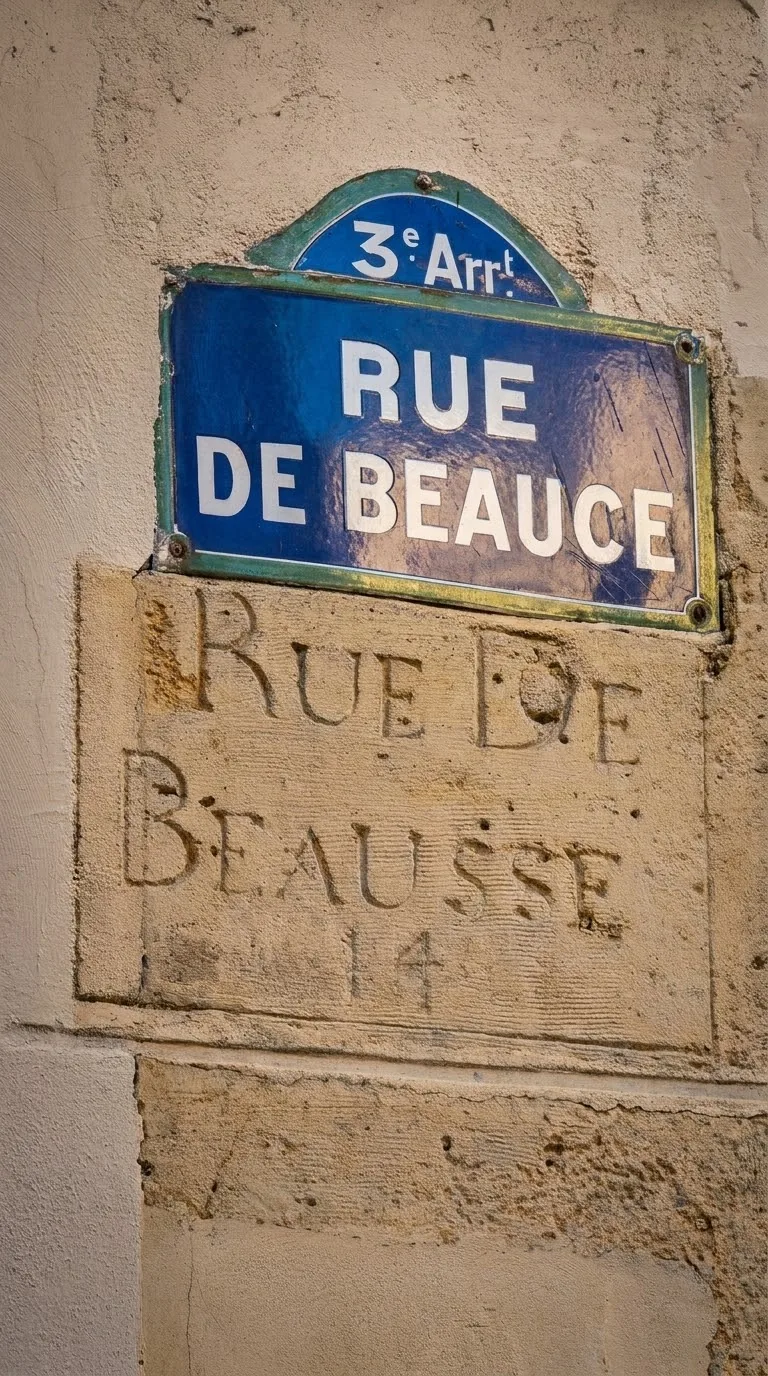
On the corner, the names of the old streets are carved in stone, and it's worth looking for them. Rue de Beauce and Rue Sourdis sit on the same straight line, and this line is the boundary between the 13th-century subdivision of land and that of 1608. Once you cross it, you enter the territory of a royal project that never came to fruition.
In 1608, Henry IV (reigned 1589–1610) decided to build his third royal square here, after Place Dauphine and Place des Vosges , then called the Royal Square. The area between the city wall and the Temple complex was mainly vegetable gardens and remnants of marshes. The Order of the Temple gave up the land, and a group of financiers hiding behind a straw man took over the rights to it and divided it into plots in 1608–1610.
The plan was drawn up by the royal engineer Claude Chastillon (1560–1616). The square, called the Place de France, was to be a semicircle about 150 meters in diameter, surrounded by identical buildings with turrets and high slate roofs. A new gate was planned in the city wall, and eight streets were to branch off from the square like a star, each named after a different province of the kingdom.
On May 14, 1610, François Ravaillac (1578–1610) stabbed the king to death in the rue de la Ferronnerie, and the square was buried with him. No buildings were built and the gate was not opened. What remains are the names of the districts on some of the streets, such as rue de Poitou, rue de Bretagne and rue de Normandie, and the curved line of rue Debelleyme, a few minutes' walk east from here, which still traces the planned semicircle. Rue de Saintonge and rue du Perche, which we will pass through later, also bear the names of old French districts. The development of the neighborhood was continued after the king's death by the financier Claude Charlot, who, instead of a royal square, laid out a network of straight streets here, and you will meet the street named after him at the next stop.
By the way, Madeleine de Scudéry (1607–1701), the writer who invented the map of the Land of Tenderness, also lived on rue de Beauce. You can read about her on the trail in the footsteps of Madame de Savigny.
rue Charlot from end to end
From 28 to 7 rue Charlot
This street is named after that Claude Charlot, and it was made up of four older streets. We walk south on it, and it has five short stops.
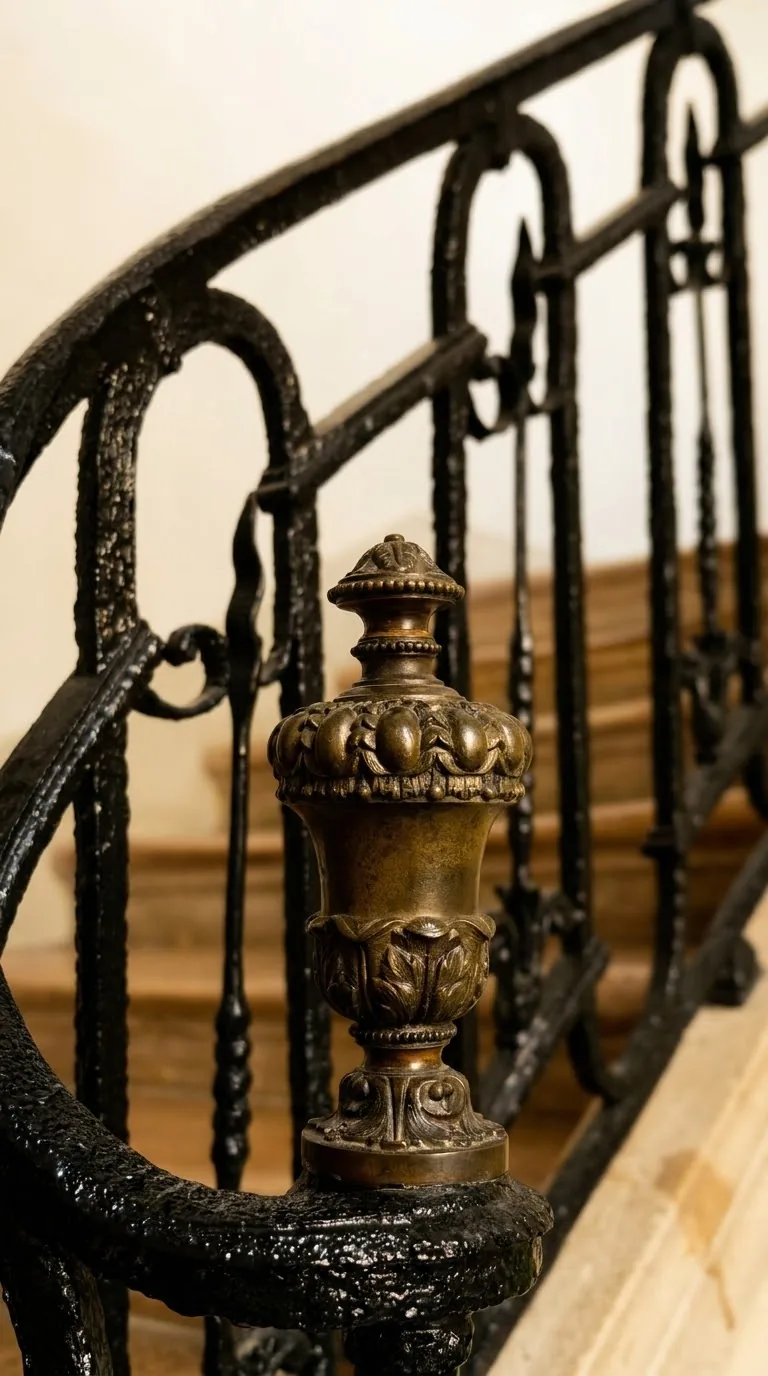
At number 28, a fairly flat balcony marks what is known as the Petit Hôtel de Barancourt, which was actually remodeled around 1705. Go immediately to the right, into the passage: there is a beautiful staircase from the Louis XIV era with an iron railing, and deep in the paved courtyard is a building with a concave movement that is a little jewel.
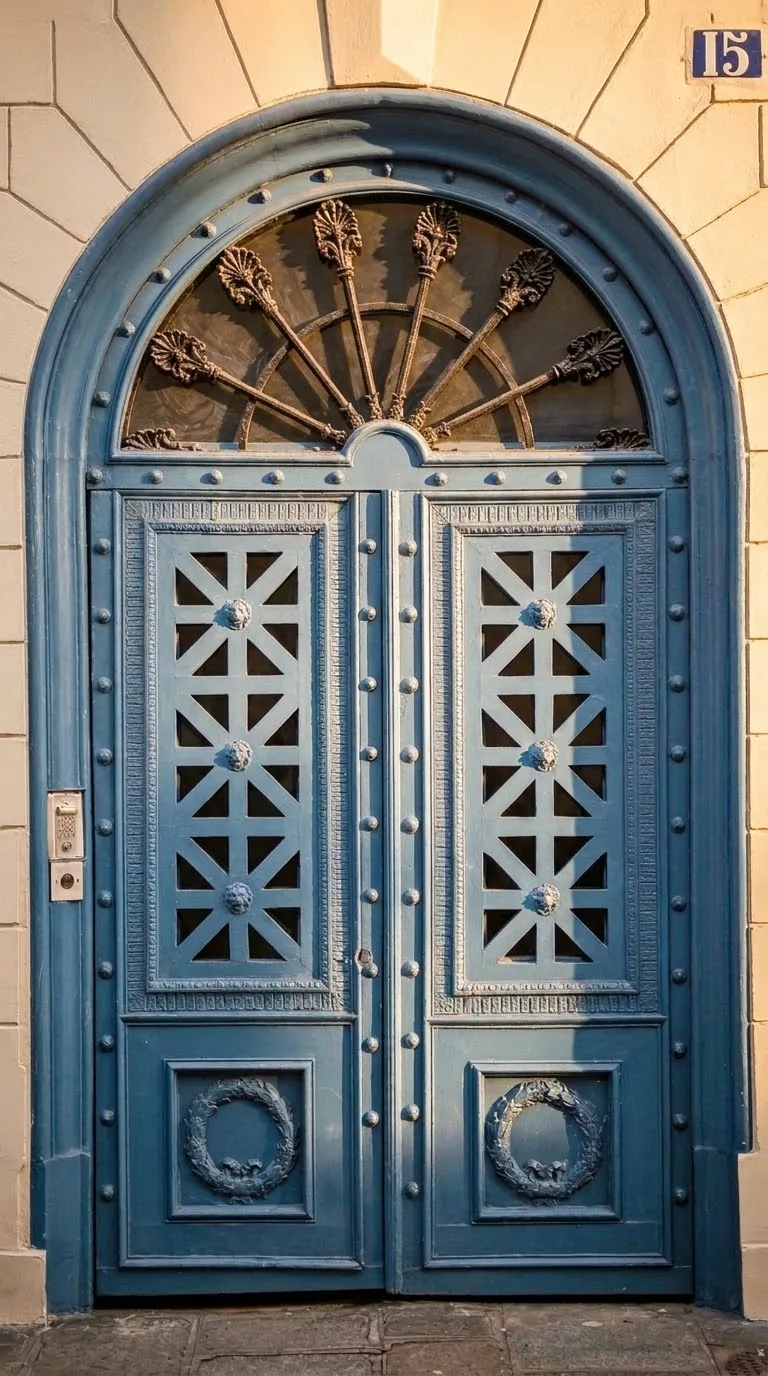
At number 15, notice a beautiful door in the Directory or Empire style, with an upper window decorated with palm leaves, and at number 12 stands a small hotel built in 1610.
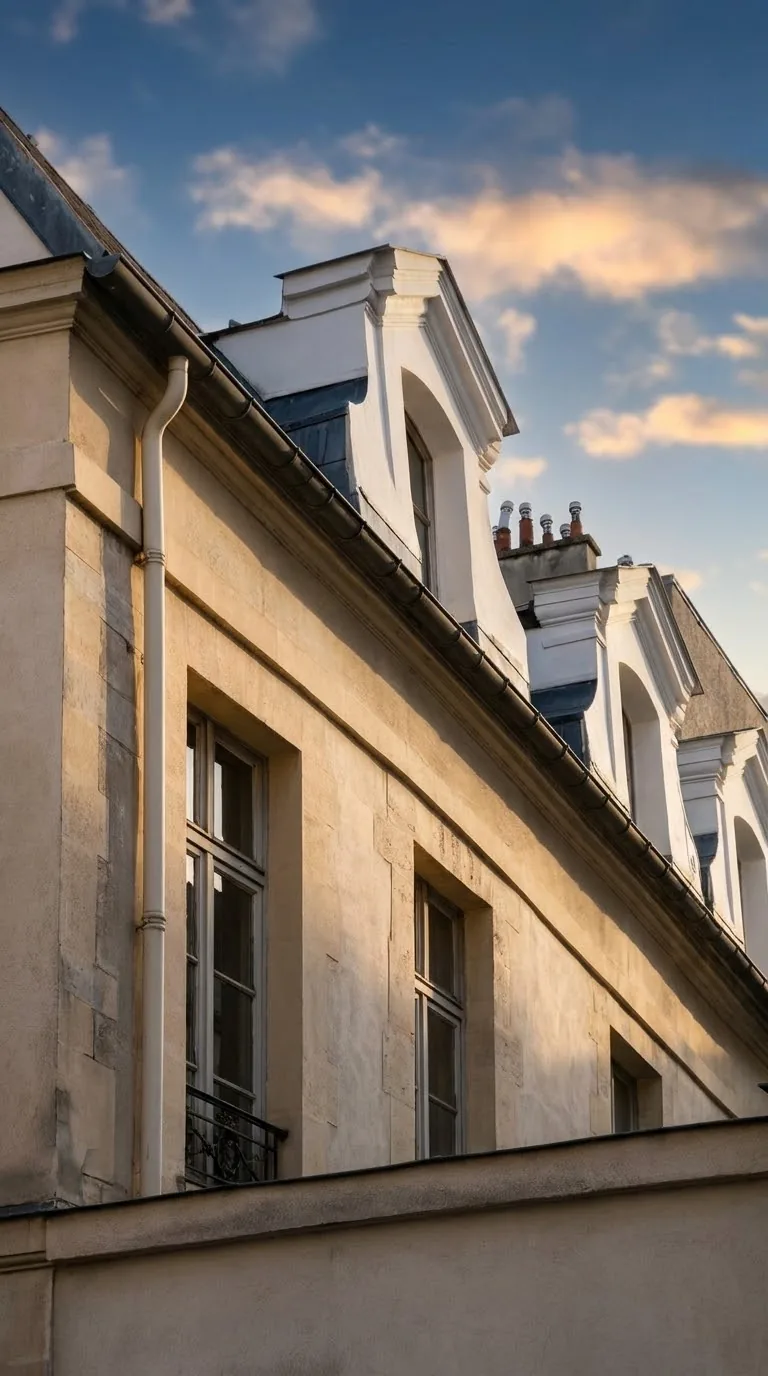
It has been heavily renovated, but the carriage gate with its carved doors in the neo-Louis XV style, and especially the skylights with the Louis XIV-style “fins,” are among the originals in the district.
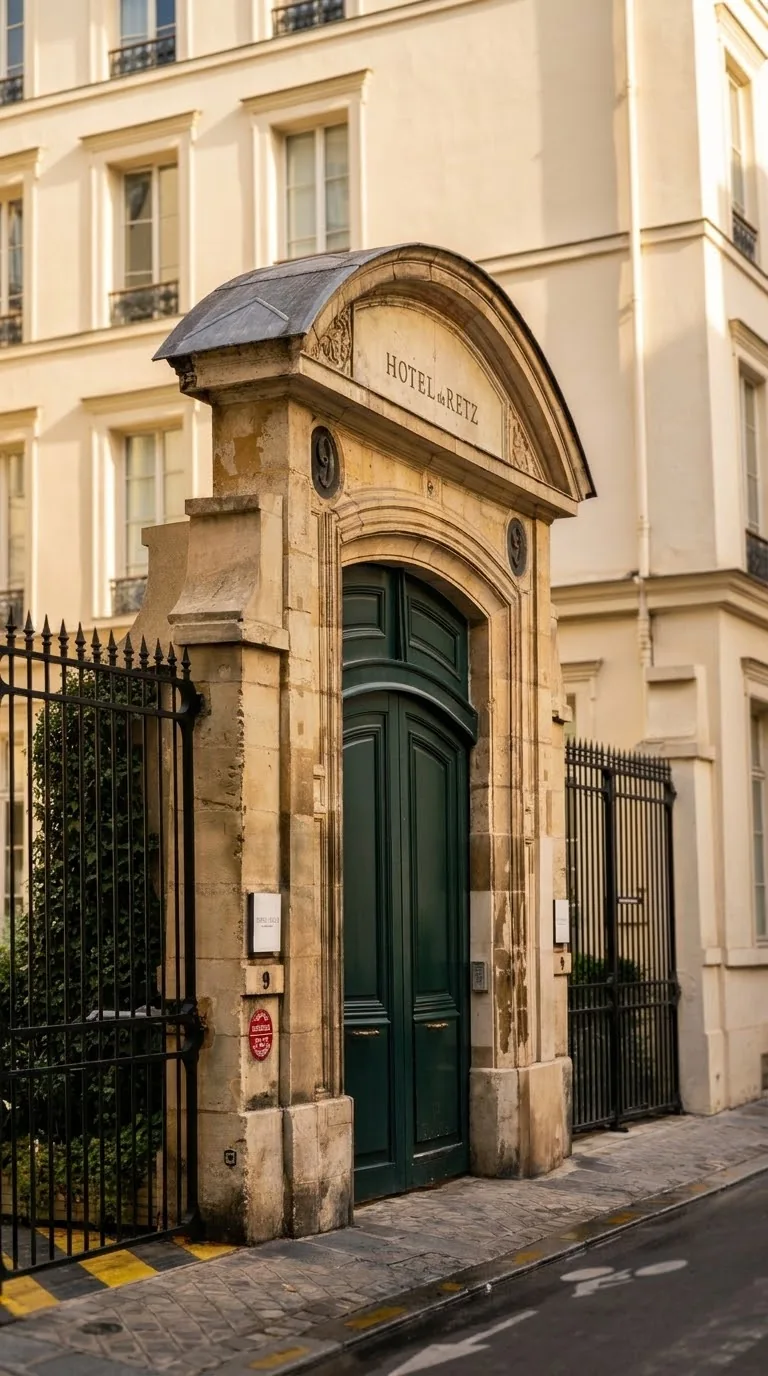
Just before the end, at number 9, stands a single stone gate inscribed with the name Hôtel de Retz, and is all that remains of the house built here between 1613 and 1632. In 1649, the house was bought by Pierre de Gondi (1602–1676), Duke of Retz and brother of Cardinal de Retz (1613–1679), one of the leaders of the Fronde rebellion. Two years later, Madame de Sévigné (1626–1696) stayed here. The house burned down and was rebuilt in 1839, in 1950 it became a toy factory, and in 1994, after a five-year renovation, an art exhibition space was opened.
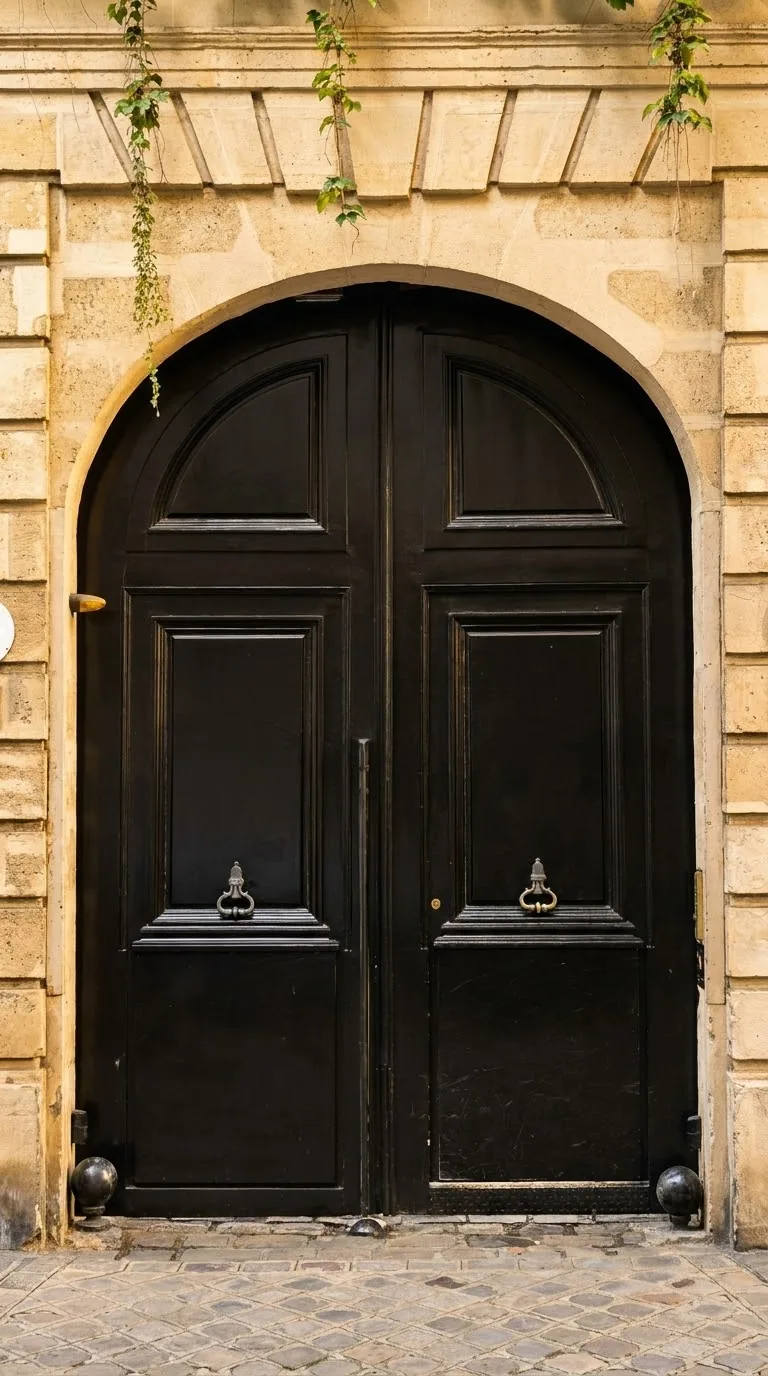
The street ends at number 7, the Hôtel Cornuel. Built around 1614–1616, it changed hands several times, and in 1636 it passed into the hands of the financier Claude Cornuel, after whom it is named. The house was extended in the 19th century and lost much, but the ends of the wings remain intact, topped by massive stone dormers.
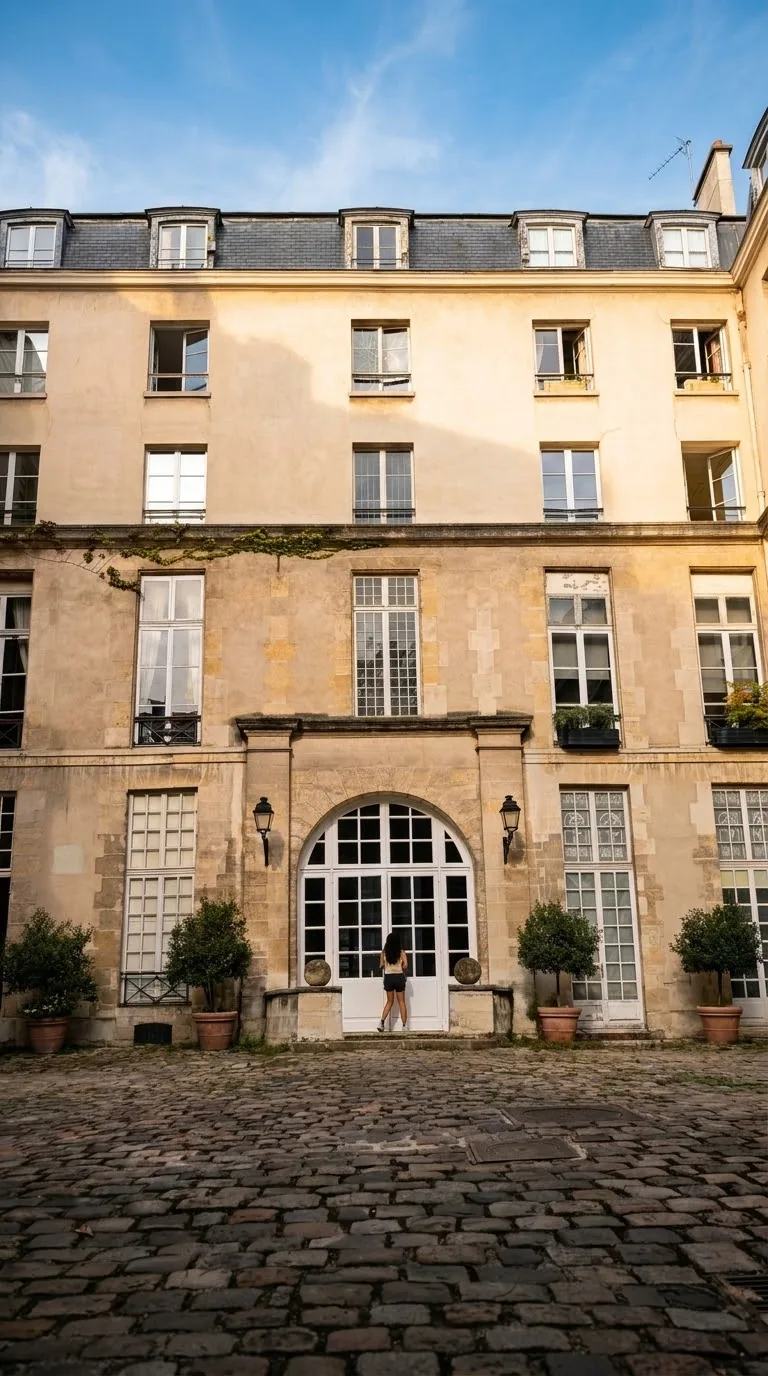
A few years ago, painted ceilings from the Louis XIII era were discovered inside, with high-quality painted wooden beams. Enter the small courtyard that replaced the old garden: everything is picturesque there.
The Capuchins who became an Armenian cathedral
We meet Claude Charlot again. In 1623, as part of the development of the neighborhood, Charlot founded a monastery where Capuchin monks settled, and the following year their chapel, the church you see today, was built on the site of an old ball court, one wall of which still stands along rue Charlot. In the tradition of those days, the Capuchins also served as the neighborhood's firefighters.
During the French Revolution, the abbey was destroyed and the grounds redistributed, but the chapel survived and became a parish church in 1791. It was closed in 1793, bought by the City of Paris in 1798, and restored to worship in 1811 after the Concordat. The altar area was rebuilt by the architect Hippolyte Godde (1781–1869) in 1828–1832, and the front porch was added by Victor Baltard (1805–1874) in 1855. In 1844, an organ by the organ builder Aristide Cavaillé-Coll (1811–1899), one of his first in Paris, was installed.
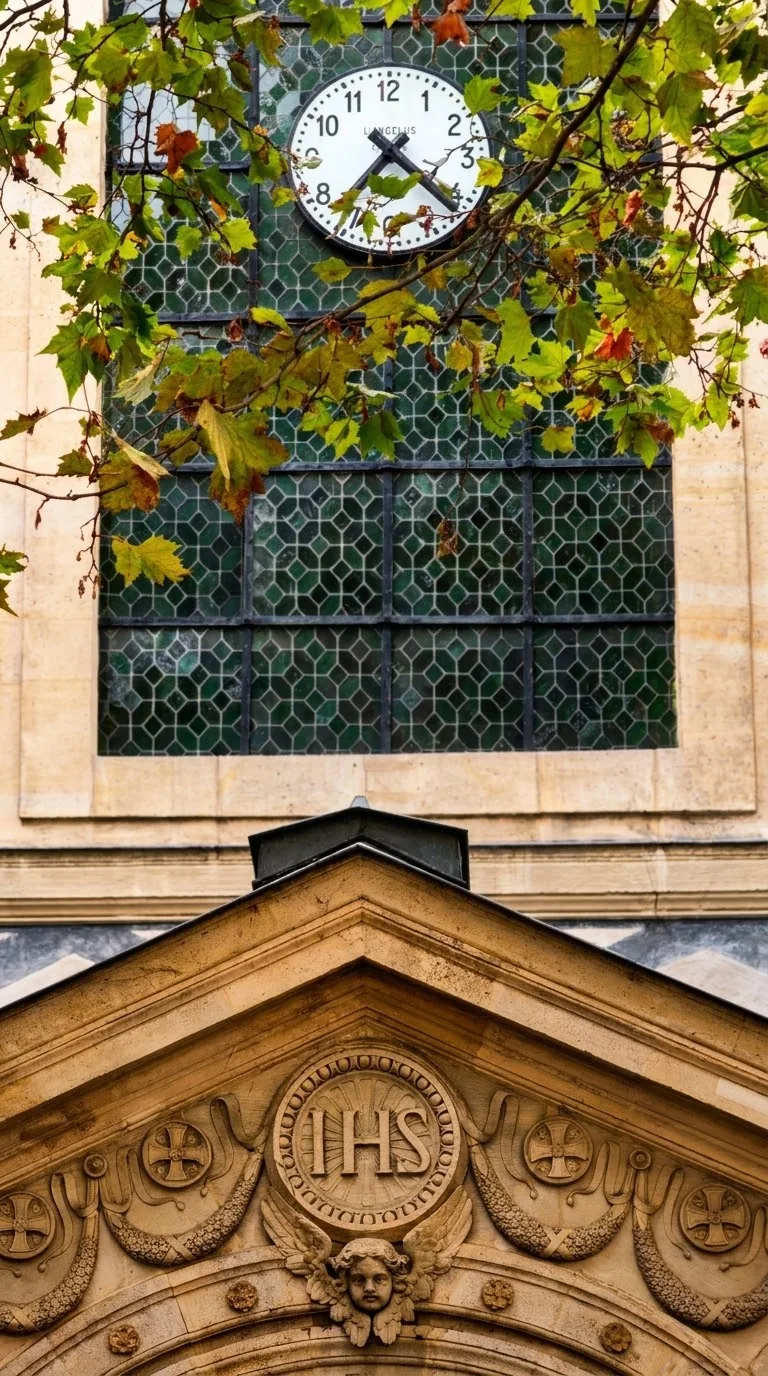
In 1971, the church was handed over to the Armenian Catholic community of Paris, and it remains its Sainte-Croix Cathedral to this day. The modest facade does not prepare you for the interior: a wide, low-vaulted hall with only one side wing, in the Franciscan tradition. On either side of the stairs stand statues of saints, and that of Saint-François is attributed to the great sculptor Germain Pilon (1528–1590). The church is mainly open for prayers and concerts, so if you find it open, take advantage of the opportunity.
Pascal, the helmet factory and the giant thermometer
From 4 to 24 rue de Saintonge , and with a short detour 38 rue de Poitou
Rue de Saintonge was formed by the union of three old streets, and we walk north along it. The rule of thumb here is simple: the further north you go, the more modest the houses become, because the southern part was close to the aristocratic Marais.
At number 4 stands an austere neoclassical house built for a wealthy notary in 1764, and some believe the architect behind it was Étienne-Louis Boullée (1728–1799). Its neighbor at number 6 is the surprise: behind a shabby-looking facade lies a three-story workhouse with wooden galleries, built in 1830–1832 for a manufacturer of military helmets who supplied the National Guard. For years, it was thought that a theater from the Directory era was hidden there, but in the end the truth turned out to be just as interesting.
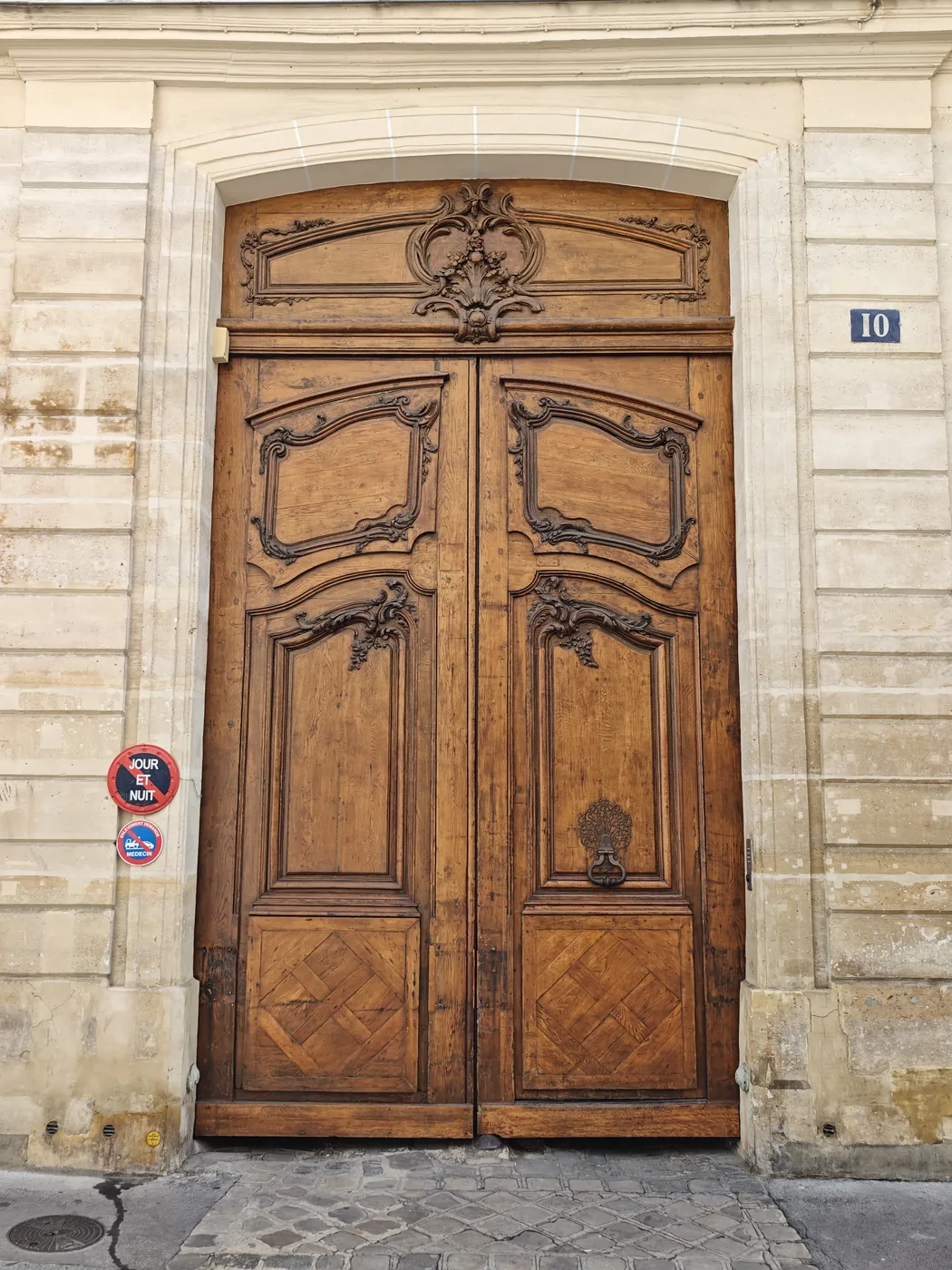
At number 8, dormer windows are built on the house of financier Adrien Bence (died 1696), who made a fortune in the shadow of the treasurer Nicolas Fouquet (1615–1680), and managed to keep it even after the patron's downfall (you can read about this story in the article about Vau le Vicomte ). Bence built the house for himself in 1660–1661 and lived in it until his death. At the end of the left wing, a royal staircase unfolds around a square shell, with a very beautiful symmetrical cast iron railing. In the wing opposite, a door with a carved frieze of foliage and pecking birds leads to a small wooden staircase. At number 10, the neighbor, which was bought by a goldsmith in 1759 and rebuilt by his architect brother, the facade is simple, but the carriage gate doors are richly carved in the style of the Louis XV period.
Blaise Pascal (1623–1662) lived at number 15 in his youth, and left the house in 1651, when his father Étienne Pascal (1588–1651) died. The house has been changed almost beyond recognition, so that only the address remains. At the corner of rue de Poitou, at number 12, a tall apartment building for a chief baker was built in 1774, and the old name of the street is still engraved on it.
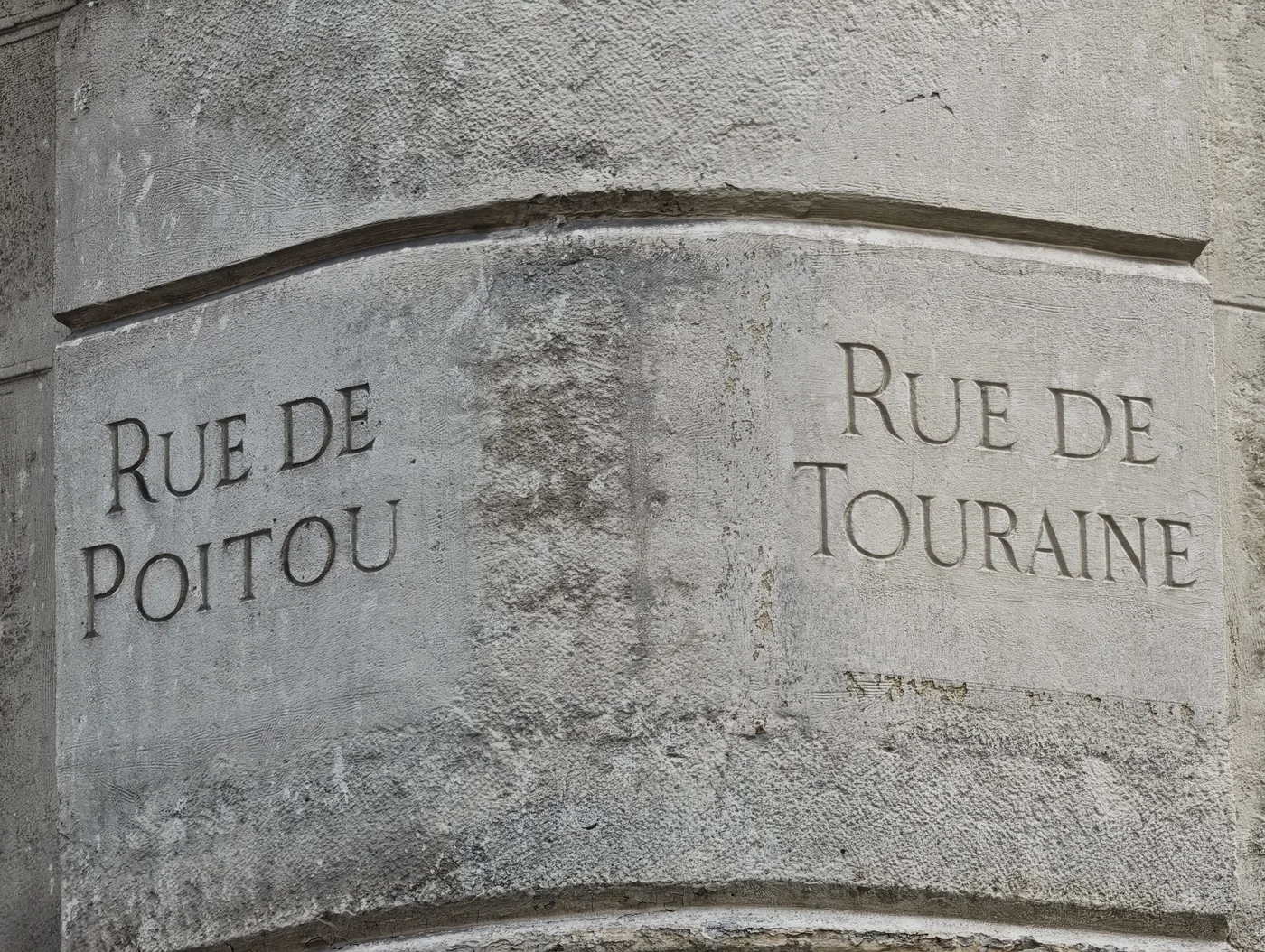
It's worth making a short detour to rue de Poitou and returning, both because of the sequence of ancient facades and because of the signs: at number 38 hangs a sign in the shape of a giant thermometer, the kind that is almost gone in Paris.
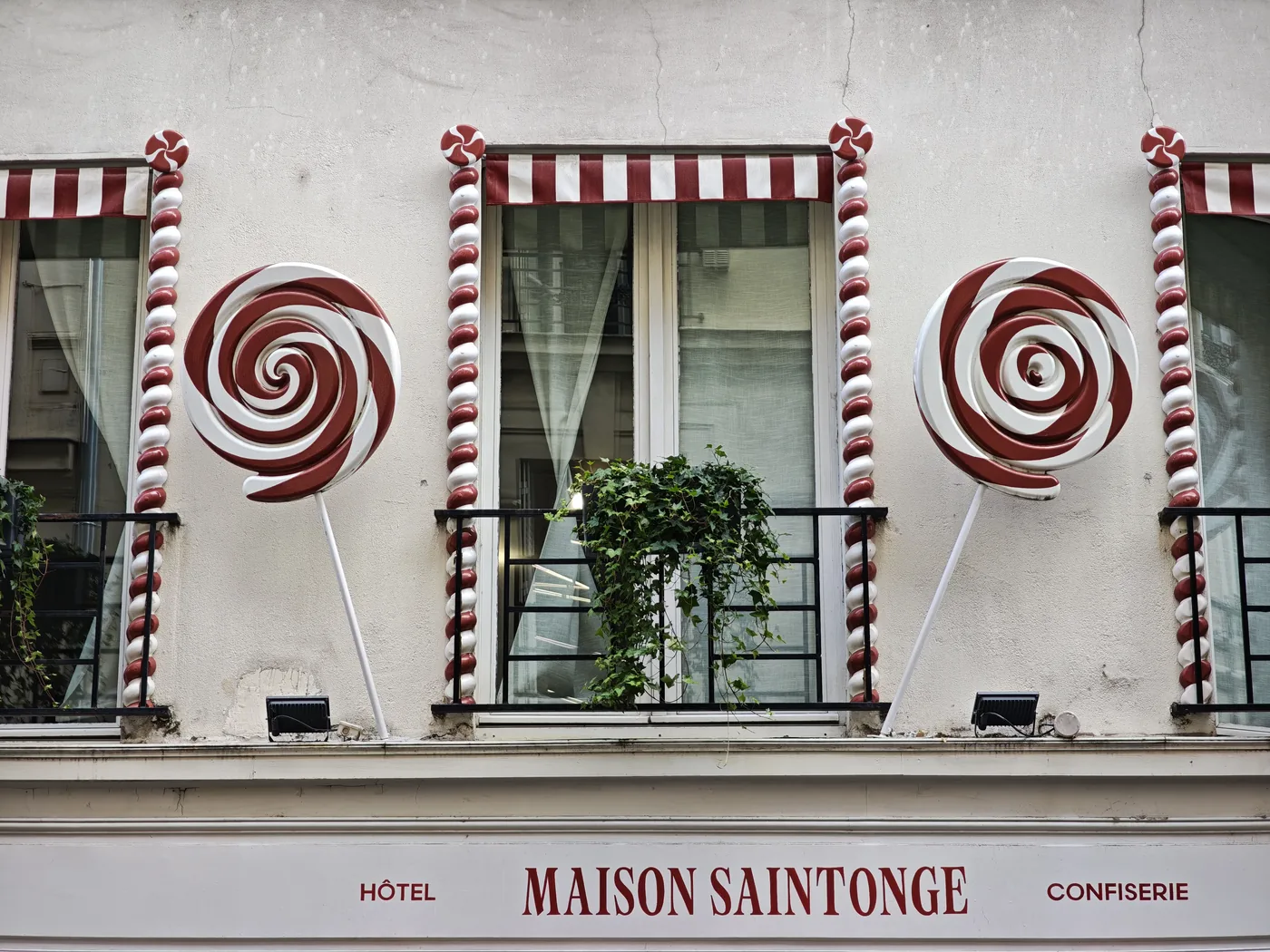
Returning to rue de Saintonge and continuing north, I discovered Maison Saintonge at number 16, a 4-star boutique hotel inspired by a 1950s candy store. In the front, between the windows, are giant lollipops, and in the hotel itself, which has 22 rooms, there is a small candy store where guests can buy candy at any time. If you feel like sleeping in a candy store, you can book a room here 🙂
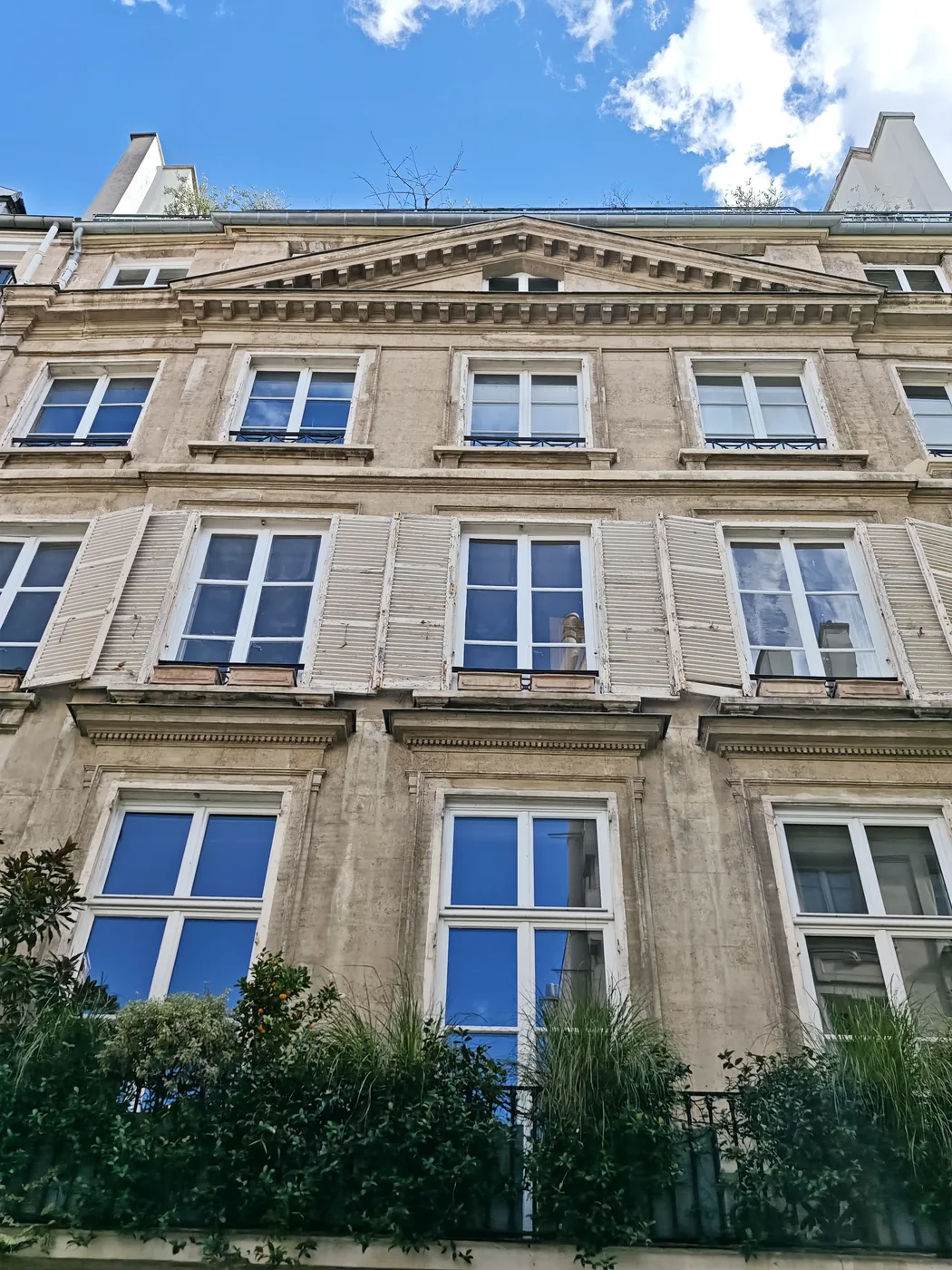
At number 20 stands a beautiful apartment building that a contractor and architect built for himself in 1780, with a triangular gable and a balcony on consoles, and at number 24, hidden deep in the courtyard is a small, charming circular alley of stairs.
The End: A Meal at the Red Children's
The route ends where it began, in terms of the story. Founded in 1615 as the “Little Market of the Marais,” the Marché des Enfants Rouges is the oldest covered market in Paris still in operation. In the late 18th century, after the neighboring orphanage we saw on rue Portefoin closed, it became known as the Children Who Wore Red.
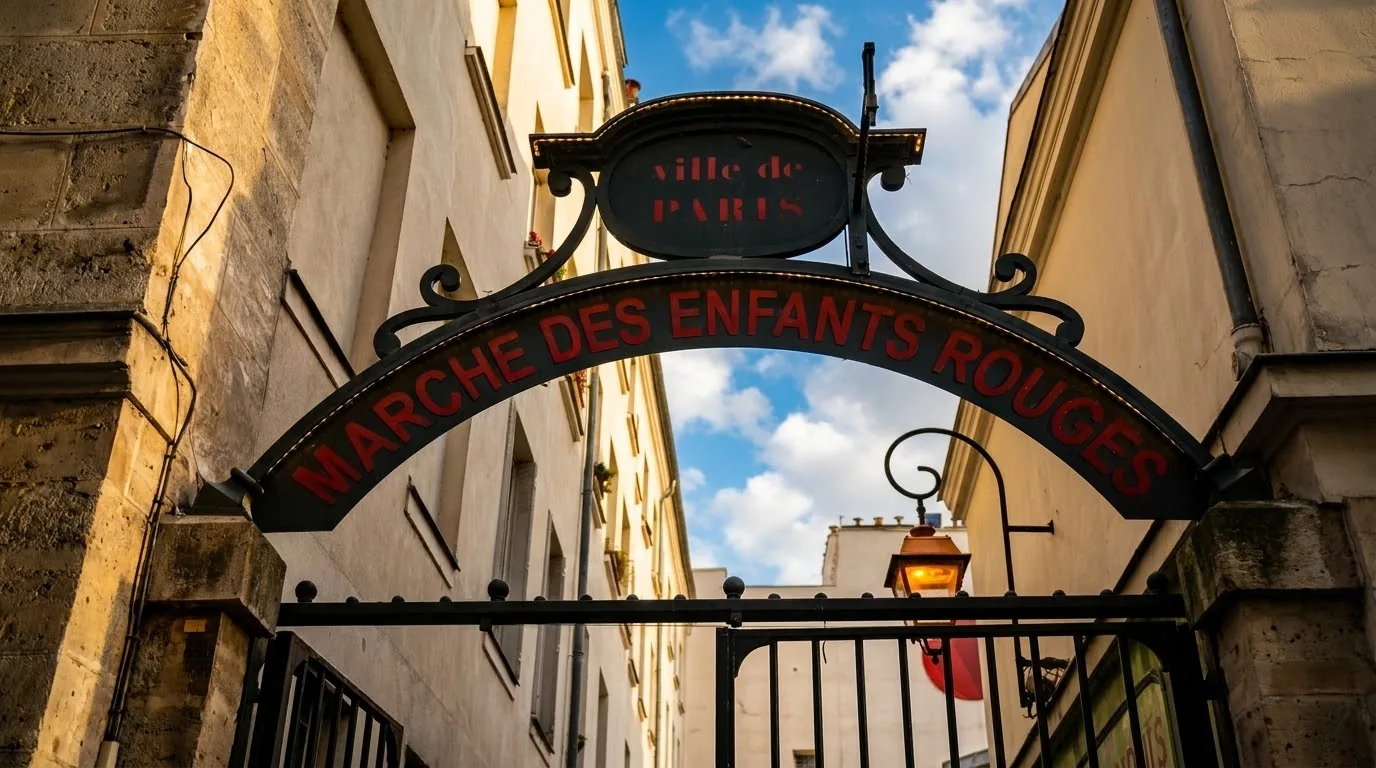
In 1982, the market was declared a protected heritage site, and in the 1990s it was almost demolished to make way for a parking lot. It was saved by the neighborhood’s residents, led by the director Bertrand Tavernier (1941–2021), and the market reopened in 2000 after renovation. Today, it has about twenty vendors, and this is where you should end up: Moroccan, Lebanese, Italian, Japanese and vegetable stalls, with communal tables in the middle.
The market is closed on Mondays. On Tuesdays, Wednesdays, Fridays and Saturdays it is open from 8:30 to 20:30, on Thursdays until 21:30, and on Sundays until 17:00. On weekend afternoons it is very difficult to find a table, so I recommend arriving early, or taking your food and eating it in the Square du Temple garden, which is a few minutes away. You can find more Parisian markets in my article on the markets of Paris.
Where to sleep near the track in the 3rd district
This route was born from the neighborhood where I'm staying in Paris, so my recommendations start with Audi's apartments, all of which are a short walk from the starting point.
-
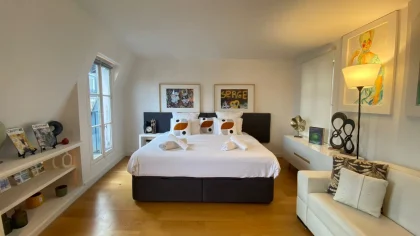
Apartment number 1 near Pompidou
Apartment on rue Simon le Franc, a few steps from the Pompidou Center and a seven-minute walk from the starting point of the route. Modern design, meticulously crafted alongside ancient charm, and suitable for couples or a small family. This is the apartment I try to get every time I come, and I don't always succeed.
-
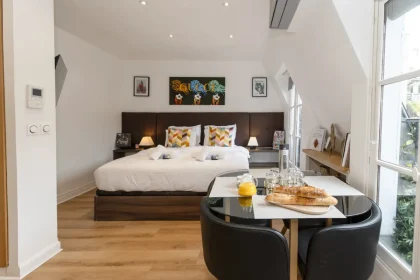
Apartment number 2 near Pompidou
The same building on rue Simon le Franc, an apartment suitable for a small family. A smart space that makes the most of every square meter, right next to the cafes and boutiques of the 4th arrondissement, and a short walk from the first stop on the route.
-
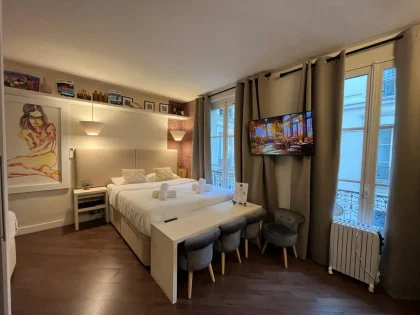
The studio apartment on rue Simon le Franc
The smallest apartment in the building, a bright and tastefully decorated studio with a fully equipped kitchenette. Suitable for a couple or a couple with a child, and allows you to go straight to the track in the morning.
-
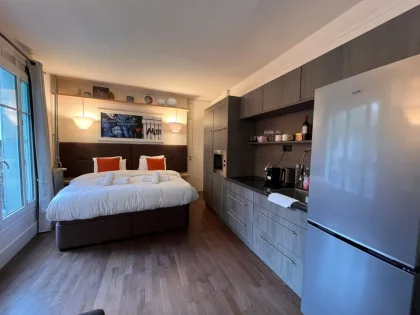
The apartment on rue Beaubourg
An elegant and bright apartment with an elevator, from whose window you can see the Pompidou Center. Air-conditioned and quiet, and from here a few minutes' walk north brings you straight to the Haudriettes Fountain where the route begins.
-
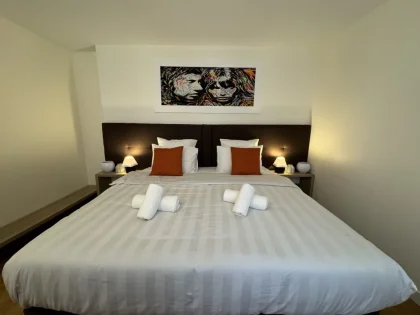
The apartment in Sainte-Croix-de-la-Bretonnerie
The apartment is located on one of the bustling streets of the Marais, but all its windows face an internal courtyard, so it is very quiet. From here you can walk to this route, to the Ile de la Cité, and to the Town Hall Square.
-
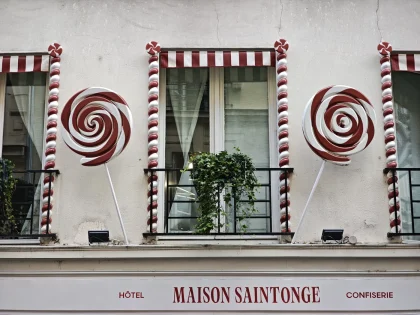
Saintonge House
A 4-star boutique hotel at 16 rue de Saintonge, right on the course, designed in the style of a 1950s candy store. It has 22 rooms and a small candy store where guests can buy candy at any time, and is also within walking distance of the Marché des Enfants Rouges, where the course ends.
Anyone who prefers a hotel, or whose apartments are booked for their dates, will find all my recommendations in articles about hotels in the 3rd District and apartments in the 3rd District.
More hiking trails and attractions in the 3rd arrondissement and Marais
This is not my only route in the district, and if you are planning a few days in the neighborhood, these are the complementary routes:
- Western Mara, which starts at the same point and heads south and west, to the Pompidou, Sainte-Marie and the Hôtel de Ville.
- Marais Quarter for Beginners, among the main attractions, for those who this is their first time.
- Walking route on rue de Turenne, which begins exactly where this route ends.
- Following Madame de Savignier, a historical tour of the northern Mara.
- Culinary tour of the Marais district וPatisserie tour in the Marais, for those who come for the food.
You can find all the district's attractions in the article about attractions in the third arrondissement , and I have compiled a list of all the tourist routes in Paris on one page.
Questions and answers about the route in the 3th district
These are the questions I get the most about the area and this route: