
Matisse's soul thirsted to discover new, more distant, more exotic landscapes, across the sea. And here he was again on the road, his first contact with the East, which he always loved, he said, and to which he was always drawn.
Biskra, Algeria – Back to Childhood
In the spring of 1906, Matisse reached the edge of the desert, to Biskra, Algeria. Matisse spent two weeks in the touristic city of springs, the “Queen of the Desert,” which made a strong impression on him and caused him to return to the hallucinations of his childhood.
I found a magnificent, fresh oasis, with lots of water, winding between the palm trees. The first time I saw the desert, I saw nothing, I was lost in my childhood imaginations and thought about them endlessly. I kept looking towards the horizon to search for the sea. The light, because of the sun, and so it always is, is dazzling.
I got to know myself a little better.
From this journey he brought one picture and several objects, carpets, fabrics, and ceramics, which would appear regularly in his works until the end of his life.


Matisse loved fabrics and textiles and had been interested in their types, colors, and patterns since his youth in the north. In 1889, while he was an intern at a notary's office in the city of Saint-Quentin, he attended the embroidery on fabrics classes every morning at the school of the portrait painter Quentin de La Tour.
In this picture, “Still Life with a Red Carpet,” which is reminiscent of the paintings of Edouard Vierre, each object has its own role. Matisse gave objects importance in his pictures, as he did to people. An intimate, soft, warm and luxurious atmosphere envelops and caresses the viewer. The carpet covering the dresser corresponds with the one decorating the wall, the bowl of peaches sweetens a secret with the fruit plate. In deep and bright colors, a multitude of different objects come to light, a vase, foil, watermelon, a book or perhaps a white cardboard box, a Chinese fan…
In 1907, Matisse exhibited a daring painting at the Salon des Indépendants called “Blue Nude (Memory of Biscara).” The nude woman’s curves correspond with the arches created by the avenue of palm trees.

Louis Vaucel, the influential art critic who coined the word “fauvism ,” did not spare his tongue this time either when he described the picture in the same way: “A naked and ugly woman, lying on blue grass under some palm trees.” Viewers of the exhibition mocked the naked woman’s masculine features, just as they had mocked the “Woman in a Hat” from Hall 7 at the Salon d’Automne two years earlier: the large feet, the biceps, the broad shoulders, the thick neck, the short hair… a woman or a man or both?
Picasso also took the opportunity to make a sarcastic remark about Matisse's skills, but experts say that this picture had a hand in the birth of "Les Demoiselles d'Avignon." It was the last picture that Leo and Gertrude Stein bought from Matisse. The latter was deeply hurt by the hostile attitude this time but continued on his way.
In 1909, Matisse left Paris with his family and settled not far southwest of the capital, in Issy-les-Moulineaux at 92 avenue du Général-de-Gaulle, Issy-les-Moulineaux, to get away from the polluted air and get closer to nature, as his grandson, Marguerite's son, would explain. In the elegant bourgeois house, from the Second Empire period, with a garden of trees, he built a studio and lived there until 1917. An important and productive period in his life in which he painted sixty pictures, among them the famous "The Dance" (1909) and "The Music" (1910).
After Collioure, Isi is where I like to be. The colors, an unattainable substance, are so intense that my paintings are no better than reproductions by comparison.

Spain
In October 1910, Matisse visited the great Islamic Art Exhibition in Munich, which brought together 3500 exhibits from all over the Muslim world. Matisse had seen Islamic art exhibits before, but the Munich exhibition was a unique event in its scope and diversity.
This art is connected to a larger space, a real plastic space. I have received proof again. Everything I see here inspires me, whereas in Paris, under the gray sky, I feel paralyzed.
A month after visiting the exhibition in Munich, in mid-November 1910, Matisse hurried to travel to Spain to continue discovering the East through Muslim-Andalusian art. Matisse visited Cordoba, Granada, and Seville, looking, fascinated, at the porcelain tiles covering the walls, the carpets on the floor, the window blinds filtering the view. The recurring motifs resonated with him.
In Seville, Matisse bought a large sheet of dark blue fabric, dotted with ochre flowers, which allowed him to develop the arabesque motif, which he continued to interpret, in different and varied versions, throughout his life.

Matisse returned from Spain in January 1911. The sheet of canvas, which he brought from Seville, is in the painting depicting his studio in Issy-les-Moulino.

The blue and green highlight the nuances of the pink and yellow, and the entire painting evokes a feeling of comfort and harmony in a world that is perhaps realistic, perhaps supernatural.
In the series of four paintings, which includes “The Pink Studio,” we should also mention “The Red Studio,” from the same year, which depicts the same workshop. The painting, which was initially misunderstood and received coldly, became a landmark in the history of art and influenced many American painters, especially Mark Rothko. Several works by Matisse can be recognized in the painting against a red background. The walls of Matisse’s studio were gray, but the artist chose to dominate the red, with the objects inside, works, sculptures, and furniture, framed in light lines that do not break the chromatic unity. The space created in which the color that became the main thing dominates, in which the objects, which are represented minimally, seem to float, is almost abstract.
Red symbolizes the fire of creation, the intimate world of the painter, a temple where everything merges. All his objects dissolve in red, the viewer becomes, too, the color red. This is a painting about the creative process.
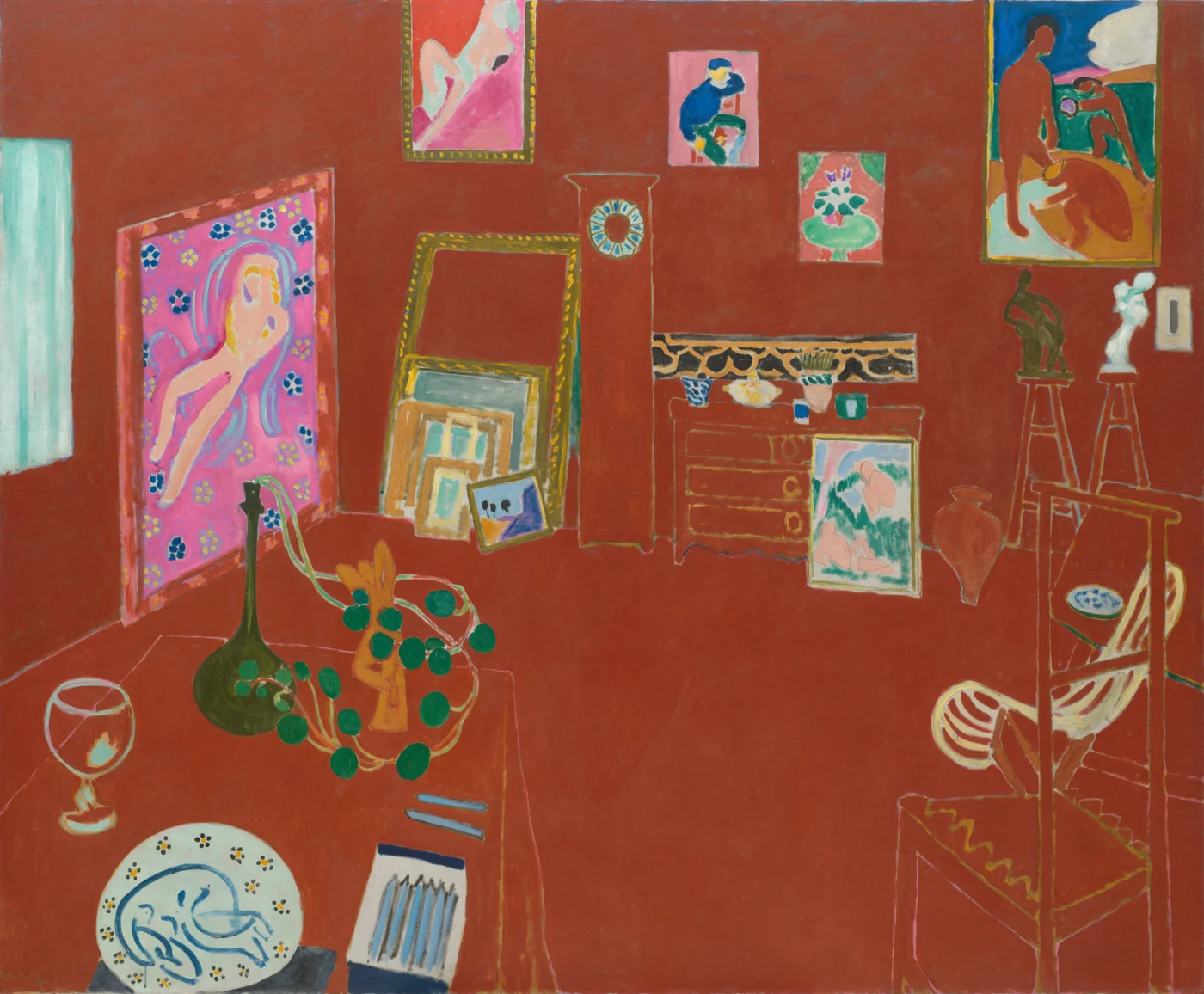
The Red Studio, Museum of Modern Art, New York, 1911
Tangier, Morocco
The 44-year-old Matisse was in distress. Fauvism no longer satisfied him, and in Morocco he hoped to break his shackles and broaden his horizons. At the end of January 1912, Henri sailed with his wife Amelie to Tangier and took up residence in the Hotel Villa de France, which overlooks the city. Room 35, second floor. A flood fell for a whole month, forcing him to stay in the hotel.
After the rain stopped, a wonder of bulb-like flowers and greenery emerged from the ground and all the hills surrounding Tangier, lion's fur, turned green, an extraordinary green. The sky was slightly cloudy, like in a Delacroix painting.

An Englishman living in the city allowed Matisse to paint at his estate, “Villa Brooks.”
I was working in a large garden, in a corner full of thick trees whose foliage climbed higher and higher. The ground was covered with thorns. I had never seen thorns before.
The majestic trees high in the sky, the multitude of magnificent thorns, and the illuminated space that united these two forces of nature, lifted my spirits and excited me.
I painted there for quite a long time, a month and a half, maybe.

Matisse worked on the painting of the thorns for a month and a half without being satisfied. During his sleepless nights, his devoted wife read him stories to calm him down. Amelie had to leave Tangier before him, and so, on March 31, he explained to her in a letter.
I made peace with the painting I had been working on for longer than the others. I understood what had damaged it. The two sunspots on the pine tree broke the momentum of the lines and killed the light green, almost yellow, tree in the background. Without the spots, the painting would have been much larger.
What a pity I didn't see this before... If I had noticed, I wouldn't have been so discouraged before you left. You should know that after bouts of despair comes improvement. I must understand myself in order to live.
When he returned home in early April, he was again dissatisfied with the painting. In the winter of 1913 he returned to Tangier with the intention of fixing it. But everything in the familiar landscape now seemed small to him. The sublime sensations were in the painting, not in the trees. Matisse needed a second encounter to reach an insight.
From his first stay, from January to April 1912, he returned tormented. The feelings that nature aroused in him caught him in a stranglehold, and it took him tiresome efforts to free himself from its embrace. In sadness, Matisse painted.
The second stay, from October 1912 to February 1913, however, brought him the longed-for calm. Matisse returned satisfied. His contact with the landscape and the inhabitants lifted his spirits and made him happy. The memories of the oriental motifs, colors and light served him well for a long time afterwards.
Matisse also walked around the city, not only in nature, and was impressed by the light refracting at special angles on the whiteness of the buildings. A mosque and tomb of a Muslim theologian in the Tangier casbah are in a picture called “The Moorish” (Western, originally “a man living in a ribat,” i.e. in a fortified mosque, and today a word that denotes a sage-monk-saint as well as the mosque in which he lived and the tomb in which he was buried).

Hearing the sounds of a violin coming from a small café, Matisse wanted to meet the violinist and went inside. To surprise the musician, he took the violin from his hands and impressed the audience with his playing (Matisse had learned the violin as a child and practiced it afterwards). This pleasant and intimate moment of camaraderie with the locals gave rise to one of Matisse's most notable paintings in Tangier.

The refinement and refinement of the lines reaches its peak. Those seated in a kind of aquarium, united in their serenity, are depicted neither in detail nor individually. Each of them resembles the other, the skin in ochre, the clothing in gray and white. What is important is the pose that says peace, the same peace that Matisse longed for so much and found, after suffering, in Tangier.
Among the twenty paintings and numerous drawings that Matisse brought from Morocco, a special place is occupied by the work he called the “Moroccan Triptych”: “View from a Window” on the left, “Gate of the Kasbah” on the right, and “Zora on the Terrace” in the center.


At the center of the triptych is Zora, Matisse's main model in Tangier. Zora was forbidden by Moroccan police order to leave the brothel where she was imprisoned. Matisse therefore went there every morning to paint her on the terrace, which is barely visible in the picture.
The young woman sits on a carpet in a Muslim prayer posture. Zora is depicted as a saint levitating above a carpet, with the censers and aquarium on either side accompanying her as ritual paraphernalia. The blue-green background creates a sense of water or sky in which the figure and objects float. The spirituality of the figure is further emphasized by the placement of the panel dedicated to her in the center of the triptych. Matisse specifically stated that the three panels should be presented in the order he specified.
While the world sank into the dark abyss of World War I, Matisse retreated into his own world, filled with his impressions of Tangier, and painted “The Moroccans.”

The painting called “The Moroccans” represents the beginning of my expression in shades of black and their contrasts. It’s hard for me to describe it in words. Figures of Moroccans lying on a terrace with watermelons and pumpkins.
The Orientals used black as a color. The Impressionists removed black from their palette and I brought it back and gave it an important place. Because black is not only a color but also light. The discovery came to me, then, from the East.
“Window in Tangier or Matisse’s Morocco”
Nice
Matisse took that beloved East with him starting in December 1917, when he slowly settled in Nice.
At first I lived at the Hotel Beau Rivage (literally: Beautiful Beach, A.L). When I returned to the city the following winter, I lived at the Hotel de la Mediterranee (literally: Mediterranean Sea, A.L) to which I returned every winter, from October to May, for the next five years. After that I rented an apartment on the Place Charles Felix, on the top floor, overlooking the market square and the sea.
A beautiful area, Nice, what a soft and gentle light despite its brightness. When I realized that every day I would come back and look at it, I could not believe the happiness that had fallen upon me. This is a region in which light plays the main role. Color comes later. But it is the color, of course, that allows the light to be translated.

Matisse painted this picture in April 1918 from the balcony of an apartment he rented for a few weeks. The azure-blue bay, with palm trees at its edges, takes up most of the space, light and color, with the window sill on the right delimiting them in a straight line.
The room at the Hôtel de la Mediterranee, where Matisse stayed from 1918 for four winters, became a workshop that he decorated with accessories for the many paintings he made there. The room, in its old-fashioned style, charmed him with its terracotta tiled floor, arched window, shutters that softened the light, and intimate atmosphere.
A good old hotel, of course! And what beautiful Italian-style ceilings! What beautiful floors! It was a mistake to demolish the building.
I stayed there for four years because I enjoyed painting there. Remember the light that came through the blinds? From below, like a theater stage. Everything was imaginary, absurd, amazing, delightful.


An intense theatrical atmosphere permeates the work “Women on a Sofa or The Sofa.” The viewer looks at it as if from the stands of an Italian theater. The red curtain, striped with black, resembles a screen. The oval mirror with a swan’s neck echoes the backrest of the chair. The same Venetian mirror is encountered in other paintings.
The picture is organized around the large window of the room, which is painted in its entirety, on the curtain, the windowpane, and the view of the trees and sea seen through them, uniting the inside and outside. The two women are sketched with basic lines. The woman reclining on the sofa, with raised hands holding a book, repeats the pose of the figure represented in the picture hanging above her. A painting within a painting.
Don't be mistaken. The abundance of details is not there to drown the viewer but to create a harmonious composition, which translates the emotions of the painter. All the elements are arranged decoratively and each of them has its own importance, whether primary or secondary. Not a single comma is superfluous.
Matisse eventually broke away from the picturesque hotel and rented an apartment at 1 Place Charles-Felix, initially one apartment on the third floor of the building and then a second apartment on the fourth and top floor. Two interconnected rooms on the third floor served as his workshop.
Immersed in the Mediterranean light of the city, the workshop was filled with carpets, fabrics, curtains, blinds, ceramic vessels, copper vessels, kaftans, tassels and more that he had brought from the East. Until now, they had been in his home in Issy-les-Moulinos. An armchair, a stool, a mattress, cushions, on a stage that he placed and took down for the various sets, completed the effect of the theatrical scene.
In this way, the artist created a world within a world that allowed him to continue his journeys through memory, nostalgia, and dreams. In this way, he also joined the lineage of Eugène Delacroix and Jean-Auguste-Dominique Ingres, the 19th-century painters he admired.
Objects are like actors. A good actor can act in ten plays. One object can play a different role in ten different pictures.
The more he traveled, the more he frequented antique shops and flea markets, the more Matisse expanded his “working library,” his collection of numerous objects, but this habit was not new. The Venetian look, for example, in the Rococo style had already served him in the severe paintings of 1914 and now played a different role in the paintings of the imaginary harem. Matisse’s collections can be seen in the Matisse Museum in Nice and the Matisse Museum in Cateau-Cambrésie.
In the paintings of the harem in Nice, however, Matisse made extensive use of combinations of decorative elements, from different styles, in different roles. Here the perforated partition seems like a window or illuminated stained glass, there it appears as a sealed door.
In this workshop, the artist dresses his models in the clothes of harem women, a subject he will deal with for more than a decade.

I saw them in Morocco, and so I was able to depict them in my paintings, without falsification, after I returned to France. Look at them carefully, the women of the harem! A triumphant, blazing sun, taking over colors and shapes. But the oriental interior design, the splendor of the fabrics and carpets, the rich costumes, the sensuality of the heavy, sleepy body, the slackness of the gaze in anticipation of pleasure, all the grace of the siesta at the height of the intensity of the arabesques and colors, must not be mistaken and deviate from the main point.
The anecdote for the sake of the anecdote – not my business. The painting for the sake of the painting is my business. Under the light of the dulling sun, in which the figures and objects are, is born in secret, lurking, waiting to be discovered, the great tension between the various components of the painting. This is the main thing.
The great tension of the painting in the Women of the Harem series is the relationship between the model and the background. Matisse, who attributed equal importance to the human figure and the decorative motifs in organizing the picture, debated the issue. Should he contrast the model with the background, creating tension between the two subjects? Should he highlight the woman in her languid sensuality and blur the fragile background? Or, conversely, reduce the description of the woman to a few lines and emphasize the rich setting? Or perhaps even reduce the tension between the two subjects, in one way or another, unite the woman and the background, for example, dress the model in clothing details that repeat the motifs around her? Each element in the composition has its own role, but some have a primary role and others a secondary role.
Matisse invited his viewers to participate in his deliberations, to share with him the experience of painting, to take an active part in it, to enter the picture and complete it. Matisse did not paint his female models realistically because, as he said, “I do not create a woman, I paint her.” Matisse adopted Delacroix’s statement: “Accuracy is not truth.”

The model reclining on a sofa is dressed in harem clothes, which highlight the generous curves of her body. Her numerous jewels create an impression of splendor and grandeur, emphasized by the two rich wall fabrics. The flowers in the vase placed on the stool between the sofa and the wall seem to be swallowed up in the waves of the floral motifs of the fabrics. Real flowers and decorative flowers merge into one continuous sequence. The flowers in the vase placed on the table on the left side of the picture, on the other hand, stand out with their yellow-white brilliance, against a dimmer background. Next to them is a still life – a jug and a bowl of fruit.

There are countless versions surrounding the women of the harem… The painter’s main model, Henriette, who was a dancer, actress and musician, in addition to being Matisse’s model for 7 years, loses her characteristics, is swallowed up in the picture, sinks into anonymity. Sometimes doubled, two women of the harem, or even more for the sake of games of symmetry and contrasts of poses. The woman of the harem becomes interchangeable, doubled, objectified, but only in painting, of course. Warm relations of friendship and appreciation prevailed between Henri Matisse and his models. Always.


And again distress
Among the paintings of the women of the harem, Henri and Amelie Matisse lead a fairly bourgeois lifestyle of an established artist and his wife. More than thirty years have passed since their wedding. Henri, who has just turned 60, is at the height of his fame and free from financial worries. Not only can he now buy warm clothes for his family but also numerous real estate properties… and he does not have to sell a house he already owns when he desires to buy a new one.
But Matisse's mood depends on his art. Henri sinks again into black bitterness, into a deep existential crisis. The magic of the harem women has expired. The ecstasy has faded. Nice is no longer new. The sources of inspiration have closed, ended. How will he renew himself? As always, Matisse will find a solution in an intermittent journey that he habitually takes towards the unknown. And this time to the other end of the world. What color will the light be in Polynesia?
This concludes part two of the article.
This article is the first in a series of four articles about Henri Matisse.
To read Part 3, click on this link.
More on the subject
Miriam Puri:
How beautiful this article is! And I love the quotes from Matisse that you bring. Wonderfully done, I feel like I'm at an exhibition at the Grand Palais in Paris! I'm not exaggerating, this is how you organize an exhibition, excellent! Your article filled me with joy and I thank you very much.
Caesarean age:
You continue to enrich us.
Benzi Goren:
Thank you very much for another wonderful post.
Frida Lieberman:
Great pleasure, as usual.
Deborah Avigur:
I read with eagerness and pleasure.
Kochva Peled:
Detailed and interesting. I really enjoyed it.
Ruth Shimoni:
Stunning article.
Hannah Sharon:
Thank you, Orna. Wonderful!
Addicted to Matisse's paintings from the Tangier and Morocco period.
Sophie Rakhlenko:
I really enjoyed the colorful, spectacular article, which enlightens the eyes and broadens the mind. In a review of Matisse's many travels, while analyzing the works, Dr. Orna Lieberman manages to convey the charm of the East to which he was drawn, shares his hesitations, and in all of this brings the viewer closer to understanding his motivation to constantly seek new ways of expression and not stay in place, so to speak. And since while reading, I felt that I already knew the author more closely, I also want to thank her personally, so thank you very much, Orna!
Orna Lieberman:
A thousand thanks for the moving response.