

For 500 years, Leonardo da Vinci has been a source of contention between Italians and French people – some claim his Italian identity and others claim his affiliation with the Kingdom of France. The reality itself is of course complex: the genius Da Vinci, who during his life was engaged in painting, sculpture, architecture, engineering, the invention of weapons of war and aviation, the study of anatomy and more, was a nomadic man. He began his artistic career in Florence, and even competed head-to-head with Michelangelo, but continued onward following sponsors. In Milan, he worked for the Sforza family and designed weapons (he actually invented the tank). There he also painted his famous 'Last Supper', on the wall of a church.
Milan was occupied by the French and Leonardo moved between Metova, Venice and other cities, carrying out projects for various rulers. The life of an ambitious genius during the Renaissance was not easy. He returned to Milan, which was under French control , and worked there for seven years, after which he was called to serve the Medici Pope in Rome, but this only lasted two years. In 1516, da Vinci left Italy and joined the retinue of King Francis I of France . This made him the court painter, gave him a stipend and the freedom to work and research as he pleased. This is how Leonardo spent his last years. In 1519, he was in the castle of Clos Lusa in the arms of the king, so it is said. It could be said that Leonardo's genius was discovered in Italy, but it was France that gave him peace, and since then there has been a certain animosity between the countries on this basis.

A painting by Ingres depicting the death of Leonardo da Vinci in the arms of Francis I. Image source: Wikipedia. This year marks the 1th anniversary of Leonardo da Vinci's death and the main and largest exhibition is scheduled to open in November atLouvre In Paris. It may sound simple, but many difficulties arose along the way. The Mona Lisa, a painting that occupied Leonardo for years and humanity for centuries, is on display at the Louvre inParis As part of the assets Leonardo left after his death in France. In 1911, an unknown person from Perugia stole the Mona Lisa from the Louvre. It was not a very complicated operation because the means of protection were minimal, but the search for it took years and it was he who turned the painting into the cultural icon we know today. When he was caught, the man said that all he wanted was to return the Mona Lisa to its home – Italy.
To this day, the Mona Lisa is displayed under heavy guard in the Louvre, but in Italy there are those who are not giving up and hope to “bring it home,” as they say.
Salvator Mundi, the painting that broke all sales records
Strange as it may sound, there are only 21 oil paintings that are universally agreed to have been painted by Leonardo. There are many reasons for this: Leonardo experimented with color, some of which did not turn out well; his extensive travels left a trail of works in unexpected places; and the fact that Leonardo's creative process was longer than usual - he worked on some of the works for years, returning each time and changing one detail or another, color or element. At the same time, it is inconceivable that he created so few paintings, and therefore the prevailing opinion is that there are some that simply have not yet been discovered or identified as the fruits of his brush.
Such is the story of Salvator Mundi – a painting that sold for $58 as an unidentified painting from the Renaissance period, which underwent a long process of cleaning, conservation and in-depth investigation, until they managed to reach a consensus that it was a real Leonardo da Vinci (along the way, it changed hands several times and starred in a high-profile trial, but that's for another post). Two years ago, after a brilliant marketing process by Christie's, 'Savior of the World' was sold for a record price – $450 million! This is the highest price ever paid for a work of art.
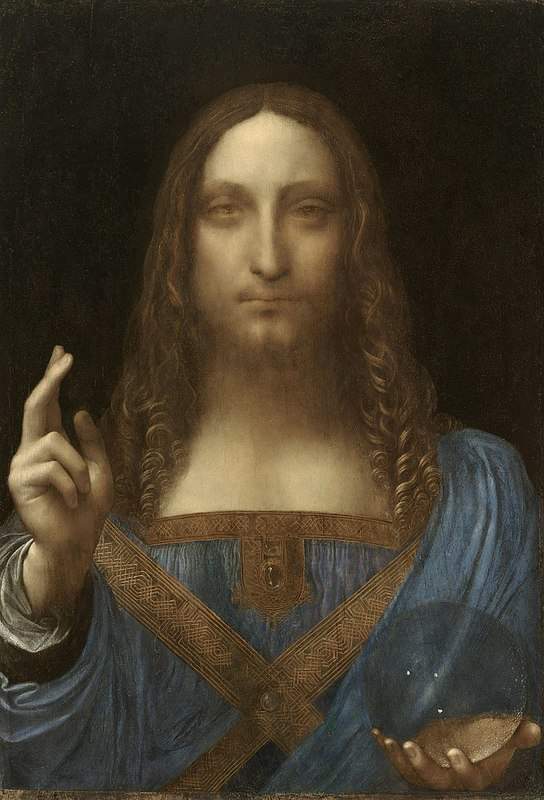
The mysterious buyer is a close associate of the Saudi royal family and was intended to be displayed at the opening of the Louvre Abu Dhabi in September 2018. In fact, traces of the painting disappeared for a while and it was unclear where it was and who owned it. It later turned out that Salvator Mundi was sailing on a luxurious and enormous yacht owned by the Saudi prince in the warm waters of the Mediterranean, not exactly ideal conditions for an oil painting that celebrated its 500th anniversary (compare this to the strict conditions of the Mona Lisa and you will understand).
Salvator Mundi is among the works that were supposed to participate in the major exhibition at the Louvre, but recently Louvre experts began to raise doubts about the painting's authenticity and decided to present it as a work from Da Vinci's workshop. Of course, this could greatly damage the painting's value, and therefore the owners decided not to lend it to this exhibition. Too bad. I can attest that even if it is not a 100% Leonardo work, it is an impressive painting and I really enjoyed seeing it in the grand tour that Christie's gave it before the sale.
Will the virtuous man be hosted at the Louvre?
Another work that is not clear whether it will make it to the Louvre exhibition is a drawing of the famous Vitruvian Man, who set the standard for ideal human proportions. The drawing is held by the Accademia Gallery in Venice, and the Louvre requested to loan it in advance. In recent months, a group called “Our Italy” petitioned the court demanding that the drawing not be released due to concerns for its safety during the complex journey. It must be understood that for 500-year-old paper, any movement, uncontrolled exposure to light or humidity, could cause irreversible damage.

In addition, they claimed that even if it were returned to Venice, they would not be able to display the painting for a long period of time in order to restore it, thus supposedly favoring visitors to the Louvre over those at the Academy. Of course, the dispute has deeper roots. A junior minister in the Italian government even spoke out on the subject, saying: “There are many things that the Louvre Museum needs to return to us, even beyond the old dispute over the Mona Lisa.” The court ruled that the painting would not be lent, but at the moment the issue has become more controversial and may require political intervention.
And what about the Mona Lisa? Well, the longtime resident of the Louvre will not actually participate in this historic exhibition. It will continue to reside in its regular exhibition hall, where it can be viewed at no special cost, unlike the exhibition, which will involve a special fee. Who said equality, liberty, and fraternity?
Click here to buy tickets to the exhibition
For updated information on additional exhibitions in Paris, click here.
A few words about Shlomit Oren
Shlomit is the owner of the blog so-art, which she started while studying at Sotheby's in London. She also writes for Portfolio magazine and assists individuals and companies in purchasing works of art. You can also join her guided art tours of museums and galleries and learn the stories behind the art.
More on the subject