
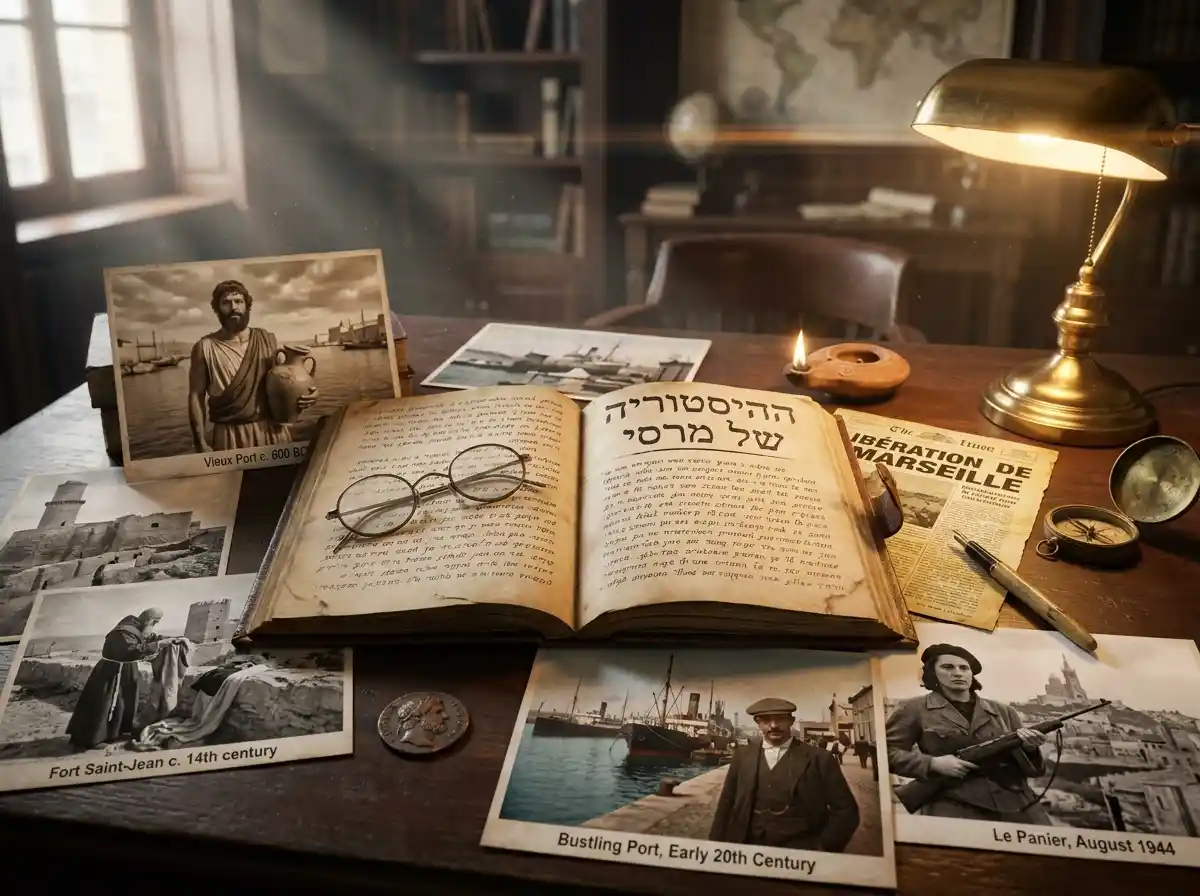
in short
- Around 600 BC: Greeks from Phocaea found Massalia on the Gulf of Halkidoni, present-day Via-Pora.
- 49 BC: The city supports Pompey, Julius Caesar berates it, and it loses its independence.
- Around 415: Jean Cassian establishes the Abbey of Saint-Victor, one of the first monasteries in the West.
- 1252 and 1257: The peace treaties subordinate Marseille to Charles d'Anjou and leave it some of its rights.
- November 1423: The forces of Alfonso V of Aragon plunder the city and steal the port chain.
- 1660: Louis XIV conquers Marseille and builds two fortresses whose cannons are aimed at the city.
- 1720: The ship Grand Saint-Antoine brings the last plague to France, and about half the city dies.
- 1943: The Germans blow up 1,500 buildings in the Saint-Jean district, and 50 streets are wiped out.
Marseille is the oldest city in France, and it is also the French city that has been most frequently tried to be wiped off the map. The Greeks founded it around 600 BC, the Romans besieged it, the Franks sacked it, the Vikings raided it, the Catalans burned it, a French king pointed cannons at it from two citadels, a plague killed about half of its inhabitants, and the Germans blew up an entire district in the heart of the city. It is still here.
The gap between what happened in Marseille and what is said about it is, in my opinion, one of the biggest in France. Ask an Israeli traveler where the name “The Marseilles” came from, and chances are he will tell you that the song was written there. It wasn’t written there.
So before we get started, let's talk about what you'll find in this article. I start with a wedding where a Gallic princess chose a Greek sailor, move on to Julius Caesar's siege, the four days when Catalans stole the harbor chain, the fortress whose cannons were pointed inward, and the ship that brought the last plague to the harbor in France. From there, to the song that gave the city its name, to the district that was wiped out in February 1943, and to the Marseilles of today. If you're planning an actual visit, you might also want to read the Marseilles tourist guide.
600 BC: The wedding where the stranger was chosen
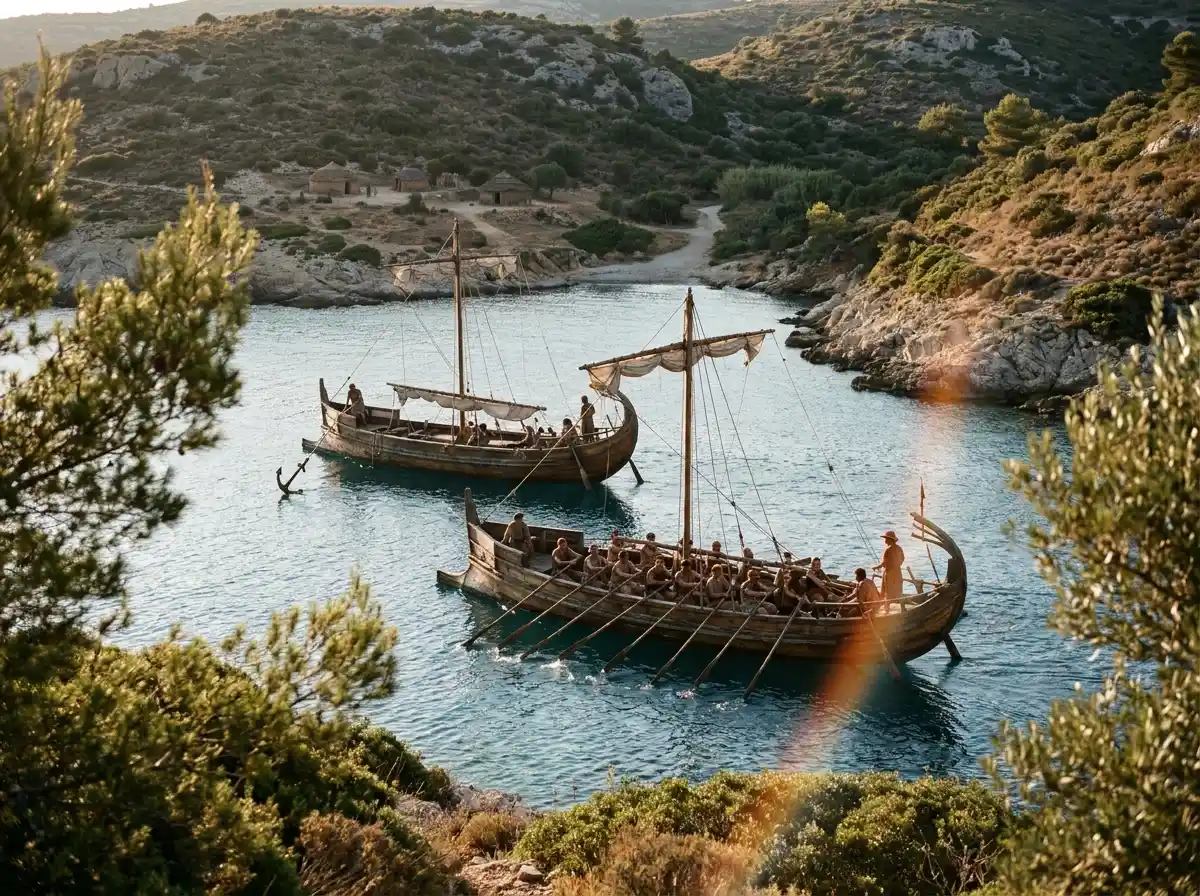
It all started because of bad soil. Phocaea, a Greek city in Asia Minor, sat on a narrow, infertile strip of land, and its inhabitants made their living from the sea: fishing, trading, and even a little piracy. One of their patrols reached a small, sheltered bay on the Gallic coast, a bay called Lacydon, which is today's Vieux-Port, the old port.
This is where the legend begins, and it comes to us in two versions. The fleet commanders, Simos and Protis, approached Nannus, king of the Sagubri tribe, and asked permission to settle. According to tradition, Nannus held his daughter’s wedding on that very day, and according to local custom, the bride chose her husband herself by offering a cup of water to the man she wanted. The daughter passed by all the local suitors and offered the cup to a Greek. In Aristotle (384–322 BC), the bride’s name is Peta, and in the Roman historian Justin, it is Gyptis. Either way, the dowry she received was the beach on which the ship landed, and on which Massalia was built.
Archaeology confirms the dating and teaches that the Greeks arrived in a populated area and formed alliances there. A legend about a marriage between a Greek and a Gaul is exactly the story that wins for a group that wants to explain to itself why it deserves to be there.
Massalia grew rapidly, and from the 5th century BC it was one of the two main trading ports in the western Mediterranean, alongside Carthage. It was headed by an assembly of 600 elected citizens called Timooks, from which came a board of directors of 15. The most fascinating figure of the period actually came from the city: Pythéas, a seafarer and astronomer from Salium, sailed in the second half of the 4th century BC through the Pillars of Hercules and north, described Britain, reached the line where the sun does not set, and reported on a “frozen sea” that was impossible to sail. His text is also the oldest to link the tides and the moon.
49 BC: Marseille chose the losing side
The alliance with Rome lasted more than 400 years, and everything changed during the civil war. When the conflict between Julius Caesar (Jules César, 100–44 BC) and Pompey (Pompée, 106–48 BC) broke out, Marseille chose Pompey, and this was a completely logical choice: in 77 BC Pompey had granted them the territories of the Volsci west of the Rhone. But Caesar was on his way to Spain and needed passage. The negotiations failed, and the city closed its gates to him.
Caesar himself continued on to Spain, leaving command to Caius Trebonius (died 43 BC), with three legions, siege towers, and a naval blockade. For the main naval battle, on 27 June 49 BC, the Romans hastily built 12 ships near Arles from greenwood, which made them slow and almost impossible to maneuver. They won nonetheless, and the siege lasted until 25 October.
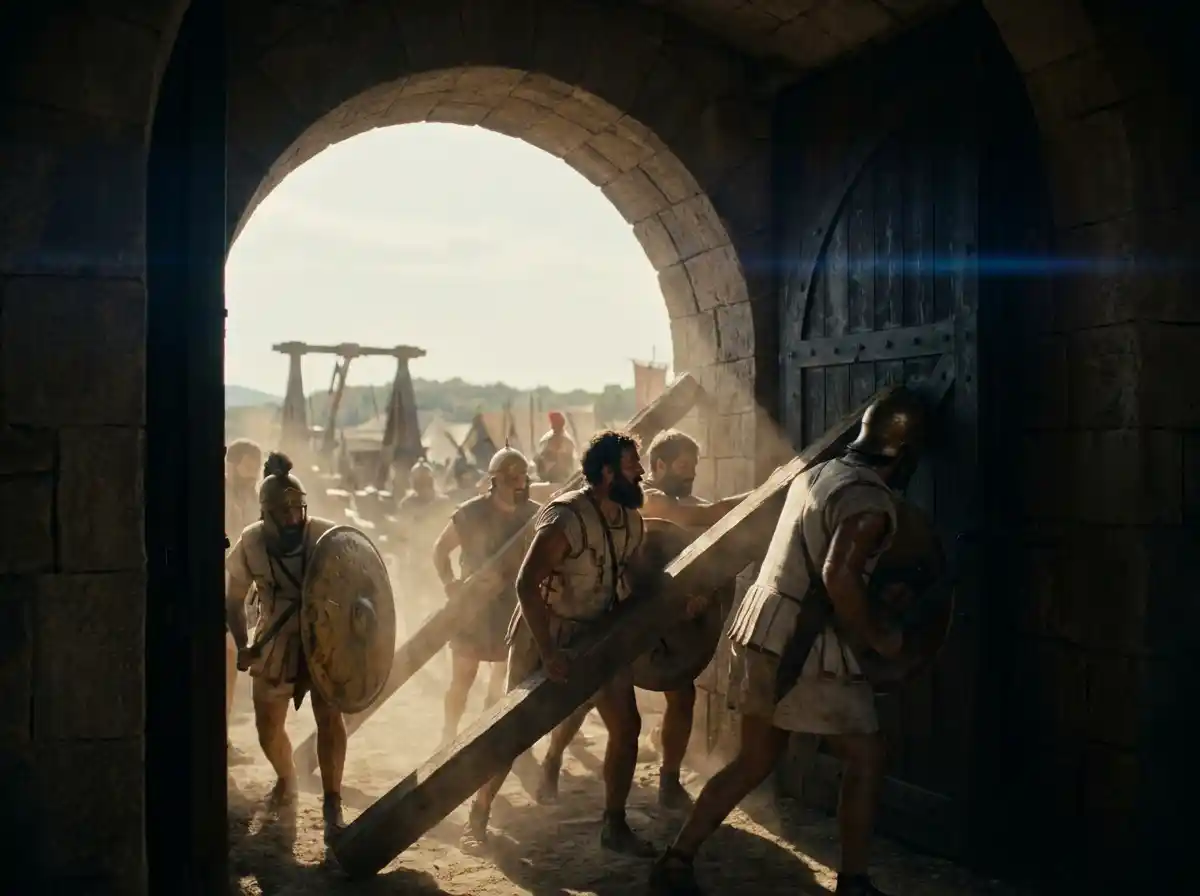
What happened next teaches us something about Caesar. He did not allow the city to be plundered, probably because of its old friendship with Rome, but took everything from it except its honor. Massalia lost most of its territory and colonies, kept Nice and the Stoic islands, and remained a free city without the right to conduct an independent foreign policy. In short, under Rome, Massalia lost its de facto independence. However, at the same time as losing its political independence, Massalia enjoyed an intellectual flourishing and became a city of teachers, known for the quality of its teaching in rhetoric, law, and medicine.
415 to 1040: The Monastery, the Franks, and the Vikings
At the beginning of the 4th century, according to tradition, a Christian officer named Victor was executed in Marseille, and around his tomb arose a century later the spiritual turning point of the city. Jean Cassien, who was born around 360 on the banks of the Danube and spent years with the hermit monks in Egypt, arrived in Marseille around 415 and founded two monasteries there, one for men and one for women. The church of Saint-Victor dates from 440. Cassien wrote there the “Institutes” and the “Discourses,” two works that shaped the entire Western monasticism. He died in Marseille around 435 and was buried there.
From then on, things got less pleasant. Between 736 and 739, the Franks of Charles Martel (d. 741) captured Marseille and plundered it, and between 751 and 768, the church's property was confiscated. In 838 and 848, it was raided by Saracens, and in 859 by the Vikings of Hastings, who had come from Nantes and spent the winter in the Camargue. The result was an almost complete retreat: in the 9th century and the first half of the 10th century, Marseille almost ceased to function as a trading port, and Arles, which was better protected and served as the capital of Provence, received maritime traffic.
The recovery came from the least expected direction. In 904, Louis the Blind (King of Provence from 890 to 928) granted Saint-Victor the entire southern bank of the port, marking the beginning of a monastic empire. In 977, the first Viscount of Marseille appeared, and on October 15, 1040, Pope Benedict IX consecrated the abbey church in a ceremony that gave it the title of “Second Rome.” Where there was hardly a city left, the great economic power of Provence arose.
13th to 15th centuries: Republic of merchants, then lord
At the beginning of the 13th century, Marseille was almost a city-state. In 1212, the “Confraternity of the Holy Spirit” (confrérie du Saint-Esprit) was founded, an organization of merchants and craftsmen that gave the city a kind of self-government. In 1221, a podesta was appointed as its head, just like in the Italian communes, and it declared itself a republic.
The end came with Charles Ier d'Anjou (reigned in Provence from 1246 to 1285), brother of King Louis IX, who received the Countship of Provence in his marriage to Beatrice of Provence (1234 to 1267) and found large cities in no hurry to recognize him. In August 1251, he besieged Marseille, and in 1252 it surrendered. The agreement signed on July 26, 1252, was called the "Chapters of Peace" (Chapitres de Paix), and on June 6, 1257, a second and much stricter version was imposed on the city, in which Charles became lord of the city and himself appointed the commissioner at its head. The inhabitants nevertheless retained an impressive list of rights:
- The right to assemble, bear arms, and elect some of the officials
- Taxation only with their consent
- Right not to be tried outside the city
- Exemption from customs and transit fees throughout Provence
- Right to mint currency and appoint consuls in foreign cities
It sounds like a lot, and it really was a lot. It was also the end of independence. Three residents who called on their city to oppose the agreement, Brito, Anselm, and P. Vetuli, were sentenced to exile.
November 20, 1423: Four days, and a necklace still in Valencia
The conflict that destroyed Marseille was not hers at all. It was over Naples. Jeanne II (r. 1414–35), the sonless Queen of Naples, adopted successive heirs: first Alphonse V of Aragon (r. 1416–58), then Louis III of Anjou (r. 1417–34), who was also Count of Provence. Realizing that he had lost, Alphonse decided to return to Aragon in October 1423. Along the way, he wanted to collect something from his rival’s allies.
Marseille knew he was coming, because his fleet had been seen at Nice and then at Toulon, but it had sent a large part of its force to support Louis III's Italian campaign and remained half-disbanded. On 18 November, scouts on the hill of Merceiber and the hill of La Garde spotted the Aragonese fleet: 18 galleys and 12 ships. On 20 November, a first force landed in the bay west of Saint-Victor, captured the abbey and the chapel of Saint-Nicolas, and after dark took possession of the heavy chain that closed the mouth of the harbour. The Maubert Tower, which stood where the King René Tower in Fort Saint-Jean now stands, held out, but the chain broke and the galleys entered.
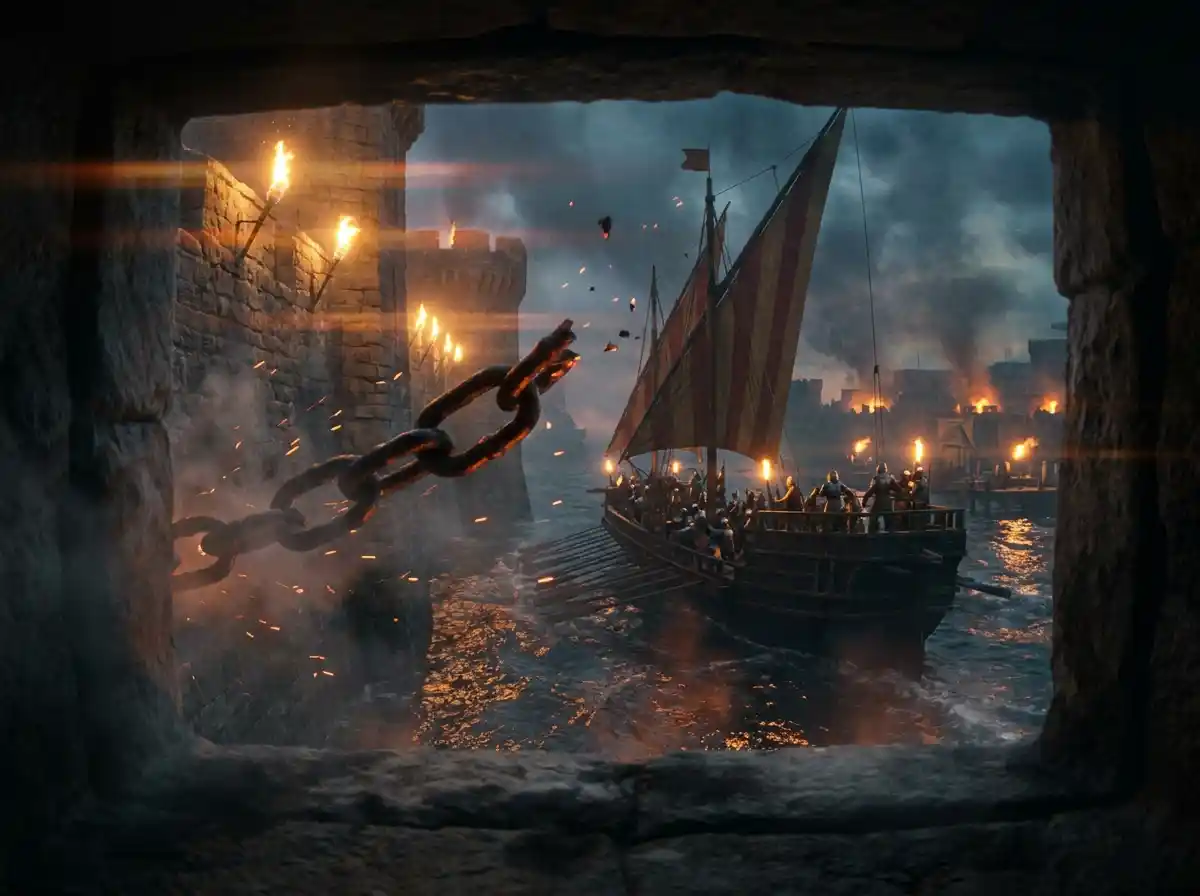
On 22 November, troops from Aix-en-Provence arrived to help, but their colours were the same as those of the Aragonese, and the Mercians thought they were enemy reinforcements and panicked. Aix changed its colours following the incident. On 23 November, Alfonso gathered his men, and at the end of the month he set out for Aragon with the spoils: the relics of Saint Louis of Anjou, Mercian prisoners, and the two parts of the port chain. The city's troubles did not end with his departure, as local rioters continued to loot the ruins, and order was only restored on 12 December.
The necklace was never returned. It hangs to this day in the chapter house of the Valencia Cathedral in Spain, and the people of Marseille continue to demand its return. On June 24, 1956, the diocese of Valencia made a small gesture and returned two vertebrae of the saint, which had been placed in the church of Saint-Préhol. A necklace, as we know, is more difficult to divide into symbolic parts.
1481 to 1688: The Women on the Wall, and the Citadel That Turned Inward
In 1481, Provence passed into the hands of France, and Marseille set a condition: the peace treaties of 1252 and 1257 would be recognized by the kingdom. The condition was accepted without debate, and every king who visited the city from then on was required to renew the oath before entering through the Porte Réale.
The next test came in 1524. Charles III de Bourbon (1490–1527), the Count of France who had sided with Emperor Charles V (1519–1556), invaded Provence. Aix surrendered without a fight on 7 August, leaving Marseilles. The siege lasted from 19 August to 29 September, and the inhabitants filled the breaches in the wall, cut through the tunnels dug by the imperialists, and repelled the assaults until the forces withdrew to Italy.
The women are the ones who have survived this story. According to tradition, they worked at night on the canals, and in three days they completed a work estimated at 15, which is why the excavation was called the “Ladies’ Canal.” Apparently, their part was in strengthening the walls rather than in the fighting itself, and the poets who wrote about it later tended to exaggerate. The municipality nevertheless commemorated them, and on August 7, 1805, the street that descends from the Aix Gate to the sea was given the name Boulevard des Dames. In those years, the Château d’If was also built, by order of François I (king from 1515–1547), on a small island opposite the harbor.
Then came Louis XIV. After a decade of unrest, a popular uprising broke out in Marseille in 1658 against the king’s imposed Consulate, and this time the response was overwhelming. On January 19, 1660, the king wrote to the Duke de Mercœur, governor of Provence, ordering him to occupy the city and build a fortress there. Two days later, some 7,000 soldiers entered, destroyed the Porte Royale, disarmed the inhabitants, and suspended the city council.
On February 11, the cornerstone of Fort Saint-Nicolas was laid. On the stone was engraved a text that should be read slowly: “Lest faithful Marseille, which too often falls victim to the criminal riots of individuals, should lose the city and the kingdom, whether through the ardor of their audacious zeal or through an excessive desire for liberty.” The engineer was Louis Nicolas de Clerville (1610–1677), and the work was completed in four years. The guns of the fort, as well as those of Fort Saint-Jean opposite, were aimed at the city and not at the sea.
On March 2, the king entered Marseille through a breach in the wall opened by his cannon fire, refused to accept the keys to the city, and remained there for five days. Vauban (1633–1707), who visited the place 15 years later, wrote of the fortress as “the most magnificent collection of everything that ever occurred, from the absurd and ridiculous, to the minds of the worst engineers in the world.” Compensation came in money: in 1665 the galley arsenal was built and the area of the city increased from 67 to 195 hectares, and on October 5, 1688, Jean-Baptiste Colbert de Seignelay (1651–1690) signed an order that regulated the production of soap, banned animal fat and required pure olive oil. Thus was born Marseille soap (savon de Marseille) as a protected brand, almost three centuries before the concept was invented.
May 25, 1720: The ship that brought the plague
The Grand-Saint-Antoine was a three-masted merchant ship owned by a Marseilles native. She left the city on 22 July 1719 for the usual route to the Levant: Smyrna, Larnaca in Cyprus, and Sidon in Lebanon. From there she loaded 300,000 pounds worth of silk and cotton, destined for the Beaucaire Fair of July 1720. Ownership of the cargo was divided into four quarters, one of which was held by Jean-Baptiste Estelle, the first patron of Marseilles. Another quarter was held by the captain himself, Jean-Baptiste Chataud (1681–1728). In other words, the people who were to decide on the length of the quarantine had a direct interest in keeping it short.
On April 3, a Turkish passenger died on board, two days after boarding, followed by seven sailors and the ship's surgeon. In Livorno, Chateau declared that his men had died of "epidemic fevers," and was nevertheless given a clean bill of health, partly because the Italians did not want the ship with them either. On May 25, she arrived in Marseille. Instead of docking at Île de Jarre, the island designated for disinfecting suspicious ships, she docked at Pomègues, and the captain declared to the health office that his men had died of spoiled food.
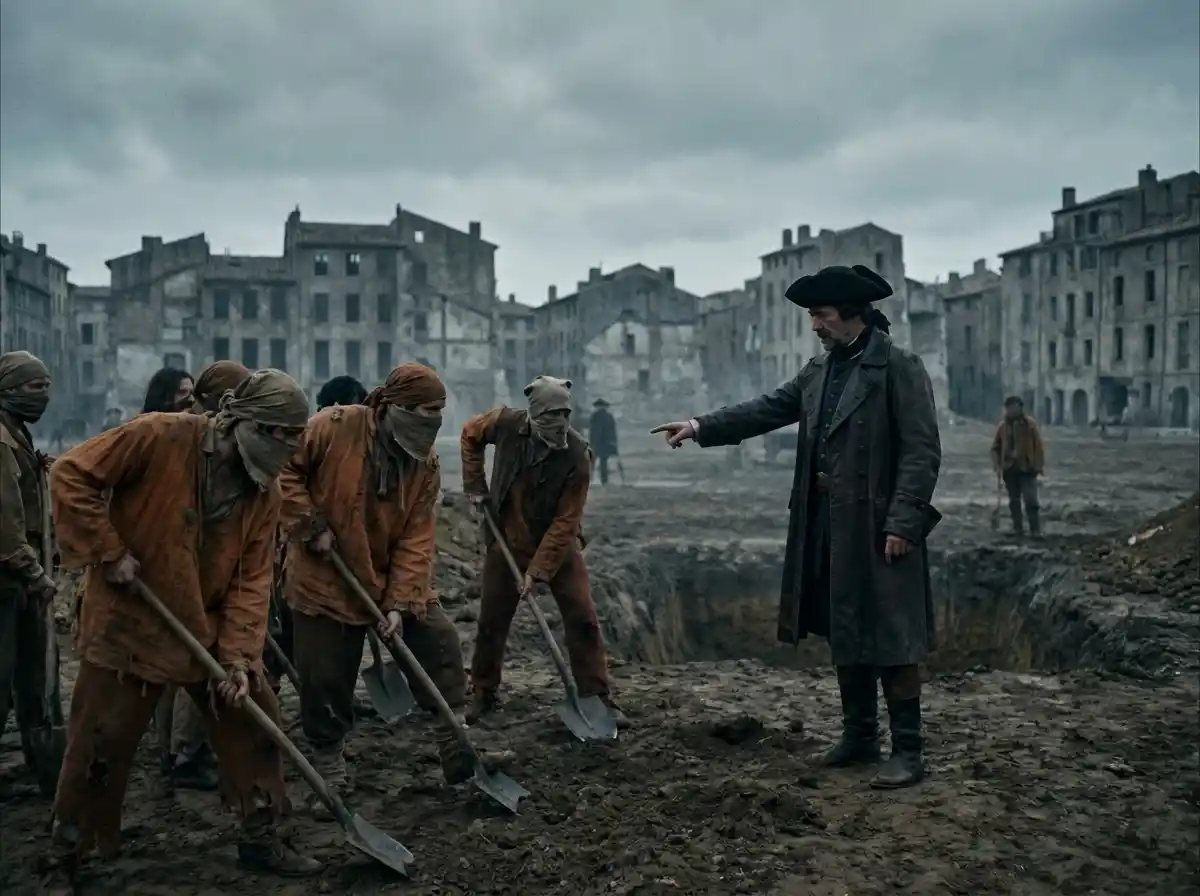
On June 4, she was allowed to approach the quarantine houses of Arenc and unload passengers and goods there. The guard posted on board died. The porters who carried the bales died. Only on June 27 was the ship transferred to a real quarantine on the Île des Jars, and that no longer mattered: on June 20, a 58-year-old washerwoman collapsed in the street with a bubo, a swollen lymph node, at the corner of the lip. On July 9, the plague was officially declared.
At the height of the outbreak, about a thousand people died in Marseille a day. More than 1,200 bodies were piled up on the Esplanade de la Tourette, a poor quarter of sailors' families, and some lay there for three weeks. No one would go in. On September 16, 1720, Nicolas Roze (1675–1733), known as Bellier Roze, led a force of about 150 soldiers and prisoners who had signed a deal: freedom in exchange for work. In half an hour, they threw the bodies into two old bastions that had opened under the square, and covered everything with quicklime and dirt to ground level. Almost everyone who participated died. Roze himself fell ill with the disease, and recovered.
The order to burn the ship was given by Regent Philippe d'Orléans (regent 1715–1723) on 28 July, and was carried out on 25 and 26 September, almost two months later. By January 1723, between 30,000 and 40,000 people had died in Marseille out of a population of 80,000 to 90,000, and about 100,000 in the whole of Provence. A 27-kilometre-long dry stone wall was built in the Vaucluse mountains against the plague.
The question remains who was guilty. Chateau was imprisoned at Château d'If on September 8, 1720, later transferred to the Admiralty Prison, and then forgotten. On July 8, 1723, the verdict was given: “We, the Deputy Governor in Council, following the complaint of the Royal Prosecutor, exclude the said Chateau from trial and trial,” and on August 3, his release was signed. He served two years and eleven months, although two weeks after his arrest, the Deputy Governor himself ceased to believe in his guilt. There is a version that it was Prince Estelle who ordered the captain to sail to Livorno in order to obtain a permit that would save the long quarantine and prevent damage to the goods. This claim has never been proven.
The case continues underwater. In June 1978, the remains of the burned ship were found north of the Île des Jards, at a depth of 10 to 18 meters. The anchor, weighing about a ton and measuring 3.80 meters long, was restored in 2012 and is now displayed at the entrance to the Marseille History Museum. In 2016, a study by the Max Planck Institute determined that the plague was a re-emergence of the 14th-century strain of the Black Death, and not a new strain that arrived from Asia. Every May 28, three hundred years later, a candle with the city's emblem is still placed in a ceremony called the "Vow of the French."
1792 to 1794: The song that gave the city its name, and the city that lost its name
On the night of 25–26 April 1792, an engineering officer named Claude Joseph Rouget de Lisle (1760–1836) sat in Strasbourg and wrote a poem. The mayor, Philippe-Frédéric de Dietrich (1748–1793), asked him for a piece that would rally the soldiers going to war, and the result was called “Chant de guerre pour l'armée du Rhin”. Marseille was not involved in this in any way.
A copy of the song reached Montpellier, and from there it came to the hands of François Mireur (1770–1798), a young doctor who was sent to Marseille to organize the departure of the volunteers to Paris. On June 22, 1792, at the end of a dinner of the Club of Friends of the Constitution in a hall on rue Thubaneau, he sang the song, and the audience adopted it as a marching song. At the end of the month, the city council recruited about 500 volunteers, and they marched into Paris with the song in their mouths. On July 30, they entered the city, and the Parisian crowd, who did not bother to find out its real name, simply called it “the Marseillaise.” On August 10, it was sung during the storming of the Tuileries Palace, and on July 14, 1795, it was declared the national anthem of the Republic.
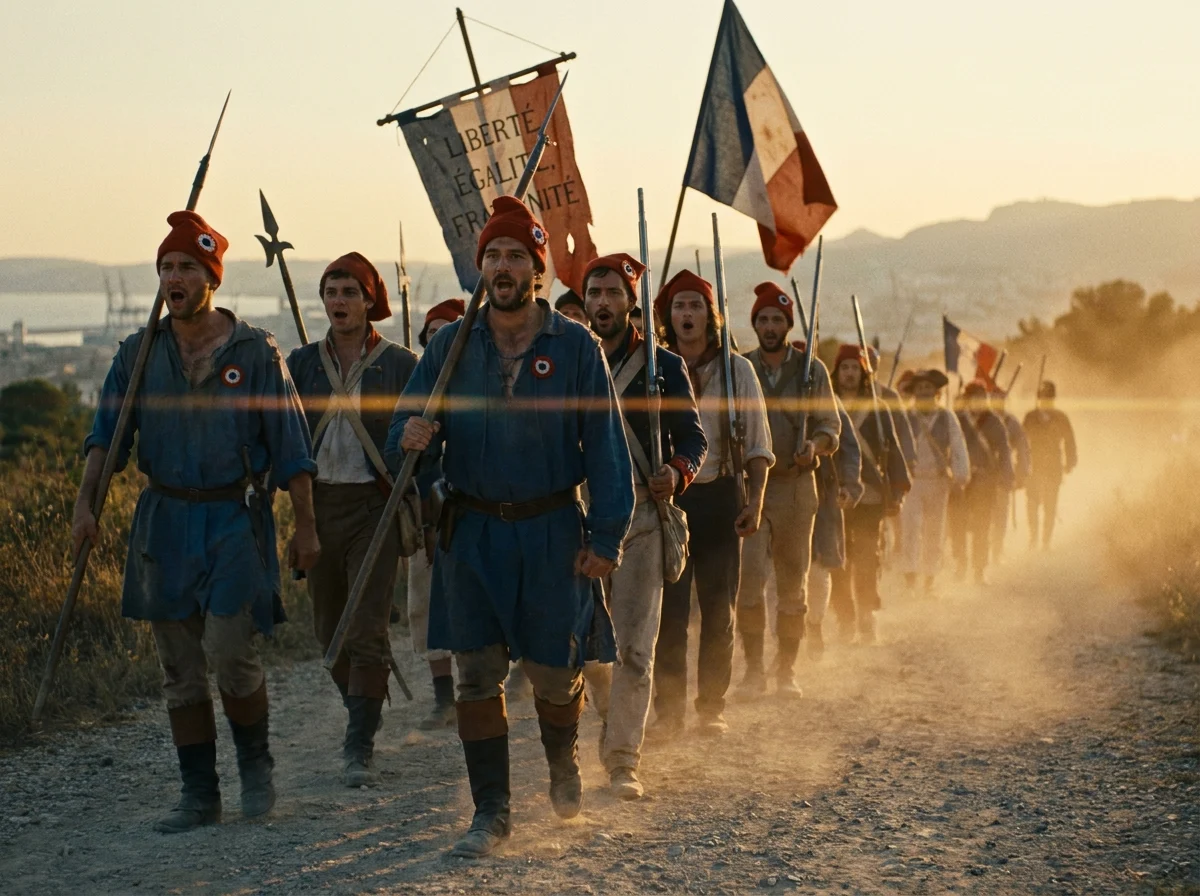
This was Marseille’s great moment in the revolution. The next moment was less successful. In 1793, the city joined the federalist camp against the Jacobin Convention, and on August 25, General Carteaux (Jean-François Carteaux, 1751–1813) entered the city without a fight. The punishment was symbolic, and that’s exactly why it stung: on January 6, 1794, Marseille was stripped of its right to be called by its own name, and it was officially registered as “the city without a name.” The name was restored on February 12, after five and a half weeks. In a city that gave the Republic its anthem, that’s something of an achievement.
19th Century: Juliet, Suez, and Bitter Habon
In 1830, France set out to conquer Algiers, and Marseille became the gateway. Port traffic, which stood at 1,374,067 tons in 1830, soared to 2,932,005 by 1847, and the Viaduct, which had supplied the city for two thousand years, was choked.
A law of 5 August 1844 ordered the construction of a new basin to the north of it, the La Joliette basin, at a cost of 18 million francs. To protect it from the wind and the sea, a concrete quay was built using a method that Marseille engineers had learned from the port of Algiers. The first use was in 1847, the work was completed in 1853, when it became clear that the basin was too small. By 1914, 77 hectares of new basins had been added to the 48 hectares of the Via-Por and La Joliette combined, and the opening of the Suez Canal in August 1869 made Marseilles definitively the “gateway to the East”.
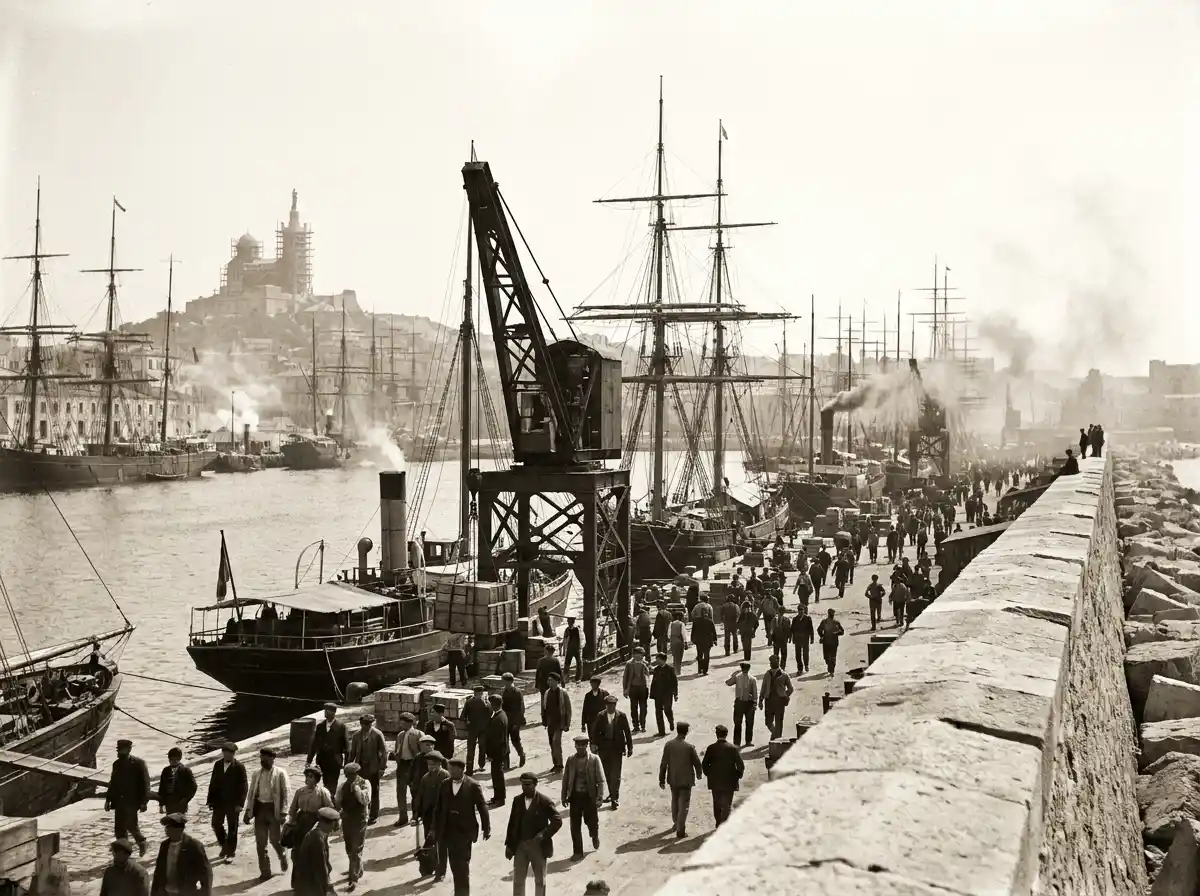
The money that came in did what money does. The hill above the city received a small chapel in 1214, in the 16th century it became a fortress, and in 1853 Bishop Eugène de Mazenod (1782–1861) decided that it needed a basilica. The cornerstone was laid on September 11, 1853, and the plans were given to Henri-Jacques Espérandieu (1829–1874), a 23-year-old Protestant architect. The dedication took place in June 1864 in the presence of 43 bishops, and the gilded statue of the Virgin, 11.2 meters high, was placed on the spire in 1870. The people of Marseille have called her La Bonne Mère (the Good Mother) ever since. At the same time, the city became the capital of soap, with 90 factories in the 19th century and a peak of 180,000 tons in 1913, and absorbed waves of Italian immigration that shaped the accent, the cuisine, and the neighborhoods around the port.
20th Century: Murder on the Canabier, and an Erasable Quarter
On October 9, 1934, King Alexander I of Yugoslavia (Alexandre Ier, reigned 1921–1934) disembarked from a cruiser called Dubrovnik at Via-Forte, and was received by the French Foreign Minister Louis Barthou (1862–1934). The two got into an open car and the convoy began to move up at La Canebière. A man named Vlado Tchernozemski, 37, crossed the thin security line, jumped onto the car's step, and fired. The king died on the spot. Barthou was shot in the arm, apparently by a bullet fired from the police, and bled to death. It was the first political assassination in history to be filmed on television, and the international reaction gave rise to the 1937 Geneva Convention and the first legal treaties against political terrorism.
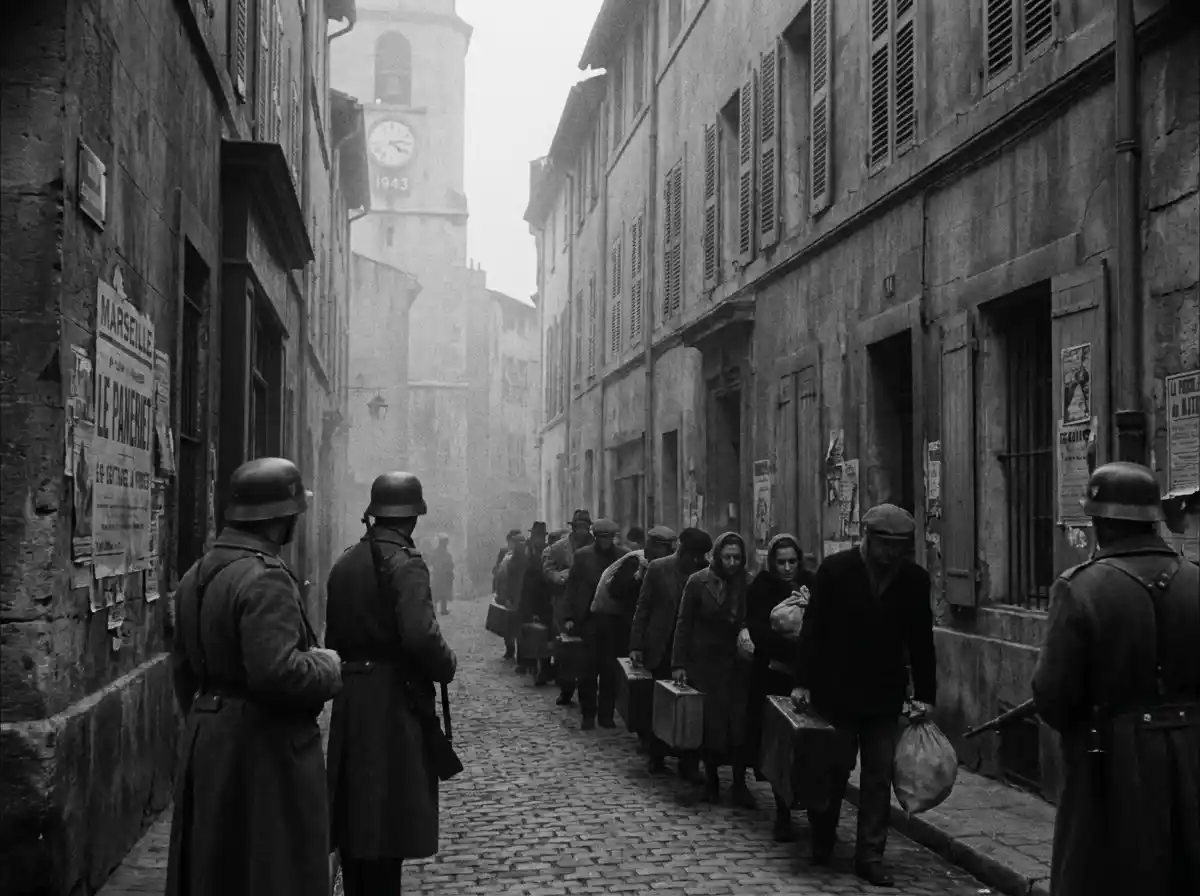
Nine years later came the great disaster. The Germans occupied Marseille on November 12, 1942, and on January 3, 1943, resistance operations killed German officers and soldiers in the city. Himmler (Heinrich Himmler, 1900–1945) ordered reprisals, and René Bousquet (1909–1993), the head of the Vichy police, received the instructions from Carl Oberg (1897–1965), who had come especially from Paris.
Between January 22 and 24, 1943, about 6,000 people were arrested, and 1,642 of them were deported, including 782 Jews. At the same time, about 20,000 residents of the Saint-Jean district, the oldest district in the city, on the north bank of the Viaduct, were evacuated from their homes, and about 12,000 of them were transferred in cattle cars to a transit camp in Fréjus. On February 1, the bombings began: over the course of more than two weeks, 1,500 buildings were blown up, 14 hectares of the old city were reduced to rubble, and 50 streets were wiped off the map. Of the 600 deportees from Oranienburg-Sachsenhausen, about a hundred returned. The affair was almost completely forgotten for decades, and only in 2019 was it recognized by the French legal system as a crime against humanity.
Marseille was liberated on 28 August 1944, and the debate about what to do with the hole immediately began. The northern platform was rebuilt by Fernand Pouillon (1912–1986), while Minister Raoul Dautry (1880–1951) commissioned an experimental residential building from Le Corbusier (1887–1965). The “residential unit”, some 340 apartments in a single concrete block on columns, was inaugurated on 14 October 1952, and the people of Marseille immediately called it “the madhouse” (la Maison du fada). Today it is a World Heritage Site. In 1962, the city absorbed a wave of repatriates from Algeria, and Gaston Defferre (1910–1986), mayor from 1953 until his death, spoke out publicly against their absorption and yet built neighborhoods in the north for them.
Today's Marseille: Aeromediterranean, the Musée d'Auban, and Rue d'Auban
In 1995, the Euroméditerranée operation was launched, a 480-hectare urban renewal project, the largest of its kind in southern Europe, which transformed the strip between the port and the center from a neglected port area into a business and residential district.
The climax came in 2013, when Marseille was chosen as the European Capital of Culture. The Viaduct was redesigned by Norman Foster (born 1935) and made semi-pedestrian, and at the end of the quay, the MuCEM, the Museum of European and Mediterranean Civilizations, designed by Rudy Ricciotti (born 1952), was inaugurated on June 7. It was the first national museum to open outside the Paris region, and it received 1,920,210 visitors in its first year of operation. The footbridge that connects it to the Port Saint-Jean is one of the most beautiful ways in which a city can acknowledge that the fortress built to dominate it has become a museum.
Today's Marseille is not finished with its troubles. On November 5, 2018, on rue d'Aubagne, pronounced: Duben, in the Noailles district, two buildings collapsed, killing eight people, and in the following weeks, some 4,500 residents were evacuated from at least 578 buildings that were deemed dangerous. On September 2, 2021, the "Marseilles en grande" plan was announced at the Palais du Pharo, one of the goals of which is to treat 10,000 apartments within 15 years.
2,600 years after Nanus gave the Greeks a beach, Marseille is still doing exactly what it did on day one: taking in people coming from the sea, arguing with the central government, and getting by. Ask yourself the next time you stand on the quay in front of the basilica how many cities in the world can say that.
Questions and answers about the history of Marseille
When was Marseille founded, and who founded it?
Around 600 BC, by Greeks from the city of Phocaea in Asia Minor. The dating is supported by archaeological findings, making Marseille the oldest city in present-day France.
What is the connection between “The Marseillaise” and the city of Marseille?
The song was written in Strasbourg in April 1792 and was originally called “The War Song for the Army of the Rhine.” Volunteers from Marseille adopted it as a marching song after it was heard in the city in June of that year, and sang it as they entered Paris on July 30. The Parisians named it after themselves, and the name stuck.
How many people died in the plague of 1720?
In Marseille itself between 30,000 and 40,000 out of a population of 80,000 to 90,000, that is, about half the city. In the whole of Provence about a hundred thousand. This was the last great plague of its kind in France.
Why does the district opposite Port Saint-Jean look relatively new?
Because it was rebuilt after 1944. In January and February 1943, the Germans, with the help of the Vichy police, blew up 1,500 buildings in the Saint-Jean district, and 50 streets were wiped off the map. In the 1950s, new architecture was built there under the leadership of Fernand Poillon.
Where is the Marseille port chain located today?
In the cathedral of Valencia, Spain. The forces of Alfonso V of Aragon broke it and took it as loot in November 1423, and it is displayed there to this day.
More on the subject