
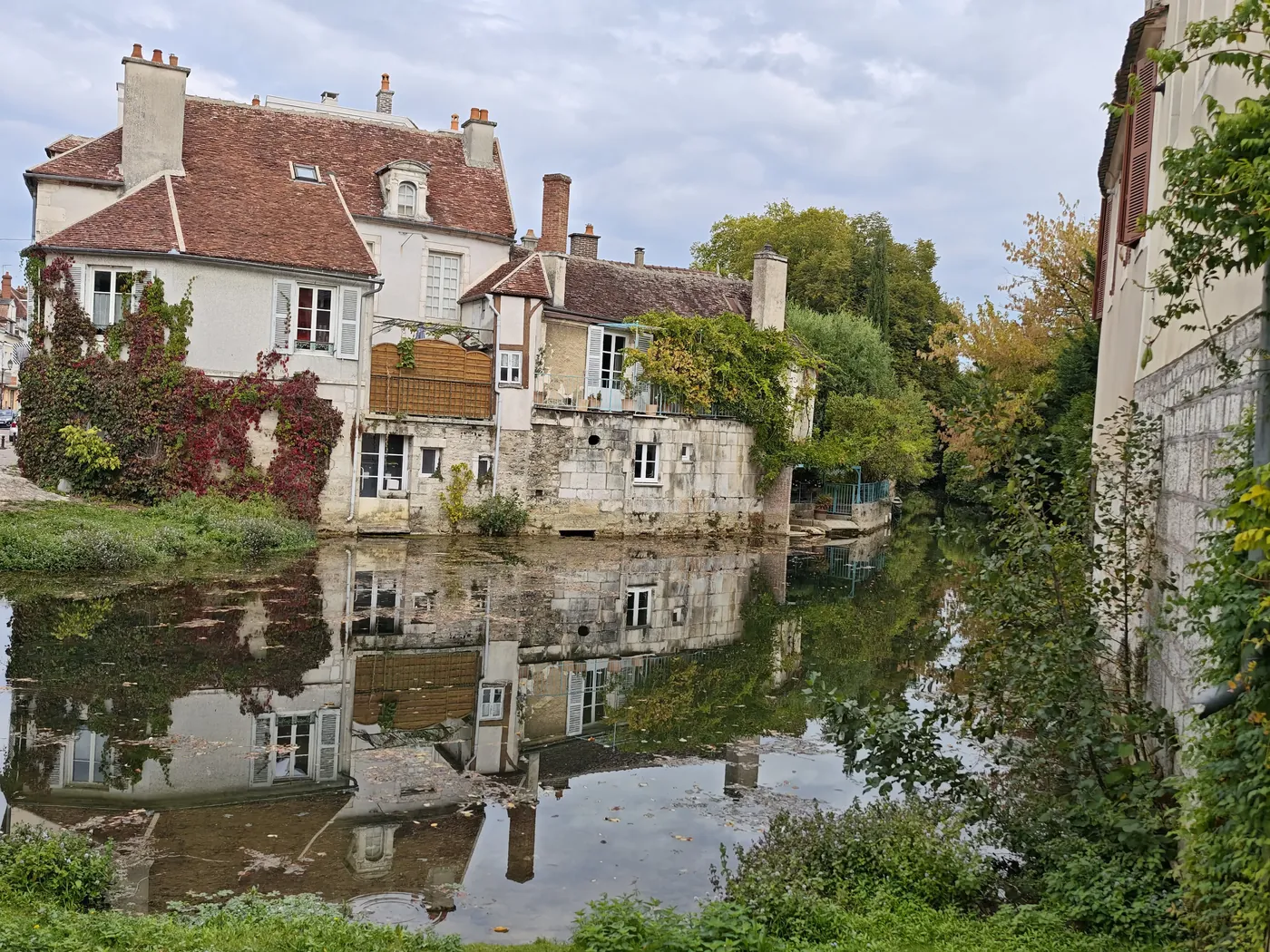
in short
- What's there: The Foss Dion, a turquoise karst spring converted into a laundry in 1758, the Hôtel-Dieu from 1293 with the longest preserved medieval hospital hall in Europe, and the Church of Saint-Pierre on a rock ledge above the town.
- status: A town of less than four thousand five hundred inhabitants, it bears the label “a small town with character”, and was formerly the capital of an independent county.
- How to get there: One hour and fifty by TER train direct from Paris-Bercy station, or two hours and forty by car from Paris on the A6. From the station to the Hôtel-Dieu it is less than five hundred meters.
- How long: Half a day for the main part, a full day with the museum and the upper church, two days if you include Chablis and the surrounding castles.
- When: The Hôtel-Dieu operates seasonally, from about Easter to the end of September. Autumn is the right time for the area, when the vineyards turn yellow.
- Bonus: The Chevalier d'Aun, Louis XV's spy who lived as a woman for thirty years, was born here in 1728, and above the door of his birthplace is engraved a verse from the Psalms.
Last October, when I was living with my parents in Auxerre and making it my base for a few days, I set out east one morning without much expectation. On the map it looked like just another small town on the road to Chablis, with a funny-sounding name, Tonnerre, which means thunder in French. I came back from there with the feeling that I had seen one of the strangest and most fascinating places in Burgundy, and with the feeling that no one had bothered to tell me about it before.
In Tonnerre there is a round turquoise cistern whose end no one has been able to find, and three divers have died in it. There is a medieval hospital hall almost ninety meters long, built in two years by a queen who lost her kingdom. There is a tomb of one of Louis XIV's famous ministers, without the body that was supposed to lie in it. There is a house where a spy was born who disguised himself as a woman for thirty years, and above whose door is carved a line from the Psalms. All of this can be seen in half a day, on foot, in a town of less than 4,500 inhabitants.
So what will you find in this article?
We'll start with the important tourist information (how to get there, what's open, what's closed and when, etc.). Then I'll write about what you must see in half a day (which is the time I dedicated to Toner) but also a few more places that I didn't manage to see and that I heard are worth a look if you have a little more time than I did. Then we'll move on to the historical part of the article, and as you know me, this is going to be the most important part because getting to know the fascinating history of the place will simply enhance your visit there. And finally, we'll also talk about accommodation in Toner and the surrounding area, because the place can definitely be a base for a trip to the Burgundy region.
By the way, Toner was part of my Burgundy itinerary , and there you will find all the days of the trip, the hotels, and the restaurants.
How to get to the toner, and how much time to devote to it
Tonnerre sits on the Armançon River and the Canal de Bourgogne, at the northeastern edge of the Yonne department, right on the seam between Burgundy and Champagne. Auxerre is thirty-five kilometers to the west, Troyes sixty-five kilometers to the north, and Chablis is less than twenty minutes away by car. It's a location that explains all the history you'll read about below: anyone who wanted to travel between Paris and Dijon passed through here.
On the train
This is the most convenient option, and I say this as someone who arrived by car. Tonnerre station is on the main line from Paris to Dijon, and TER trains leave from Paris-Bercy station and arrive in an hour and a half, direct, without changing. Along the way, they stop in Sens, Joigny, Laroche-Migennes, and Saint-Florentin. From the station to the Hôtel-Dieu, the main building in town, it is less than five hundred meters on foot. It is convenient to book tickets in advance through Omio , which centralizes the train operators on one screen and saves you the hassle of dealing with the French website (it is recommended to book train tickets as early as possible because the closer you get to the date of travel, the higher the ticket prices get).
If you live in Auxerre, like me, be aware that the direct connection between the two towns is sparse. There are one or two trains a day that come directly, and all the rest go through La Roche-Migne and require a change. It's worth checking the times in advance, otherwise you'll find that the thirty-five kilometer journey takes two hours.
in the car
From Paris it is about two hours and forty minutes on the A6, and from Ambre less than forty minutes on the RD965. By car you gain what public transport does not: Chablis, the vineyards of Épineuil, and the three castles in the area, which there is no reasonable way to reach otherwise. I did it by car and would not have done it any other way. Parking in Toner is not a problem, not even on market Saturdays, and there are places in the square near the covered market and down the main street. It is worth booking a car from Israel through Auto Shai , which has a special booking page for “anonymous Francophiles”. If you want to find more recommended sites for renting a car, you can find them in the Francophile’s toolbox.
How long, and when?
Half a day covers the essentials at a reasonable pace. A full day if you take it easy in the hospital museum, climb to the upper church and have a real meal. If you add in the surrounding castles or Chablis, that's two days in the area, and Tonnerre is a reasonable base for that thanks to the station and hotels.
The season is more important here than in big cities, because the main attraction operates in season. The Hôtel-Dieu is open from about Easter to the end of September, and in the summer season also in the mornings. Off-season you will find the town, the Foss Dion and the churches, but not necessarily the interior of the hospital. I arrived in October and it was a stamp on the border, so check in advance with the ticket interface on their website. Autumn is the right time for this area anyway, when the vineyards turn yellow and the queues at Chablis shorten.
What to look for in a half-day toner
Four things, all within walking distance of each other. The town is built on a slope: the canal and river below, the main street and market in the middle, and the church of Saint-Pierre on a ledge above it all. Plan the order by feet, not by importance, that is, from the bottom up.
Fosse Dionne, the bottomless pit
This is the image that everyone knows even if they haven't heard the name. A circular water basin fourteen meters in diameter, surrounded by a covered gallery with a burgundy tiled roof, and the water in it is such a turquoise blue that it looks like it was created in Photoshop. In French, it is called a source vauclusienne, after the famous source in Vaucluse, that is, a karst source where the water does not flow from above but rises from below, under pressure, from a network of tunnels in the limestone rock. The average output is about 300 liters per second, and on a flood day it reached 3,000 liters per second.
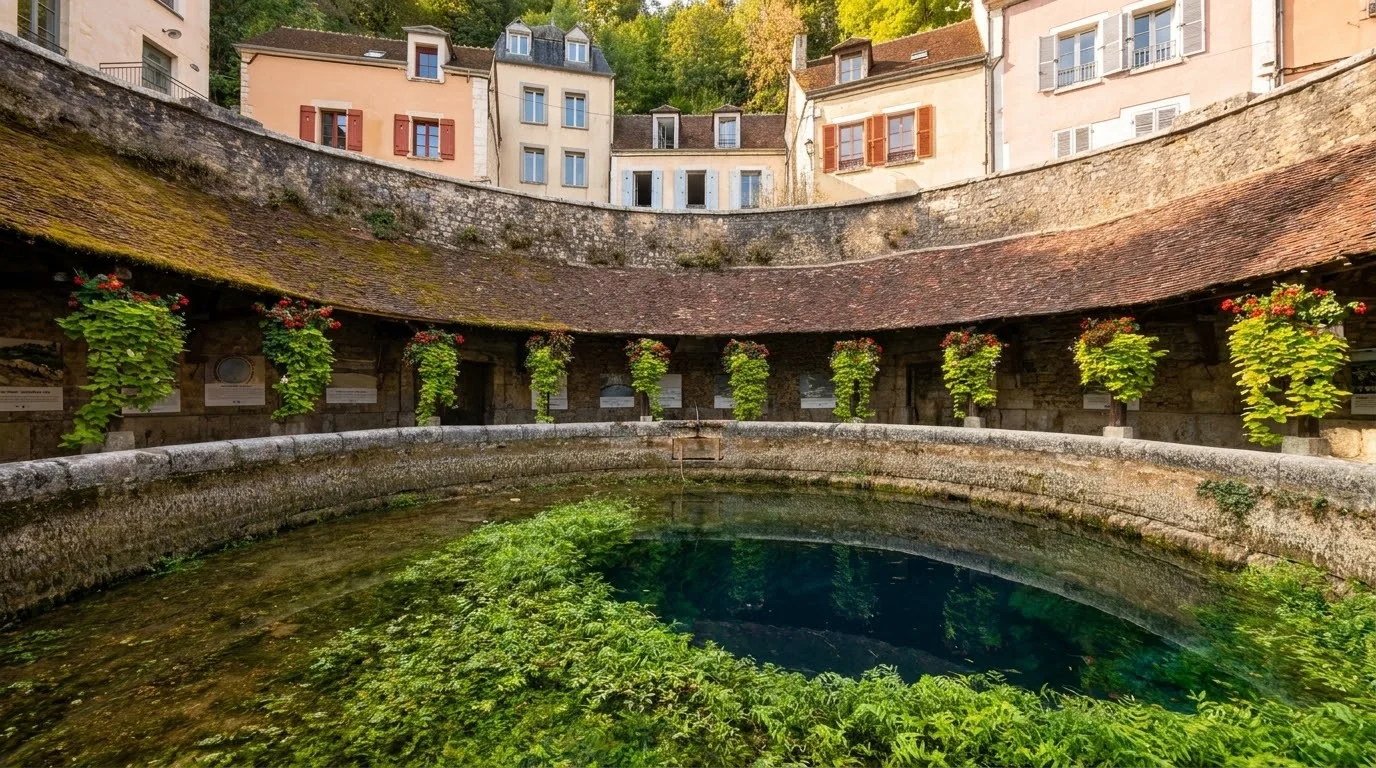
The water comes from the infiltration of rainfall in an area of tens of kilometers around, and also from a stream that disappeared into the ground about forty-three kilometers from here and emerged here. This was only discovered in the twentieth century, and the basic question, what is at the end of the tunnel, has not been solved to this day. The first dive was made in 1955. From there on, expeditions arrived in 1962, 1979, 1989 and 1996, and they all got stuck: a tunnel that descends at an angle of 45 degrees to 32 meters, then a choke point 80 by 40 centimeters wide, followed by a series of deep siphons that require decompression stops, in the turbidity of floating clay and a current that pushes inside.
Three divers died in this pit, two in 1962 and one in 1996, and after the second incident, diving was banned. The ban lasted until 2018, when a professional diver was given permission to descend with an escort, and in October 2019 reached a depth of 79.5 meters, about ten meters beyond the point where the 1989 expedition stopped. He mapped, photographed, and collected trash. He did not find the source of the water. If you are wondering if it makes any difference when you are standing there from above: yes. It is a pit that looks completely silent, and you know that someone went down into it and did not come back.
Note two practical things. One, the entrance to the plaza is free and there are no opening hours, so it's a great place for the first or last hour of daylight, without anyone. Two, the Fos Dion is in the midst of a restoration program that includes the basin foundations, the retaining walls, the beams and tiles of the laundry gallery and the observation deck above it. Such work takes years and changes access to the place, so before you plan an entire morning around it, check the municipality's website to see what's fenced off this month.
The Hôtel-Dieu, ninety meters of history
This building is the real reason to come to Tonnerre, and also the hardest thing to explain before you see it. A medieval hospital founded in 1293, called Hôtel-Dieu Notre-Dame-des-Fontenilles and by locals simply “the old hospital”. Its hospital hall is 88.5 meters long, 96 meters with the curved part to the east, and 21.5 meters wide, which makes it, according to all official sources, the longest preserved medieval hospital hall in Europe. The roof above it covers some 4,500 square meters.
What makes the impression is not the numbers but the ceiling. Exposed oak beams in an octagonal cross-section, 18 beams wide, shaped exactly like the hull of a capsized ship. Four-leaf-shaped openings were drilled into the wooden panels to ventilate the beams, meaning someone in the thirteenth century thought about wood rotting three hundred years in advance. You stand at the west end and see the entire hall as far as the altar, and you can understand why it was built that way: prayers were said in the chapel at the end, so that all the patients could participate in them from their beds.
Inside the hall and in the surrounding wings, there are several things not to be missed:
- Tomb of Marguerite of Burgundy, the founder of the place.
- The tomb monument of the Marquis de Lobois, Louis XIV's Minister of War, whose story you will read later.
- The statue of the “Virgin of the Burning Bush” from the 14th century.
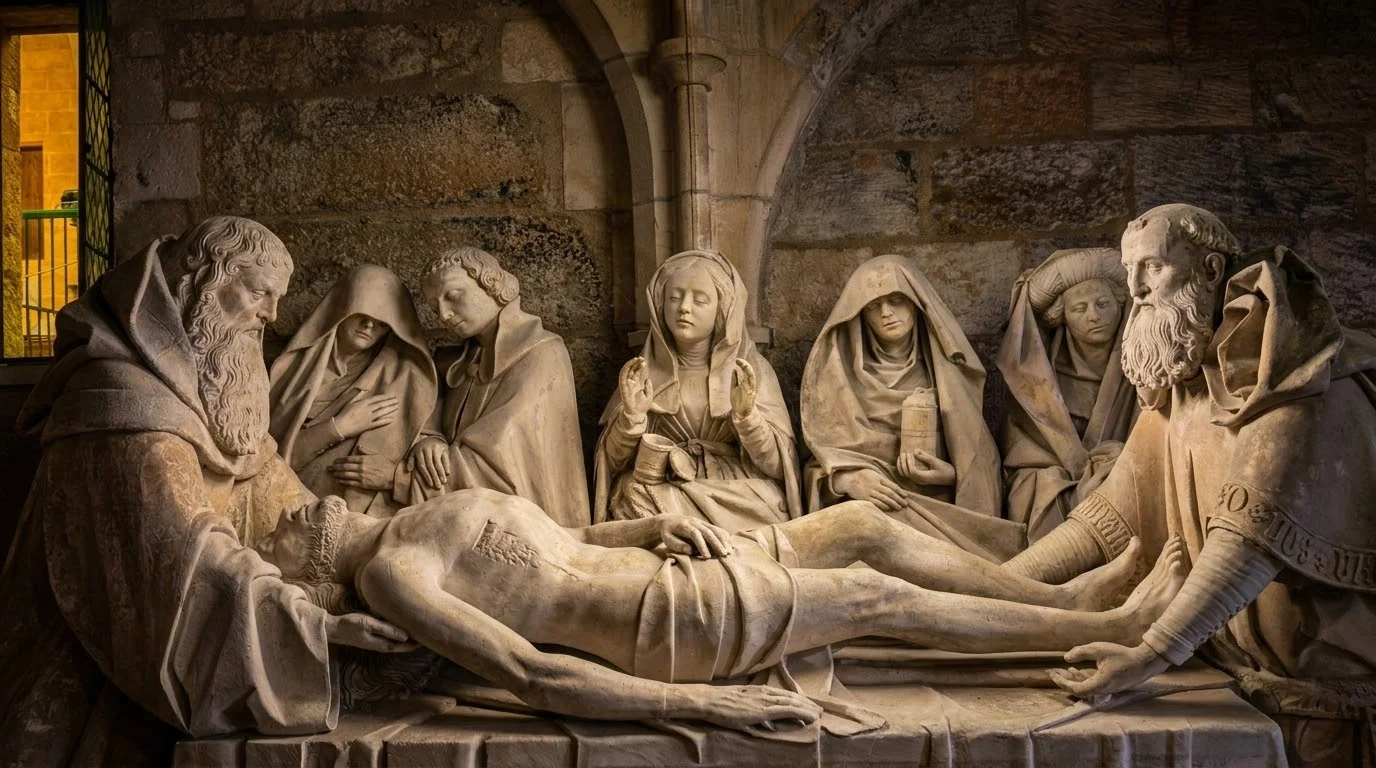
- The carved burial of Jesus from the 15th century.
- An astronomical noon line engraved into the hall floor in the 18s, because at some point they decided that an empty hospital hall was an excellent place to measure the sun.
The museum itself is located in a 17th-century wing and showcases the less romantic sides of medicine, including a reconstruction of a patient's room and tools that are best viewed without thinking too much about what was done with them.
Practically speaking: The place is now run by a private entity that has introduced a light and sound tour, and is open seasonally, more or less from Easter to the end of September, with extended hours in July and August. An adult ticket starts at eight euros, and there are also free options. The hours and prices here change from year to year more than anywhere else in town, so don't take my word for it and check the booking interface on the official website before you board the train.
Saint-Pierre Church and the ledge above the town
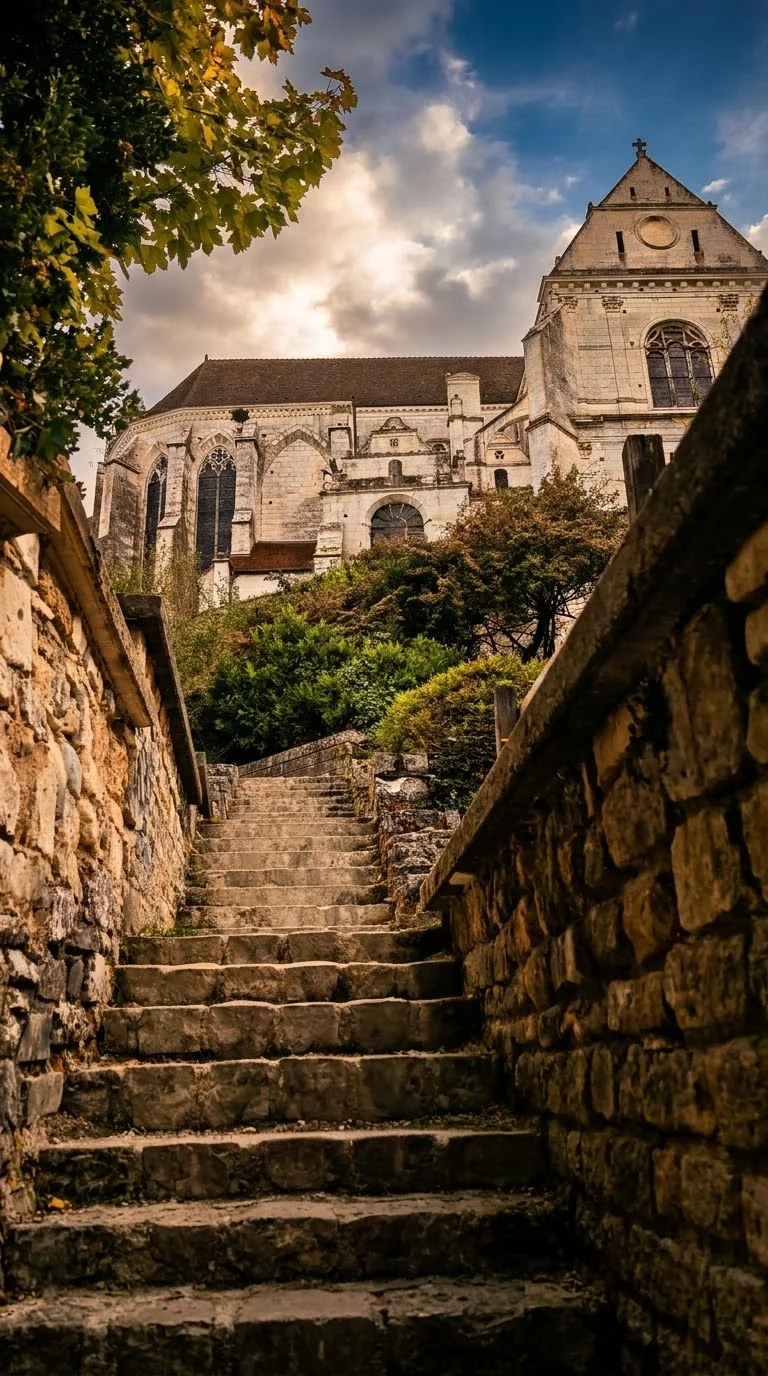
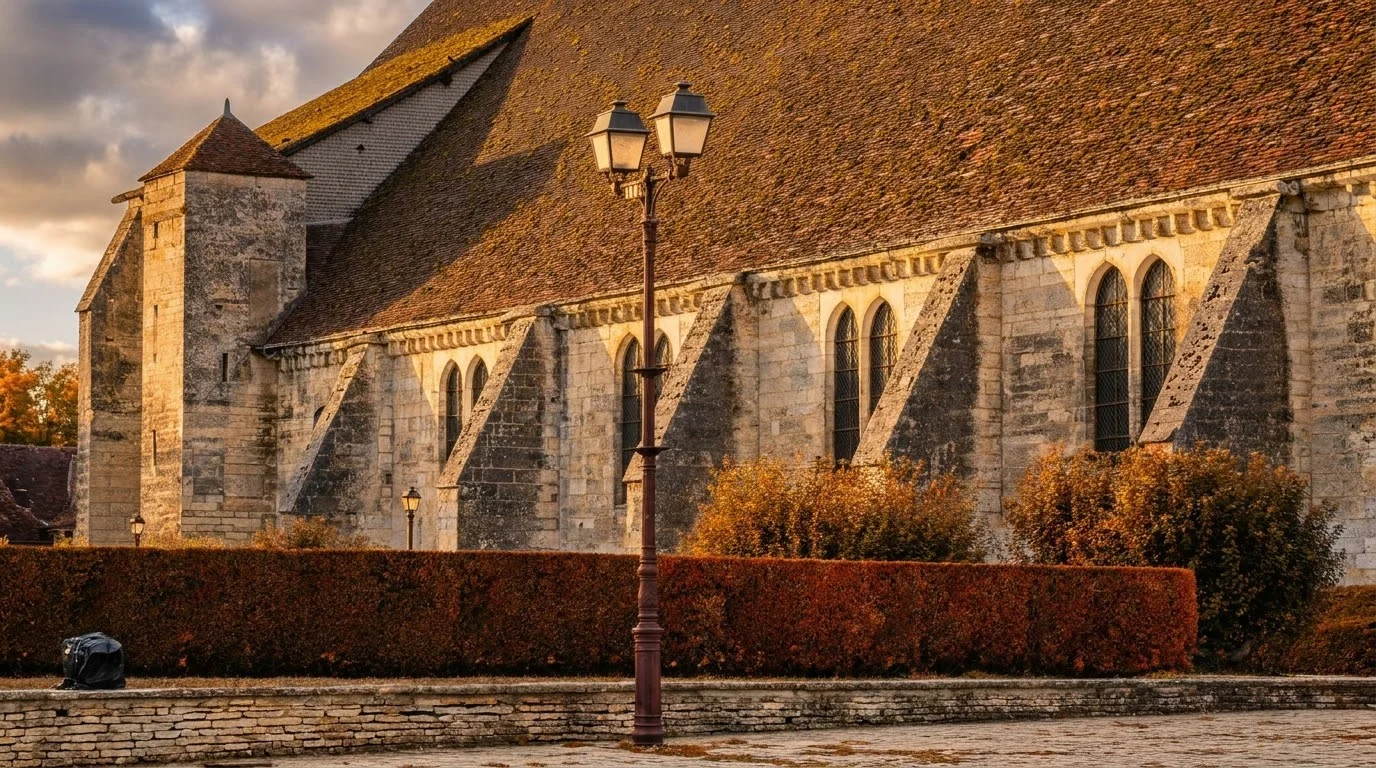
The climb to the Saint-Pierre church is a few minutes up a steep street, and it's mostly worth it for what's up there: a rock ledge from which you can see all of Tonnerre, the tiled roofs, the Notre Dame tower below, and the Armenson valley and vineyards beyond. The church itself was built in stages from the 9th century onwards, burned down almost completely in the Great Fire of 1556, and rebuilt with a Baroque façade that doesn't match anything else in the town, and that's exactly what's so lovely about it.
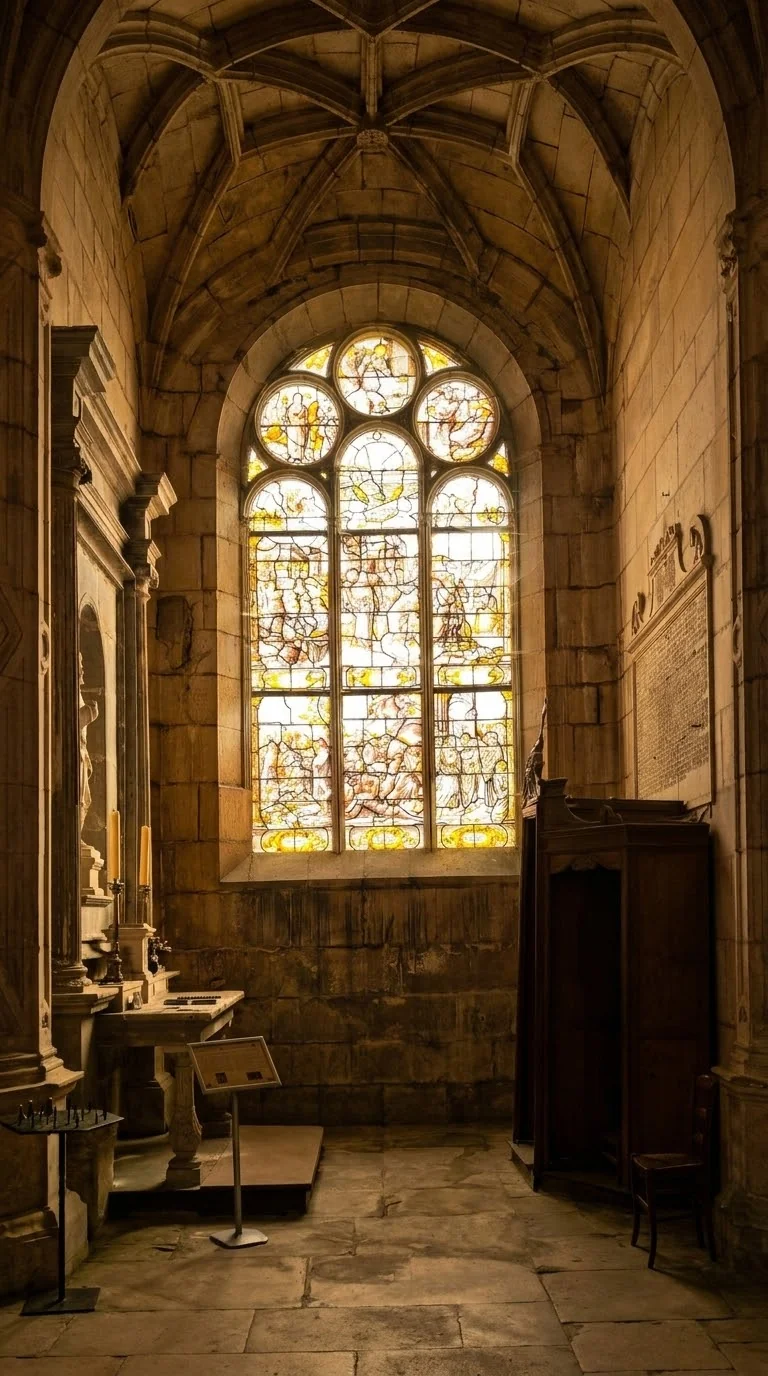
Inside, it's worth looking at the organ from 1616, the pulpit from 1712 and 1713, and the 16th-century stained glass windows that were restored in 2003. Nothing remains of the old 11th-century church.
Hôtel d'Ozes, and the row above the door
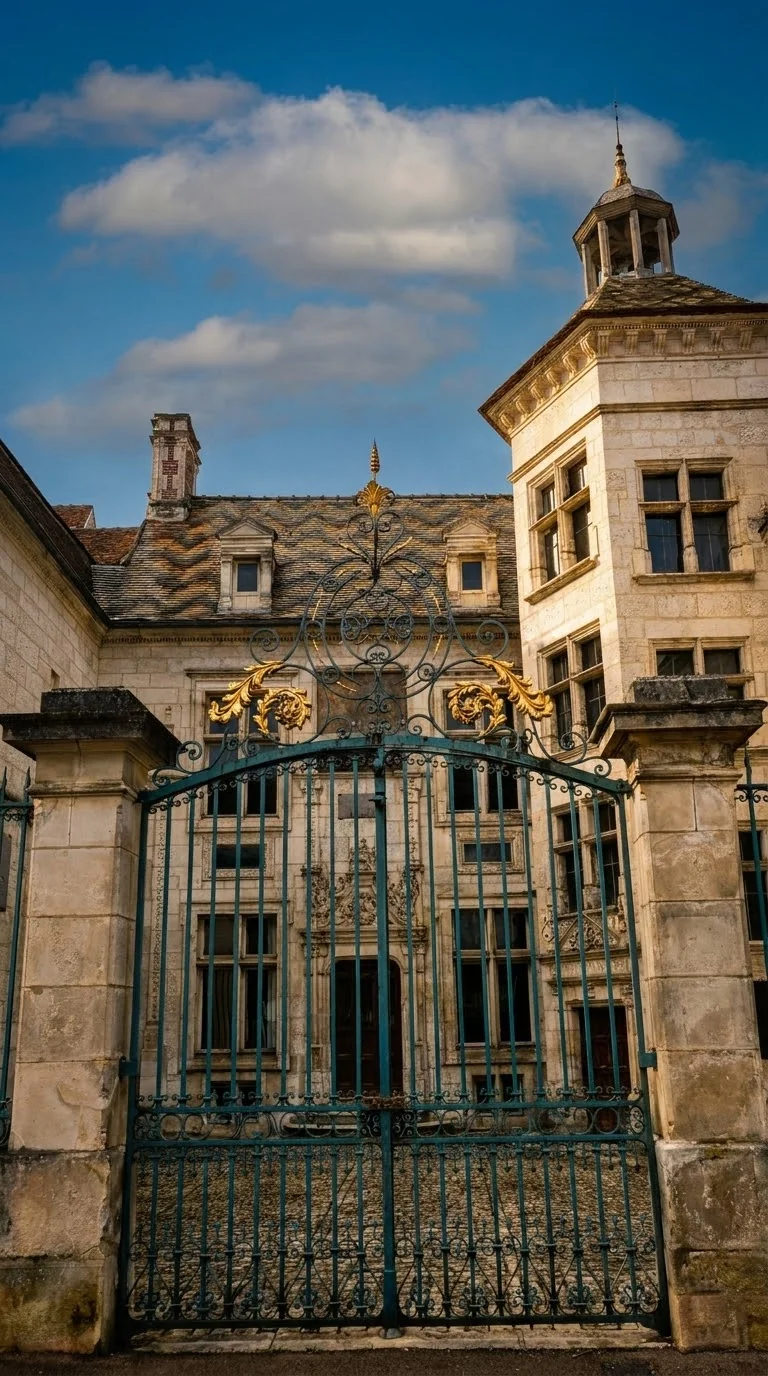
On the main street, in an easy-to-pass-by spot, stands a Renaissance façade with windows divided by stone columns and an ornate corner tower: the Hôtel d'Uzès. The house was built by a wealthy bourgeois from the town, Jean Canelle (1503–1562), who was the local tax collector. He had almost completed it when the fire of July 1556 burned down all of Tonnerre, and what you see today he built later, more magnificently. The name Uzès is not his: it was given to the house in memory of Louise de Clermont (1504–1596), Countess of Tonnerre and Duchess of Uzès, who often stayed there.
The detail that made me stop there for much more than a minute is above the door. Engraved there is a line in Latin, “NISI DOMINUS CUSTODIERIT DOMUM, FRUSTRA VIGILAT QUI CUSTODIT,” a quote from Psalm 127: “Unless the Lord guards a city, how much less a watchman.” A man who saw his new house burned down with the entire city rebuilt it, and engraved above the door a verse that says there is no point in guarding it if it is not guarded from above.
In this house, on October 5, 1728, Chevalier d'Aun was born , and you can read his story in the historical chapter or in Yigal Libernet's article on my website. The building was bought in 1879 by the French Savings Bank, underwent a controversial renovation in 1888 and was decorated with murals in 1907, and since 2023 it has been in the hands of the body that operates the Hôtel-Dieu, which is restoring it and planning to open it to the public. As of writing these lines, the opening is planned for July 2026, so if you are arriving after that date, it is worth asking the tourist office if it is possible to enter. If not, the front and the row above the door are free and always available.
If you have more than half a day
Notre Dame Cathedral, the House of Bones and the Plague of 1632
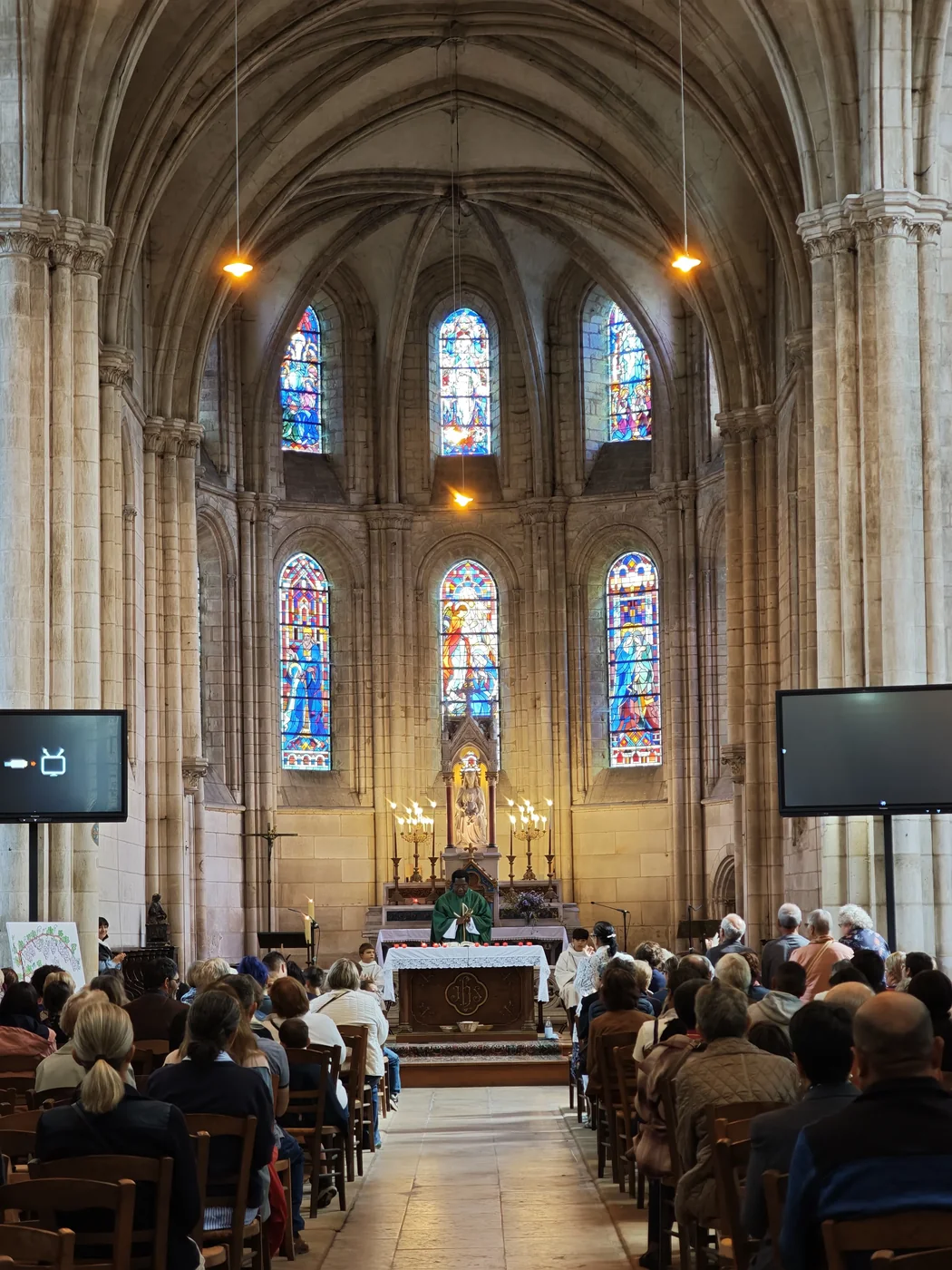
Notre-Dame sits in the middle of the slope, a 12th-century Gothic church with a single large tower that is completely out of proportion to the rest of the building. It was badly damaged in World War II bombing and has been awaiting a full restoration ever since. Inside is an impressive ossuary, a sacred relic from the monastery of Saint-Michel that was here, and a 15th-century statue. The most interesting item there is a painting dedicated to the memory of the plague of 1632, in which the Count of Toner of those days asks Saint Roch, the saint to whom they turned against it, to stop the plague. It's a small reminder that this town not only burned, but also suffered from plagues and other plagues (and yet it is still with us).
The Crypt of Saint Catherine
On Rue Saint-Pierre there is a crypt, or subterranean hall, with Romanesque vaults from the 12th century. It is all that remains of the church of Sainte-Catherine, and it is a small, cold and beautiful space that takes five minutes to visit and reminds you of how ancient the layer beneath the town is. The visit is not always open by itself, so ask at the tourist office which is housed in the Hôtel-Dieu building.
The covered market, the canal and the promenade
The covered market of Tonnerre was inaugurated in 1904, a structure of iron and glass in the style of the late 19th century, and it is somewhat similar to the Le Halle market in Paris, which was destroyed during the 1970s. It was restored in 2015 and is working. Below it, downhill, is the canal and on it a small dock for pleasure boats, and next to it is a promenade called Le Pâtis, which is actually the city park. This is the part of Tonnerre where there is nothing particularly historical, and that is precisely its advantage: after the cistern and the hospital and the churches, it is pleasant to walk for half an hour by quiet water and not learn anything.
The history of toner, from the Gauls to the present day
This is where the part that made me write this article begins. Toner is a small town where a lot of big things happened. I'm telling it in chronological order, and you'll find a kidnapping, a fire, guilt pinned on the Countess, ashes thrown into the river, and a body that no one was sure what was in it.
Tornodorum: a fortress, and a divine water source
The hill above Tonnerre was inhabited even before the Romans. Excavations on the town's grounds have found a cemetery from the late Bronze Age, and burials and cremations from the period between the Bronze and Iron Ages. On the hill itself, which the locals call Mont Bellant, an oppidum, or Gallic fortress city, developed from the La Tène period. In 2024, a rescue excavation by the French Institute for Preventive Archaeology began there, and what it revealed was a continuous and dense settlement from the late Gallic period to the 15th century, including a wall with a Gallic foundation and a continuation from the following centuries.
In Roman times, the place was called Tornodurum, a name that means fortress in the language of the Lingones, the Gallic tribe of the region, and it was the center of a district called pagus Tornodorensis. The root of the name has been interpreted in three ways: from an obscure local god named Torn, from the word dorus meaning fortress, or from the word dour meaning a place near a stream. There is a reasonable chance that all three answers are the same, because here was also a fortress, a stream, and a god. In 1782, underground spaces were uncovered here that contained weapons, ornaments, coins, and jewelry, in other words, exactly what you would expect to find in a place dedicated to worship.
Hence the name Fos Dion. It comes from Divona, the Gallic goddess of springs and abysses, and in the Gallo-Roman period the source was called Pons Divina, the divine spring. There is also a popular version that attributes the pit to Jupiter, who cast his lightning on the valley and created Tonner, and that the exact hole where the lightning struck is the Fos Dion.
The Counties: From the 10th to the 13th Century
From the mid-10th century, Tonnerre was the seat of a countship. It ruled the western fringes of the Grand Bishopric of Langres, and several members of the first line of counts themselves became bishops. They were all called Milon, and what is known about them comes mainly from the documents of the Abbey of Saint-Michel, which stood opposite the castle, on the other side of the valley.
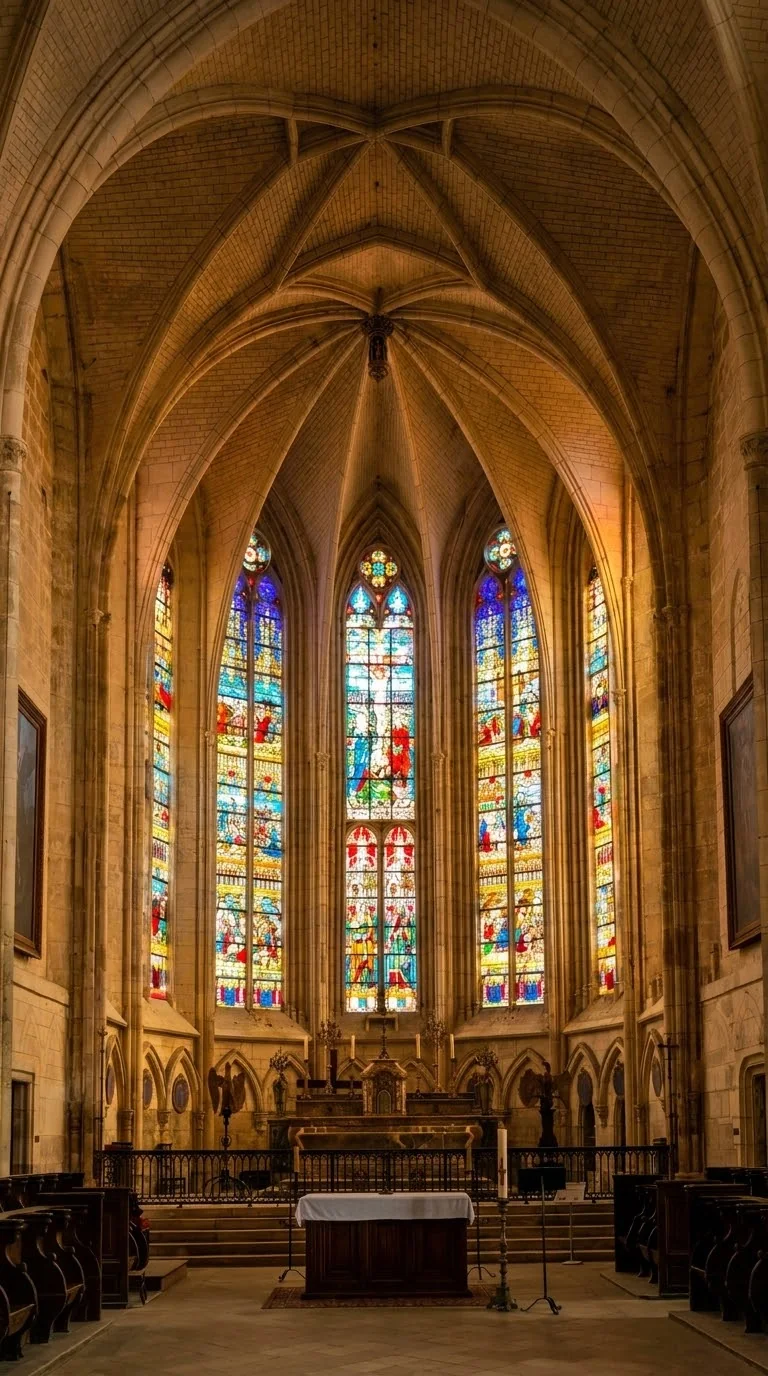
The last heiress of the first dynasty, Ermengarde de Tonnerre, married in 1045 the Count of Nevers and Osser. Her younger sister married the son of Count Brienne, which finally separated Tonnerre from the Countess of Bar-sur-Seine. From then on Tonnerre was linked to the fate of its larger neighbors, especially Nevers and Osser, and she regularly served as a dowry for widows who had been widowed. This may not seem so important at first glance, but it explains everything that followed.
The town itself grew. In 1174 it received a charter of rights (charte de franchise), a document granting the inhabitants rights before the lord. It had two important churches, Notre Dame and Saint-Pierre, both of which still exist today. Tanners' workshops opened along the Armenson and around the Pois Dion, which processed hides in water, followed by laundries. I mention this because it explains the entire structure of the town: the water below, the work around them, and the government above.
Marguerite of Burgundy: A Queen Without a Queen, and a Hospital Instead
The important figure of Tonnerre was born around 1250 and died in 1308, and her name was Marguerite de Bourgogne. She was the daughter of Eudes de Bourgogne (died 1266), Count of Navarre and Ausserre, and granddaughter of the Duke of Burgundy. In 1268 she married Charles I of Anjou (King of Sicily 1266–1285), brother of King Louis IX (King 1226–1270). Her husband reigned over Sicily and Naples, and from 1276 also bore the title of King of Jerusalem. Marguerite received Tonnerre in the distribution of inheritance while she was in Italy, but visited her only once, on All Saints' Day 1273.
Then everything collapsed. In 1282, the Sicilian Vespers (Vêpres siciliennes) revolt broke out on the island of Sicily, in which thousands of French soldiers were massacred at the time, and her husband was forced to flee from Naples to Sicily. Charles fell ill and died in 1285. Marguerite returned to the lands from which she came, to Tonnerre.
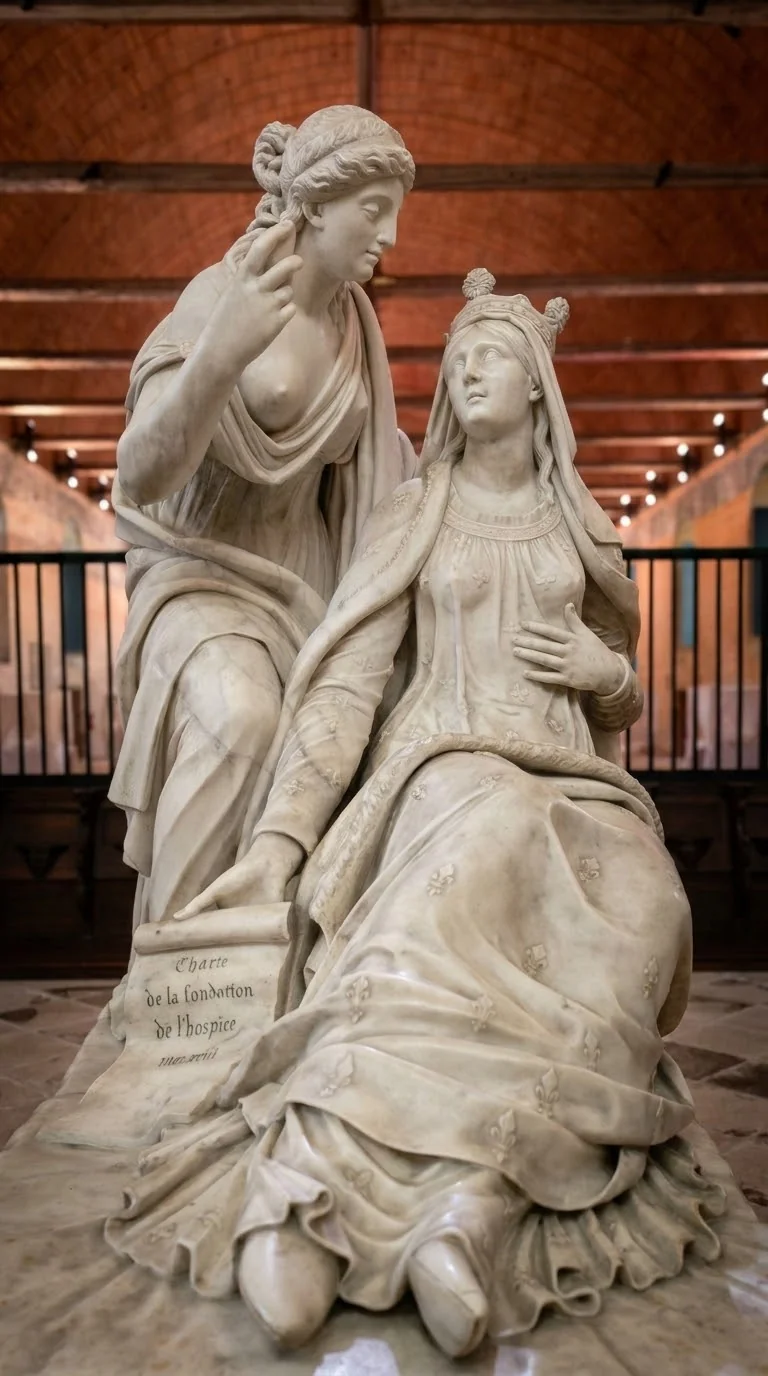
Here is the detail I like best about this whole story. She did not return alone. Two relatives settled with her at the Château de Toner: Marguerite de Beaumont, widow of Bohemond VII (Count of Tripoli 1275–1287), and Catherine de Courtenay, who held the title of Empress of Constantinople. All three lost their kingdoms and together they settled in a small Burgundian town and divided their days between prayer and charity. I know of no other place in France where you can point to a room and say that three former queens lived here.
On April 9, 1293, Marguerite Baton Rouge founded a hospital and promised it a steady income. She provided the builders with funds, the quarries and oak groves of the nearby Maulnes, and chestnut trees from the areas to the south and north. The building was erected within two years, and in 1295 it received its first patients, about forty beds. Around 1305, the statue of the “Virgin of the Burning Bush” was placed in the eastern part of the hall. On September 4, 1308, Marguerite died and was buried not far from the statue, that is, among the beds of her hospital.
1414: The kidnapping that destroyed the Upper City
The countship later passed to the House of Chalon, and in the early 15th century it was held by Louis II de Chalon (died c. 1422). In 1407 he accompanied the Duchess of Burgundy to Douai, where he met Jeanne de Perellos, a girl in the Duchess's retinue and a relative. He fell in love with her and, according to the story, he secretly visited her at the Ducal Palace and was captured. The Duchess forbade him from seeing her again.
Louis de Châlons responded by kidnapping her and hiding her in the Château de Moulins. Being a practical man, he began by looking into how to annul his marriage to his wife, Marie de La Trémoille. The duchess, no sucker, retaliated by confiscating three of his castles and the feud between husband and wife became violent. The Duke of Burgundy, Jean sans Peur (1371–1419), attempted to calm the situation and granted her husband a pardon on 10 May 1410.
However, in February 1411, the Duke accused him of insulting the government, confiscated his property and declared war on him (some say this was due to rumors that Louis de Châlons was planning to assassinate the Duke). As a result of the war, Tonnerre and the surrounding area were plundered. The local lords who remained loyal to their count were robbed by Burgundian nobles who hastened to divide the spoils among themselves.
In October 1414, Burgundian forces destroyed the fortified upper town and the castle of the counts on the hill of Mont Blanc. At the same time, the castles of Tenla and Moulin were also destroyed. And so the upper town of Tonnerre, the one that had existed on the hill since the Gallic period, was not rebuilt. It was abandoned. Everything you see today in Tonnerre is below, and above there are fields that archaeologists are digging in today and are discovering fifteen hundred years of settlement that ended because of the love story of one count.
Louis de Chalon lost his countship and was forced into exile. His two brothers died in battle, ending the male line of the family. His sisters, Jeanne II de Chalon (c. 1388–1451) and Marguerite, fought over the succession in court. Marguerite's husband, Olivier de Husson, received the title. After the Treaty of Arras in 1435, the Duke of Burgundy renounced his rights to several lands, including Tonnerre, which reverted to the House of Chalon.
July 8, 1556: The city burned, and the Countess was blamed
On July 8, 1556, towards the end of the afternoon, Toner caught fire. The fire consumed almost the entire city. It was an event that left a real trauma among the burghers of this small town.
The finger of accusation was immediately pointed at the countess herself, Louise de Clermont, Countess of Tonnerre, who was suspected of having ordered the burning. Louise was no minor figure: she served as a courtesan and friend of Queen Catherine de Médicis (1519–1589), was in charge of the education of King Charles IX (reigned 1560–1574), and Pierre de Ronsard (1524–1585) wrote a sonnet in her honor. Three months before the fire, on 10 April 1556, she married Antoine de Crousol at the Château de Amboise, and the wedding was attended by King Henry II (reigned 1547–1559), his mother Catherine de Medici, several of the greatest nobles of France, and also Mary Stuart (1542–1587), who would shortly become Queen of France and later become known as Mary Queen of Scots. In other words, in the summer of 1556, Louise was a woman at the height of her power.
Then her townspeople refused to let her in. The reason for this was that there was a very tense and murky relationship between the townspeople (the bourgeois) and Countess Louise and her new husband. Following a lengthy trial that the townspeople had against the countess regarding taxes and commercial rights (for example, a tax on wine barrels). When the fire broke out, it started in several locations at the same time. This caused enormous panic and immediate suspicion among the residents that it was a criminal and planned arson, intended to take revenge on them for the legal proceedings.
The residents filed a formal complaint against the countess for ordering the fire. The historical investigation documents, preserved to this day in the Toner municipal library, document the hostile relationship and the heavy suspicions. Local historians and clergymen in later centuries (such as Canon Mutino in the 18th century) amplified these rumors. They described the countess as a woman motivated by “revenge and base interests,” which contributed to the story becoming an urban legend about a countess who burned down her city. However, it is very important to emphasize: this accusation was never proven.
The town was rebuilt, and not quickly. According to local chronicles, it took two or three months before the inhabitants really began to clear away the ashes, the coals, and the rubble and build little by little, each according to his ability. From the records of the notary who returned to work in October of that year, one can see houses that were already in use or under construction, and also one winemaker who erected a small, flimsy, and not particularly strong structure on the remaining walls. The Hôtel d'Ozes, on the other hand, was rebuilt more magnificently than before, and above the door they carved a verse from the Psalms.
What happened to Louise de Clermont? She was widowed in 1573 when her husband died on his way back from the siege of La Rochelle, but she lived for another twenty-three years. According to records, she died in Tonnerre in 1596, and I find it ironic that the woman accused of burning Tonnerre outlived any other countess in its history, living as Countess of Tonnerre for fifty-six years (!).
Loboa: How a grave returns home without its occupant
In 1683, François Michel Le Tellier, Marquis de Louvois (1641–1691), Louis XIV's Minister of War, bought the Château de Annecy-le-Franc, and the following year, in 1684, also the Comtesse de Tonnerre. Louvois was responsible for building the modern French army and was considered one of the most feared ministers of the century. He died at Versailles in 1691, and his tomb was erected by his widow, Anne de Souvré, in the chapel of the Capuchin convent in Paris (couvent des Capucines), after Louis XIV did not agree to his being buried in the Palais des Invalides (you can read about this strange story in the article about the Palais des Invalides ).
The tomb itself is a real work of art. The statue of Lobois, half-reclining and dressed in the robe of the Order of the Holy Spirit (Ordre du Saint-Esprit), was made by François Girardon (1628–1715), one of the great court sculptors of the period, and the statue of the widow was made by two other court sculptors. Marble and bronze, and next to them is a figure of Minerva, symbolizing wisdom, and a figure symbolizing vigilance, who set foot on the earth. On the base is the family emblem: three silver lizards and three gold stars.
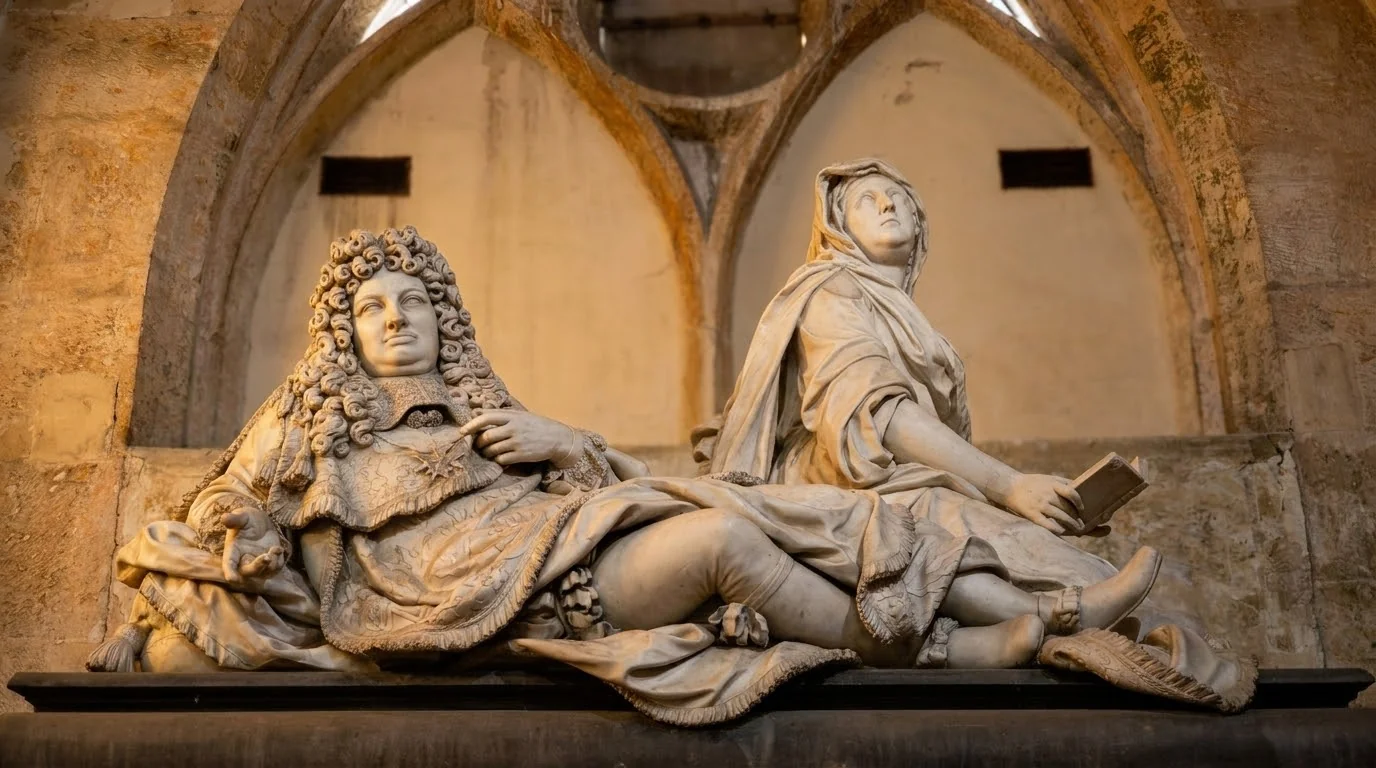
Then came the French Revolution. The tomb was desecrated, and Lebois' ashes were scattered. According to one source, they were thrown into the Seine. The monument itself was managed by Alexandre Lenoir (1761–1839), the man who collected art from desecrated churches, to transfer to the Musée des Monuments français that he founded. When that museum closed in 1817, the pieces were left without a home. In 1819, Lebois' descendants decided to reassemble the tomb monument, and they did so in the left chapel of the Great Hospital Hall in Tonnerre.
In other words: the tomb of one of the most powerful men in 17th-century France was returned to the land he had bought, magnificent as it was, without any of his belongings in it. I stood in front of it and thought not of the French army but of the fact that he had finally won a game he did not know he was playing: the building built by a countess who gave her money to the sick is the building that saved his tomb. And by the way, in 1826 a new tomb was also installed for Marguerite of Burgundy, in the place where the original tomb stood.
In the 18th century, it was decided to expand the hospital building. Between 1763 and 1767, new halls were built, including the hall named after the Marquis de Courtanvaux, who was a Count of Toner and a supporter of the hospital. That construction required the demolition of the street front and the foyer of the great hall, which is why the front of the building looks completely different today from the old part. In 1785, the astronomical noon line I mentioned above was installed in the hall. After 1792, part of the building was used as a covered market and later as a straw warehouse, and the bell tower that was there was demolished. In 1862, the place was recognized as a protected heritage site.
The Chevalier d'Aunt: The Spy, the Dresses, and the Autopsy
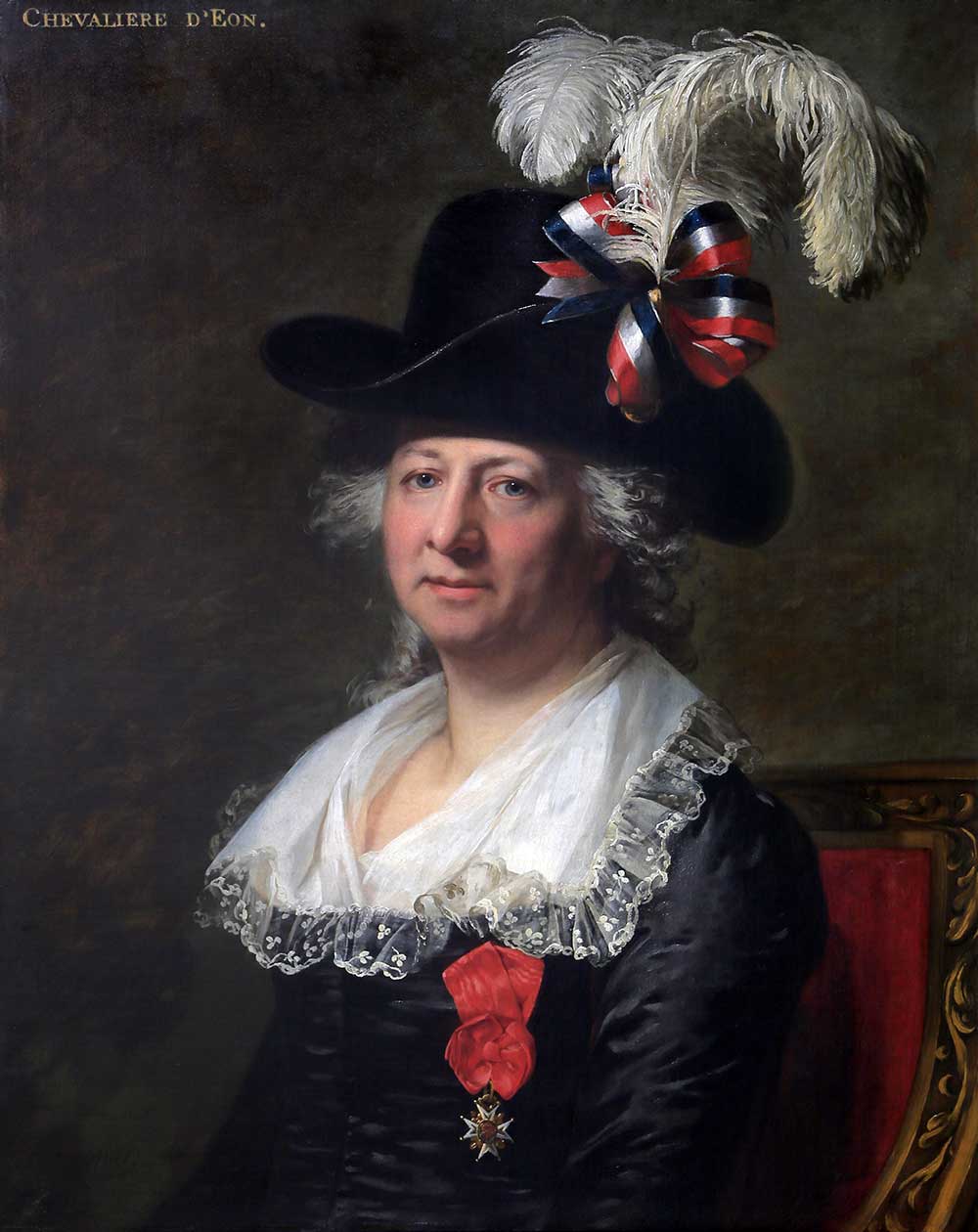
On October 5, 1728, in Auteuil-d'Ouzes, Charles d'Éon de Beaumont (1728–1810) was born. His father, Louis d'Éon, was a lawyer in the Paris parliament, a royal advisor and administrator of the royal estates in the region, and he was also the one who initiated the construction of the laundry around the Pois Dion in 1758. The son was given a series of first names, including women's names, and according to what he himself wrote in his autobiography, he was born wrapped in placental membranes and the city doctor was unable to determine his sex.
He studied in Paris, received a bar certificate in 1749, and in 1755 was sent by Louis XV (king from 1715 to 1774) on a secret mission to the court of Empress Elizabeth (Empress of Russia from 1741 to 1762) in St. Petersburg. There, according to the accepted version, he disguised himself as a woman in order to evade the British Navy, which did not allow French men to enter Russia. He was accepted as the Empress's chief reader and, through diplomatic port work, contributed to the rapprochement between France and Russia at the beginning of the Seven Years' War. During this war, he served as a captain in the Dragoon Corps, and was later sent to London as secretary of the embassy. Among other things, he prepared a plan there for a naval invasion of England.
In London, the matter exploded. The question of the Chevalier d'Aun's gender became the talk of the town and the subject of real financial interventions, while at the same time he got into trouble with his senders and was in possession of secret documents of the king. In the end, it was decided to "send him into retirement"; he received an allowance and protection, and in return he undertook to appear in public as a woman. And so between 1779 and 1785 he was kept under house arrest in Tonnerre, the family home where he was born, while wearing women's clothing.
He then returned to London, where he deteriorated. He lost his pension after the Revolution, sold his library in 1791, and earned his living by fencing, always in dress. He went to debtors' prison in 1804, was released, and after a fall was left paralyzed. He died in London on 21 May 1810, aged eighty-one, in poverty, in the house of an Englishwoman named Mary Cole. When the body was prepared for burial, it was discovered that it was that of a man. On 23 May, Surgeon Copeland, in the presence of seventeen witnesses from the Faculty of Medicine, signed a report stating that the male organs were fully developed. A previous examination, made while he was still alive without removing his clothes, had determined exactly the opposite.
He was buried in a church at St Pancras in London, and his grave disappeared in the bombings of 1940. What remains of him is a house in Toner, a cistern that his father turned into a laundromat, and a fascinating story about a man/woman who became one of the most famous spies in history.
The Vineyards, the Canal, and the 20th Century
At the end of the 18th century, Tonnerre became the main town of an administrative district, from 1790 to 1795 as a district and then, from 1800 to 1926, as a département. In the first half of the 19th century, the Burgundy Canal was completed, which ran from the Seine basin to the Saône basin and connected Tonnerre to a real movement of goods. At that time, the vineyards covered around 5,817 hectares, and most of the wine was sent to Paris.
Then came the train, and with it cheap wine from Languedoc, which took over those markets. Diseases followed: first a moth that ate the leaves in the 1930s and 1940s, then downy mildew, and from 1883 phylloxera. In 1956, a severe cold wiped out what was left of the young plantings. The one who managed to revive the vineyards in the late 1970s and 1980s was the head of the Apinoy council, André Durand, who pushed for the restoration of the appellation and the purchase of land for winemakers.
During World War II, Toner was bombed three times. In June 1940 by the Germans, and later in the war by Allied aircraft, one of which hit the church and killed fourteen people. The scars of these bombings are still visible on Notre Dame.
What's happening there today? At the 2022 census, Tonnerre had 4,268 residents, a decline of more than nine percent in six years. It is a town that is losing people, like many small towns in inland France, and which is at the same time trying to turn its heritage into something that sustains it: it bears the label “Small Town of Character” (Petite Cité de Caractère), the Poisson-d'Or is in the midst of a restoration program with public fundraising, the Hôtel-Dieu has been transferred to management that is trying to attract a new audience, and the Hôtel d'Ouzes is working on opening it to the public. In the summer, it hosts an academy of ancient music with concerts in churches, at Easter, “The Wines of Tonnerroises” (Les Vinées Tonnerroises) is held in the large hospital hall, and in September of even-numbered years there are half-days. In 2013, a French film named after it was also filmed there, and several of its scenes take place in Poisson-d'Or.
Where to sleep in Toner
There aren't many hotels in Toner, and that's why the choice is simple. I chose three places in three different ranges, and all of them have a page on Booking.com. The scores are correct as of the last check and naturally they move a bit.
-
The Abbey of Saint-Michel
This is the choice with the story. The place is located in the former Abbey of Saint-Michel, the same abbey that stood opposite the Counts' Castle on the other side of the valley and appears in every historical document of the town from the 10th century onwards. For years it was a starred hotel and restaurant, and today it is a four-star guesthouse with eight rooms, a heated indoor pool, a garden, an inside restaurant and a collection of vintage motorcycles scattered throughout the building, a combination I did not expect in a monastery. The rooms are large and the design is bold. It is above the town, about a fifteen-minute walk from the center up Montée Saint-Michel, and for those traveling by car this does not matter at all. Booking score: 8.5 to 8.7, based on hundreds of reviews.
-
The Abbey Source
Neighbor of the monastery, in a nearby village called Chemin de Bel air, and in the eyes of the balanced option in the town. Three stars, about six hundred meters from the center, that is, ten minutes on foot and the whole town is open to you. There is a heated pool, garden, bar, free private parking, restaurant, and a continental breakfast that is brought to the room, which sounds like a treat and in practice also solves the problem of a town where not all cafes are open at seven thirty in the morning. The rooms are air-conditioned and some have views of the valley and the town. Booking score: 9.0.
-
Hôtel du Centre, Restaurant Le P'tit Gourmet
If you arrive by train and want to sleep in the heart of the town, this is the option. A small, family-run hotel with nine rooms on rue de l'Hôpital, that is, exactly between the station, the Hôtel-Dieu and the Fosse Dion, about two hundred and fifty meters from the Saint-Pierre church. It has a French restaurant and a pizzeria, breakfast in the dining room or on the terrace, and free public parking right in front of the building. I say this in all honesty: its score on Booking is around 7.4 out of more than four hundred reviews, meaning it doesn't compete on interior design. The rooms are simple and without air conditioning. What guests mention again and again is the attitude, the food and the location, and that's exactly what you need from a hotel in a town like this.
If all three are full, it's worth checking out the surrounding villages, especially towards Afinoy-Vozin, which have guest rooms in stone houses and winemakers' courtyards. This is a good solution only if you have a car.
I myself stayed in Auxerre, at the Hôtel Les Maréchaux , an intimate three-star hotel with a beautiful garden and pool, where each room is decorated in the Empire style and named after one of Napoleon's marshals. If you're traveling in the area for a few days, Auxerre is a convenient base, and you can find the rest of my recommendations for hotels in the city in my article on Auxerre.
Questions and Answers
How long does it take to toner?
Half a day covers the four must-sees: the Foss Dion, the Hôtel-Dieu, the Church of Saint-Pierre and the façade of the Hôtel d'Ouzes. A full day if you take a leisurely stroll into the hospital museum and have a meal. If you add Chablis or the surrounding chateaux, that's two days in the area, and a reasonable base toner for that.
What if I only have two hours?
The Fos Dion and the Hôtel-Dieu, in that order. Both in the center, a short walk from each other, and they are two things that have no replacement anywhere else in France. The climb to the upper church can be completed with another visit.
Can I dive in Fos Dion?
No. Diving was banned in 1996, after three diver deaths, two in 1962 and one in 1996. Since 2018, exceptional permits have been granted to one professional diver under supervision and guidance, and he too did not find the source of the water. From above, viewing is free and there are no opening hours.
Is the Hôtel-Dieu open all year round?
No. It operates seasonally, from roughly Easter to the end of September, with extended hours in July and August. Adult tickets start at eight euros. Hours and prices vary from year to year, so check the booking interface on the official website before setting a date.
Need a toned car?
Not for the town itself, which is all within walking distance of the station, but yes if you want Chablis, the vineyards of Apinouille and the castles of Molen, Tenelles and Annecy-le-Franc. There is no reasonable public transportation to them.
Does Toner work as a day trip from Paris?
Yes. An hour and a half by direct train from Paris-Bercy station, and the Hôtel-Dieu is less than five hundred meters from the station, so there is no time wasted on the edges. I would still prefer to combine it with two days in the area with Auxerre or Chablis, because for a town of this size it is a shame to waste four hours by train.