
in short
- 1st to 3rd century AD: A secondary settlement on the edge of the territory of the Swallows, which becomes a separate Roman civitas called Autessiodurum.
- 418-448: Germain, a Gallo-Roman governor, becomes the city's bishop and its founding saint.
- 841-859: The Carolingian Crypts of the Abbey of Saint-Germain: the oldest frescoes in France, and one of the centers of knowledge of Europe.
- 1215: The Gothic cathedral begins. The south tower was never built, so it stands to this day with one tower.
- 1396-1538: An Easter service was held in the cathedral where the clergy danced around the labyrinth and played with a large yellow ball.
- 1429: Joan of Arc passes twice. The second time the city refuses to open the gates.
- 1567 and 1790: The Huguenots loot the cathedral; the revolution abolishes the bishopric, and the city does not receive it back.
- March 17, 1815: Napoleon and Marshal Ney meet in Auxerre on the way to Paris.
- 1849: The train from Paris stops seventeen kilometers from the city and does not enter it.
- 1886-1910: Phylloxera and cheap wine from the south are wiping out forty thousand hectares of vineyards.
- 1905 and 1996: A cathedral vicar founds AJ Auxerre; ninety-one years later, the French championship.
In the summer of 2025, archaeologists from the French Institute of Archaeology stood in a field three kilometers south of Ausserre, digging into the earth over an area of one and a half hectares. What they found was a Gallo-Roman villa that should not have been there at all: baths, marble, frescoes, mosaics and walls preserved to a height of about a meter, which the excavation director Alexandre Burgevin described as an exceptional state of preservation in a rural setting.
This site, near a place called Sainte-Nitasse, had been known since the 19th century. In 1966, they dug it up a bit for a gravel quarry and found a single square building. Then it was abandoned for another sixty years.
And what finally caused the digging? The fact that they decided to pave a bypass road for Asr.
And that, to me, is the most accurate thing that can be said about Ausser. History has bypassed this city again and again, and each time it has bypassed it, something has been preserved that has been erased elsewhere. It was separated from Sens in the third century, it lost its bishop in the Revolution, the train passed seventeen kilometers of it in 1849 and did not stop, and the vineyard that fed Paris died twice. The surprising result of all this is one of the most complete cities in France, and a football team that on paper should not have existed but has become one of the most important teams in France. Two thousand years, three threads: the river, the church, and the vine. Let's pull them.
The city born from a split
The swallows, the river and the road
Oser was not founded. It split.
The hill on which the city sits was on the southern edge of the territory of the Senones, one of the most powerful Celtic tribes in Gaul, of whom Julius Caesar himself wrote that he enjoyed great status among the others. Their capital was Agedincum, which is today's Sens. Osser was a stopover on the way, a settlement on the mountain called (according to custom) Otric, and in the first century AD it was no more than a secondary cluster of houses.
Then, in the third century, the Romans decided to cut off the southern Senone region and establish a separate civitas from it: Autessiodurum. By the fourth century, it was already one of the seven cities of the new province, surrounded by a wall, a provincial capital in every sense. And Senes, about ten minutes' drive away today, remained the metropolis. These two cities fought for primacy for the next fifteen hundred years, but Osser lost almost every round. We'll come back to that.
What turned this settlement into a city were two lines that intersected it.
The first is the Yonne, a river that can be navigable towards the Seine, that is, towards Paris. The second is the Via Agrippa, the Roman road that connected Lyon to the north and rolled to Ausser between 40 and 50 AD. A city that has both a port and a main land route can trade. This nucleus, about six hectares above the river, is exactly where the cathedral will later stand.
The vineyard has been here from the beginning, too. In nearby Escolives-Sainte-Camille, a 2nd-century relief of clusters of grapes is found, the earliest evidence of vines in the Ausser region. Eighteen hundred years later, the vineyards of Chablis grow twenty kilometers from here.
Some things don't change. We'll meet this highlight again at the end of the article, in a less flattering situation.
Germain: The governor who threatened to kill the bishop, then succeeded him
This is the city's founding story, and it's much juicier than what's told in church.
Germain (378-448) was a man of the Gallo-Roman elite, a governor appointed by the empire, who lived in Auxerre and administered a vast territory. Like any respectable aristocrat of his time, he loved to hunt, and in accordance with local custom, he used to hang the heads of the animals he hunted on a large pear tree in the center of the city. The bishop at the time, Amâtre (Bishop of Auxerre from 386–418), considered this to be pure idolatry. He tried to persuade with kindness. It didn’t work.
So he waited for Germain to leave the city, and cut down the tree.
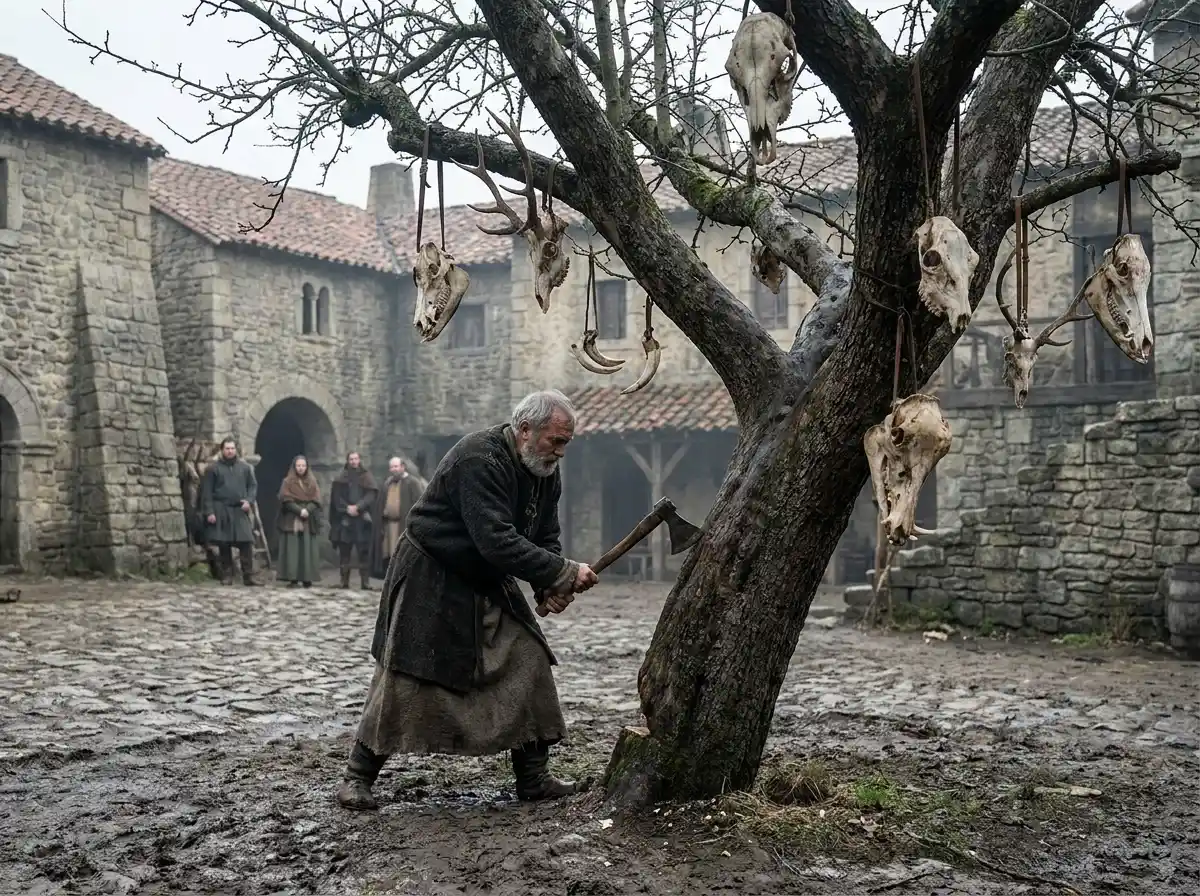
Germain, who was not known for his restraint, threatened to kill him. Amator fled to Autun, where he found refuge with the local bishop and under the protection of the prefect. And there, according to tradition, he received a revelation: the man who wanted his head would be his heir. Amator returned to Ausser, managed to convince Germain to convert to Christianity, ordained him a priest, and before his death appointed him his heir. Germain, according to what is said, did not want this at all.
He became one of the most important churchmen of the fifth century, traveled twice to Britain to combat the Pelagian heresy, died in Ravenna, Italy, and his body was brought back to Osser in a funeral procession. The monastery that can be visited today was built on his tomb (there is also a famous church named after him (Saint-Germain-l'Auxerrois) in Paris, right opposite the Louvre ).
Take a moment to digest this chain: A man threatens to murder a bishop over a tree, and becomes one of France's most famous saints.
A thousand years of bishops
The crypts, the school, and the oldest paintings in France
The monastery that stood on the tomb became a huge center. The Carolingian crypts built between 841 and 859 have survived, and contain frescoes that are considered the oldest in France. At that time, the “School of Osser” operated here, one of the centers of the Carolingian Renaissance, whose teachings spread throughout Europe. The bishops of Osser in the ninth century were courtiers, government confidants, and men of letters who corresponded with the greatest scholars of the period. They also took care to document themselves: the list of bishops of Osser, an exceptional document in all of France, was begun here by two canons in the 70s of the eighth century, and continued until the 13th century.
That is to say: this small city on the Ionian Sea was, for a time, one of the important centers of knowledge in the West.
The cathedral that remained with one tower, and the priests who played football in it
In 1207, Guillaume de Seignelay (1164-1223) ascended the bishopric of Auvers. He looked at the Romanesque cathedral that stood there, decided it was archaic, and ordered it to be demolished. In its place, he wanted a building in the new style coming from Île-de-France, the one that generations later would contemptuously call “Gothic,” that is, barbaric.
In 1215, work began on two places at the same time: the choir, built over the Romanesque crypt that had been preserved as a foundation, and the south tower of the west facade. The choir was ready within fifteen years. Then it stopped, because Guillaume's successors were less enthusiastic than he.
From then on, construction continued lazily, generation after generation. The Romanesque nave was only demolished at the beginning of the 14th century and the new one was erected in the 20s to 50s. At the same time, the side chapels were built between 1345 and 1355. The Hundred Years' War delayed everything, so the south wing was only completed in 1378. The north wing of the transept was begun in 1415. The stained glass windows of the nave were installed between 1390 and 1410. The north tower was completed in 1543.
And the south tower, the one they started in 1215? It was never built. When the Wars of Religion broke out, all hope of finishing the front was gone.
Three hundred years of construction, and in the end half a facade. Anyone who looks at it from the bridge will see it immediately.
Oser's football
In the archives of the cathedral's Capitol, a regulation of April 13, 1396, entitled Ordinatio de pila facienda, is preserved, which regulates a ceremony held on Easter Monday. The Dean of the Capitol would stand alone in the center of the labyrinth on the floor of the nave, holding a large yellow ball, begin by singing the Easter prose, and begin to march in a three-time rhythm. Around him, the clergy, holding hands, dance around the labyrinth. Then he would throw the ball to the apprentices, and they would return it with their hands and feet, while their fur cloaks flew in the air, and the ball would bounce from pillar to pillar.

The priest Jean Lebeuf (1687–1760), himself a member of the Ausser Capitol, described it in the 18th century as “a great oddity.” Modern scholars read it differently: the dance and the ball represent Messiah’s victory over Hades, the labyrinth is Hell, and the yellow ball is Light.
The ceremony was abolished in 1538. The maze itself, which had existed on the floor since 1334, was destroyed in 1690. That is, both the game and the field were eliminated, a hundred and fifty years apart.
And by the way, I know exactly what you're thinking. Auxerre is a city whose team, AJ Auxerre, has become a national brand thanks to a club that has nurtured generations of players. It turns out that the first team in the city was the Capitol of the Cathedral, and the pitch was the floor of the church. Remember that, I'll come back to it at the end.
A barricade between two masters, and Joan of Arc behind closed doors.
To understand what happened here in the 15th century, you have to understand where Osser sits: right on the seam line between the royal estate and the Duchy of Burgundy. And that means it passed from hand to hand.
In the summer of 1412, after Bourges had fallen and the civil war between the Armagnacs and the Burgundians had reached its peak, the royal army settled in Auxerre. The rival princes spent four whole weeks in the city to negotiate peace for the entire kingdom. Charles VI (reigned 1380–1422) fell ill again during that time, so the festive ceremony was presided over by Charles d'Orléans (1394–1465). On August 22, everyone in the kingdom was invited: yesterday's rivals, the heads of the clergy, the great nobles, the presidents of the Paris parliament. Everyone swore to renounce any alliance with the King of England, everyone received a pardon, everyone received back the properties and positions that had been confiscated from them.
According to the story, while the ceremony is taking place, the Duke of Orléans is surrounded by three thousand men camped nearby, and Jean sans Peur (1371–1419) is living in a Dominican monastery under the guard of Savoyard cavalry, English tool bearers, and archers. Peace is signed, and no one takes their hand off their sword.
This peace lasted a short time until the assassination of Jeanne the Fearless in 1419 by supporters of the House of Orléans. In February 1429, on her way from Lorraine to Chinon to meet the Dauphin, Joan of Arc passed through Bowser. The protocol of her interrogation, the document that has survived to this day, states that she heard mass in the “Great Church,” that is, in the cathedral. The city at that time was in the hands of the Anglo-Burgundians, that is, the enemy.
In the summer, on her way to the coronation in Reims, she returned with the royal army. This time the city refused to open the gates. The people of Ausser, who were leaning towards the Duke of Burgundy, feared reprisals if they let the French in. Three days of negotiations, and only in the face of a real threat of an assault did they agree to provide supplies to the army, without opening the gate. The army continued north, and the king was crowned in Reims. Today you will find a statue of Joan of Arc in the cathedral and considering the treatment she received, this seems a bit hypocritical to me…
In the Treaty of Arras of 1435, Charles VII (king 1422–1461) cedes to Philip the Good (Philippe le Bon, 1396–1467) the county of Auxerre along with Mâcon and the cities of the Somme. That is, from 1435 Auxerre is officially Burgundian. However, in 1477 Charles the Bold (Charles le Téméraire, 1433–1477) is killed in the Battle of Nancy, Louis XI (king 1461–1483) introduces his troops into Burgundy, and in the Second Treaty of Arras, of December 1482, the county of Auxerre is among the territories intended to return to the royal estate. After a century of uncertainty, Auxerre is French.
The Wars of Religion and the Hessian Century
1567: The Huguenots, the missing treasure, and the bishop shot at
On the night of September 28, 1567, a combined Huguenot plan to seize dozens of cities across France at once was put into effect. In Baux, it succeeded. The city fell into Protestant hands, the cathedral was looted and desecrated, and the church treasury was dispersed.
And here begins one of the most interesting stories of the area. According to testimony given in an official investigation from 1610, a woman said that the ark of St. Germain could not be broken with any hammer blow. Therefore, according to her testimony, it was buried at night in the yard or garden of a nearby mansion, by a builder who the owner of the mansion made sure to get rid of him later, so that he would not give away the place.
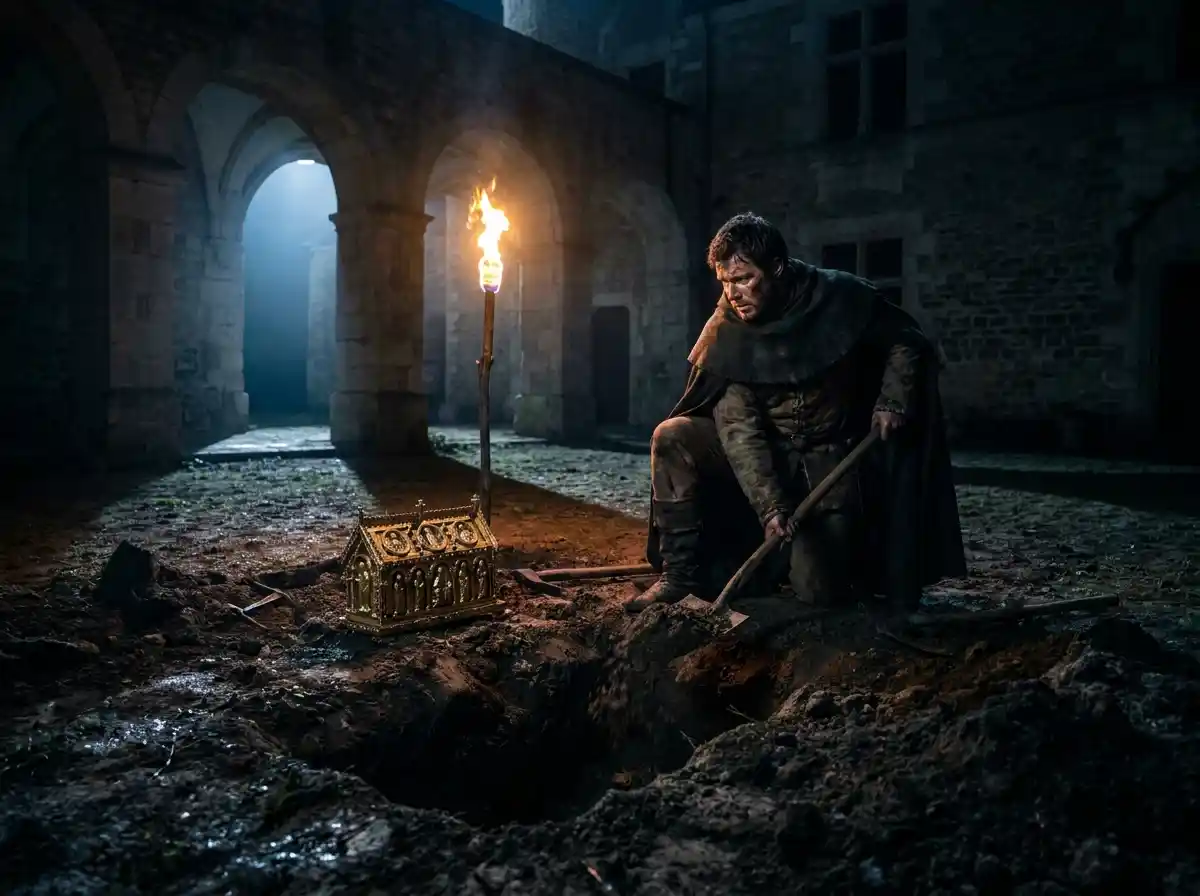
Since then, many excavations have been carried out there. To this day, according to local sources, there are residents in the area who believe that the treasure is still in the ground.
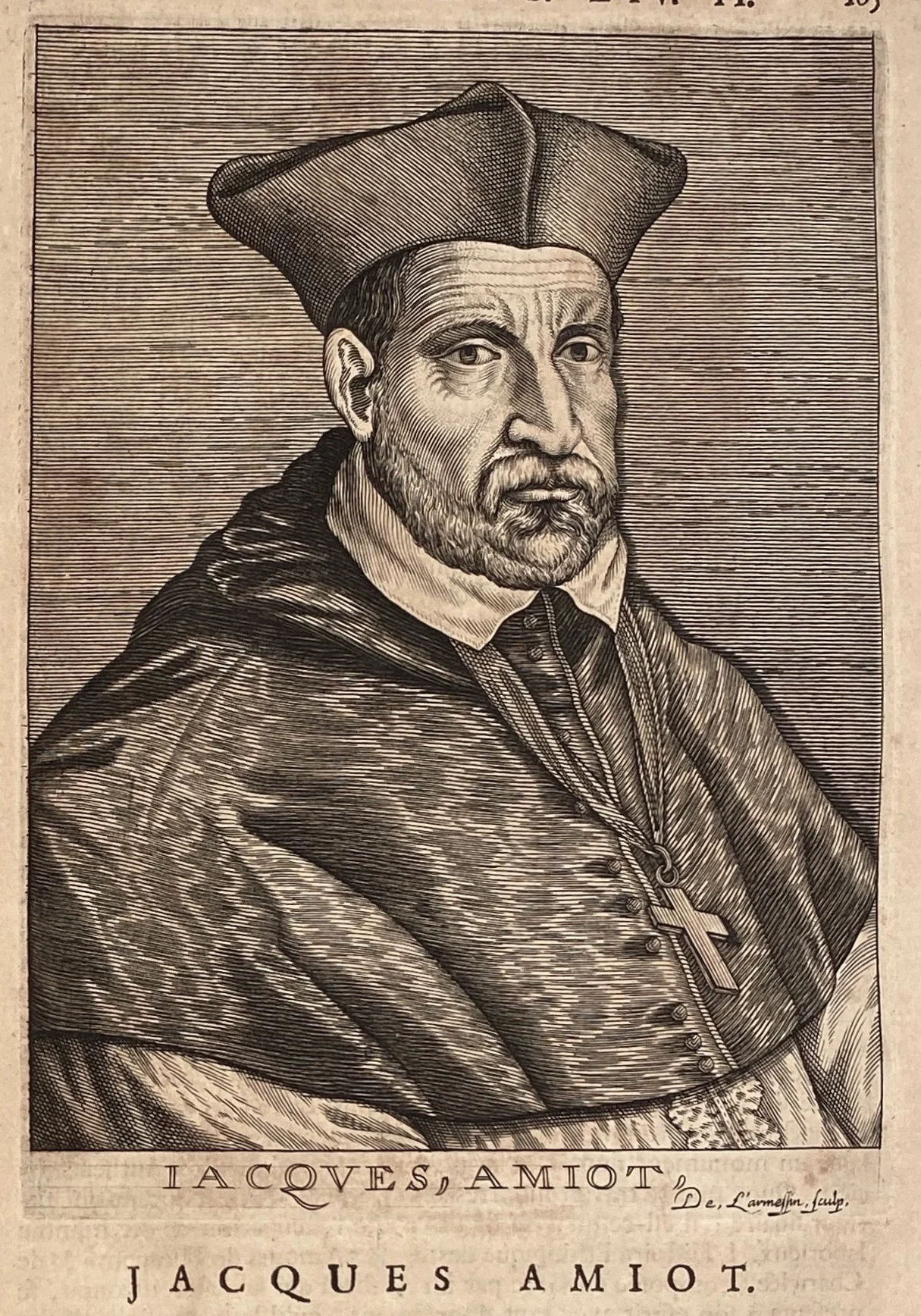
In 1570, Jacques Amyot (1513–1593), one of the most influential figures in 16th-century French culture, was appointed Bishop of Auxerre. He was the tutor of the children of the royal family and later the chief priest of Charles IX (reigned 1560–1574) and Henry III (reigned 1574–1589), and his translation of Plutarch is the text through which all of Europe read Greece and Rome (Shakespeare, incidentally, drew from him through the English translation). After his cathedral was destroyed and looted, it was he who initiated its restoration in 1576, including the stained glass windows in the choir.
Then, in December 1588, Henry III murdered the Duke of Guise and his brother the Cardinal at Blois . Amiot was there. The Faculty of Theology in Paris, the stronghold of the Catholic League, excommunicated all the clergy who had attended Mass with the king after the murder. Amiot was on the list. And in Oss, his city, it made his life hell.
In a letter to the Duke of Nevers that year, he describes how hardly a day passed without a new blow: his houses were looted, his property was robbed, and more than once a gun was pressed to his chest. There is a version that one of the members of his own cathedral capitol shot him with a gun during a procession in the spring of 1589. He was forced to leave the city for a while. He returned, and died there.
I find it quite ironic that one of France's leading clerics, a man who gave French its classical prose, spent his final years being haunted by his own city. What do you think?
Port Royal II, and Restif out of print
Almost no one tells this, which is a shame, because in the 18th century, Oss was one of the most turbulent places in France from a religious perspective.
Bishop Charles de Caylus (1669–1754) served as bishop of Auxerre for fifty years. He refused to accept the bull Unigenitus, which condemned heresy, and joined the group of bishops who challenged it before a general council. Louis XV (1715–1774) responded in the usual way: he exiled him, by signed decree, to his own diocese.
Caillois took full advantage of this. He made Auxerre a refuge for priests who had been smuggled out of other dioceses, and secretly printed the forbidden Jansenist newspaper Nouvelles ecclésiastiques in the city. In the villages of Treigny and Ronchères, in Puisaye to the west of the city, what local sources call the “center of leadership of the Jansenist party” and the “second Fort-Royal” arose. In 1720, a new owner arrived at the nearby castle of Ratilly, who hosted Jansenists who had been drawn to the patronage of the bishop of Auxerre. Caillois died in 1754, the last of the openly Jansenist bishops in France. His writings were banned by Rome.
And what's important here isn't the theology. What's important is that Osser in the mid-18th century is a city of printing houses, and in one of these printing houses, a romantic story actually took place.
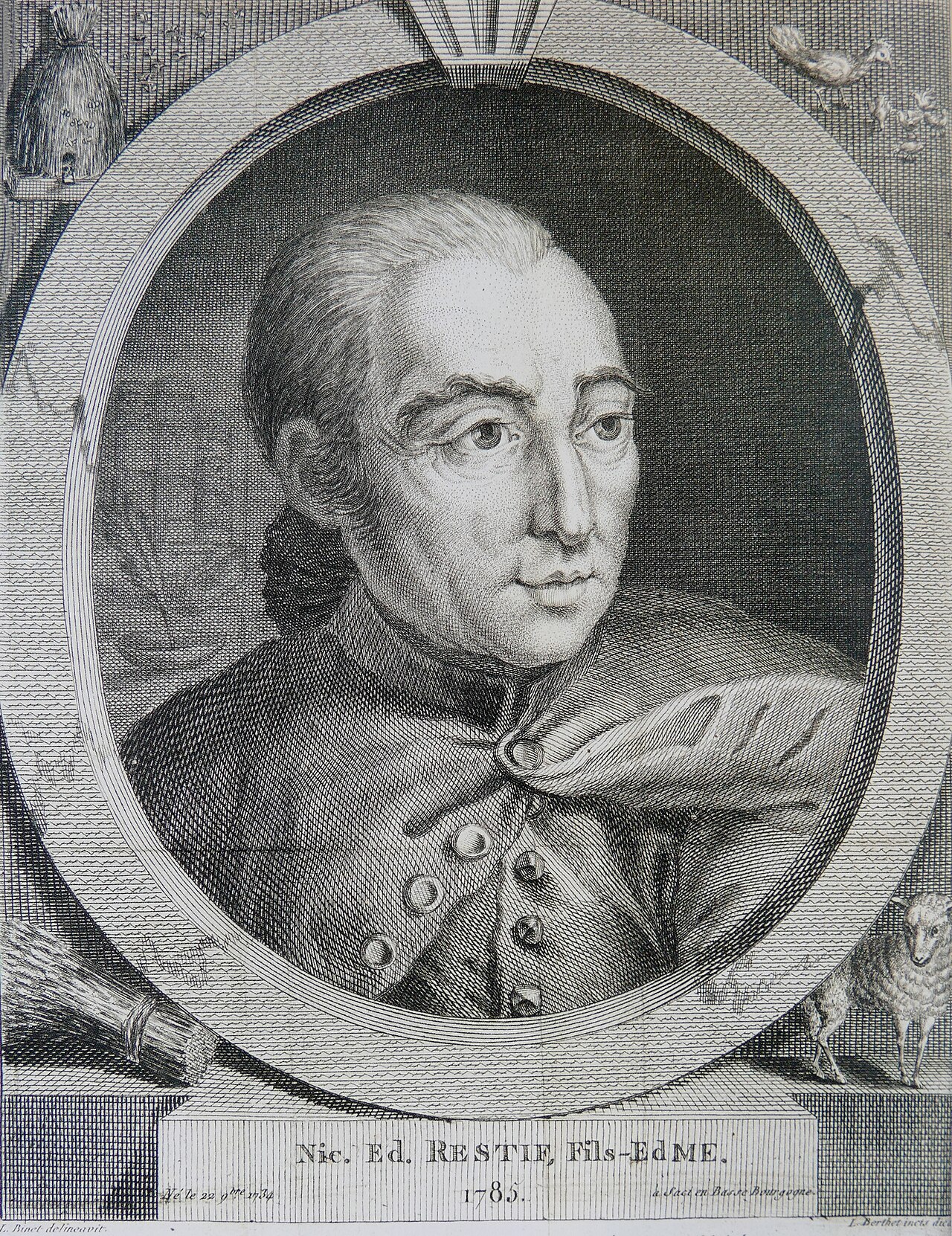
On July 14, 1751, a 16-year-old boy from the village of Sacy was sent to Auxerre to be apprenticed to the printer François Fournier. His name was Nicolas-Edme Restif de La Bretonne (1734–1806). According to the legend he himself cultivated, by the age of 15 he had already had a dozen mistresses.
At Bausser he fell in love with his employer’s wife, Marguerite Collet. In his work he would forever call her “Madame Paragon” (the name is derived from the typographic term paragon, an inside joke of a printing press). These four years were, by his own admission, the moment that cut his life in two. He was fired, went to Paris, and became one of the most prolific and scandalous writers of the 18th century, the one whom the Marquis de Sade (1740–1814) considered a sworn rival.

A statue of him now stands on Rue de l'Horloge in Auxerre, in the pedestrian district. It stands on the very street where he wandered as an apprentice printer in love.
The Revolution: The City Replaces Bishop with Prefect
Auxerre was, as we know, a bishopric from the fourth century, but all this changed during the French Revolution. On July 12, 1790, the Civil Constitution of the Clergy abolished the bishopric of Auxerre, leaving that of Sens intact. Sens again. The last bishop, Champion de Cicé (1725–1805), refused to take the oath and went into exile in Germany in 1792.
In 1801, following the Concordat, Pope Pius VII (pope 1800–1823) abolished the bishopric of Auxerre completely and annexed its territory to that of Troyes. In 1817, its return was promised, but the agreement was never ratified. In 1822, the archbishopric of Sens was re-established. Auxerre did not receive its bishopric back. To this day, the title is held by the Archbishop of Sens (who, incidentally, was also the archbishop responsible for Paris for a long time in the past, and even built a palace there in the late 15th century, which you can read about in the article about Queen Margot ).
Meanwhile, the city goes through what everyone else has gone through. The cathedral becomes a “temple of reason” and reopens for worship only in 1795. The monks of the Abbey of Saint-Germain are expelled in 1790, the abbey building itself is destroyed in 1793. The church of Saint-Eusèbe becomes a prison until 1798.
At the same time, in 1790, Oss became the provincial capital of the new department of Ion. From a bishopric capital, it became an administrative capital. Instead of a bishop, a prefect.
And that is exactly what will save the city in the next century.
Cadet Roussel: How a mocking song became the anthem of an entire army
Guillaume Joseph Roussel (1743–1807) came to Ausserre from the Jura region as a young man. He began his career as a servant, continued as a clerk for a court messenger, and thanks to marriage and a modest dowry, in 1780 he managed to acquire the position of chief messenger of the local court. A year later he bought himself a small, crooked house, and built an old gate above it, a kind of narrow and strange loggia. He was cheerful, eccentric, and loved by the townspeople.
In 1792, a local dignitary named Gaspard de Chenu, who local sources describe as his political rival, composed a mocking poem to an existing tune. The poem poked fun at the man who had everything in triplicate: three houses, three hats, three dogs.
It was supposed to remain a local joke. But Oser volunteers took the song with them to the army, the soldiers adopted it enthusiastically, and it became the marching song of the Northern Army and from there spread throughout France. To this day, children sing it in every school in France.
He died in Austerlitz without descendants. To history he was no more than a local court messenger. To France he is immortalized by a poem written to humiliate him.
March 17, 1815: The night Napoleon made the Marshal sweat
On March 1, 1815, Napoleon I landed at Golfe-Juan. Seven days later, at the Tuileries, Marshal Michel Ney (1769–1815) promised King Louis XVIII (reigned 1814–1824) that he would arrest the invader and bring him back to Paris “in an iron cage.” At that moment, according to most historians, he meant it.
Then the march began. Grenoble on March 7, Lyon on the 10th, and all the way Napoleon's army was joined by more and more soldiers who had crossed the border. Ney, who was sitting with the troops who were supposed to block the road, realized that his soldiers would not fire.
Napoleon had spent the night before at the Hôtel de la Poste in Avignon , with a mayor who refused to address him as “Your Majesty” (I wrote a separate article about that night). And so on March 17, Napoleon arrived in Oss and was received in the Prefecture of Yonne as head of state for all intents and purposes. Ney arrived in the city that evening and asked to see him. Napoleon, who knew exactly what he was doing, told him to come back the next day. He was in no hurry. On the morning of March 18, they met. A close witness says that Ney entered through the inner corridor, stood alone in the room next to the bedroom, his eyes full of tears. The door closed behind them and no one heard what was said.

This was the first marshal of the empire to return to Napoleon, and it broke the last line. That afternoon Napoleon supervised the loading of his men into boats on the Hyne. The next day, March 19, Louis XVIII fled Paris.
Eight months later, the situation changed completely. Napoleon lost the Battle of Waterloo and Louis XVIII returned. Ney was on trial for treason and asked the judges, regarding that meeting at Auvers, if it was possible to stop the sea with two hands? The judges were not impressed and sentenced him to death. And so it was that fateful meeting that sealed his fate and ended his life.
19th century: The train bypasses, the vineyard dries up
The river that worked, and the train that bypassed
For more than three hundred years, Paris was heated by the wood of the Morvan. The logs were thrown into the rivers, drifted to Clamecy, where they were assembled into enormous rafts: seventy-two meters long, two hundred logs, a week’s construction for six experienced workers. From there they were floated down the Yonne and then the Seine to the Bercy quays in Paris. In 1804, the peak year, more than five thousand such rafts arrived in Paris.
The Canal du Nivernais, the one that tourists sail on in rented boats today, was dug for this business. The rafts ceased to exist towards the end of the 19th century, when the Heure and the Seine were canalized and replaced by barges that went down with one hundred and fifty tons each. Then coal came and killed that too.
In 1849, the Paris train reached Laroche, a tiny village at the confluence of the Hône and Armançon. The main Paris-Lyon line, the one Napoleon III traveled on and which was nicknamed “the imperial artery,” did not pass through Auxerre.
Osser received a branch in 1855. A single track, opened for passengers on 11 August and for freight on 5 October, from Roch to a terminus. In 1870 it was extended to Calais, in 1893 to Cun. In 1880 the village of Roch received a locomotive depot, and from then on it grew into a railway junction with three rotundas and a rapidly growing population.
In other words: the provincial capital received an extension, and the village that no one had heard of received the movement…
But here too, Ausser turned lemons into lemonade and managed to profit from what seemed like defeat (just like the previous times). As you probably know, most historic places that developed economically had to demolish a significant part of their historic structures in order to build modern buildings that would suit progress. In contrast, the historic center of Ausser remained intact precisely because the train did not enter it, and we enjoy the beauty of the city even today.
Paul Baer, the son who closed the church
In October 1833, Paul Bert (1833–1886) was born in Auxerre. He studied law, changed direction, and became one of the brightest students of Claude Bernard (1813–1878). His work on oxygen toxicity made him the father of diving and aviation medicine, he was the youngest professor in France at Bordeaux , and from 1869 Bernard's successor at the Sorbonne.
Then came 1870 and brought him into politics. He was elected as a member of parliament for the department of Hône from 1872. A declared anti-clerical, he was a member of several liberal associations, and in November 1881 he was appointed Minister of Education in the government of Léon Gambetta (1838–1882), succeeding Jules Ferry (1832–1893). As Minister of Education of France, he was one of the fathers of the concept that a school in France should be free, secular and compulsory. In 1886 he was appointed High Commissioner of Annam-Tonkin. He died there of cholera a few months later.
There is a line here that cannot be missed: the city that was a bishopric for fourteen hundred years, that was a Jansenist stronghold, and that lost its bishop in 1790, was actually the one that gave France the minister who removed the clergy from the classrooms.
By the way, on the street that bears his name in Paris there is an excellent bistro , and even if you don't remember his name because of his education reform, you will certainly remember him for the excellent food served there.
Forty thousand hectares of vineyard, and then nothing
Remember the grape relief from Askoliv, which I mentioned at the beginning of the article? Here's what happened to it.
At the beginning of the 19th century, the Yonne was the largest wine region in Burgundy, ahead of the Saône-et-Loire and the Côte-d'Or. In the middle of the century, the vineyard area reached forty thousand hectares. The "little wine of Auxerre" supplied the taverns of Paris and its suburbs, and descended by boat down the Yonne, and continued from Rouen by sea to Britain and the northern countries. It completely eclipsed Chablis.
Then three blows. Oidium and new leaf diseases. Phylloxera, the same American aphid that ate the roots of European vines. And a third blow, which was not a disease at all: the railway, which began to bring cheap wines from the south to Paris. Between 1886 and 1910, the Ausser vineyard was almost completely wiped out. Farmers switched to cereals and cherries.
The restoration only began in the 1970s, thanks to a few winemakers who refused to give up. The appellation “Bourgogne Côte d’Auxerre” was only recognized in 1992. This means that the official recognition of Auxerre wine is younger than most of my readers…
(On the region's vineyards and what happened to them later, see Yossi Drori in the article Through the Wine in Burgundy .)
The 20th Century: War, Football, and Conservation
The War: Rene Levy, and August 24, 1944
Renée Léa Lévy (1906–1943) was born in Ausser on September 25, 1906. Both of her parents were literature teachers who taught in the city, and her grandfather was Alfred Lévy, Chief Rabbi of France from 1907 to 1919. Her father died when she was three, and her mother moved with her two daughters to Paris.
She received a degree in classics in 1932 and taught in Lille and Paris. At the outbreak of war she joined the resistance cell of the Musée de l'Homme and distributed propaganda materials. After the network was disbanded she moved to the Hector network, which specialized in collecting military intelligence, transmitting information to London about German equipment and troop movements from a transmitter kept in her home.
She was extradited. On October 25, 1941, she was arrested, the transmitter in her. La Santé prison in Paris, and then, on February 11, 1942, she was deported to Germany under the German order known as “Nacht und Nebel,” the sole purpose of which was to disappear prisoners without leaving a trace and without providing information about their place of imprisonment or their fate. Aachen. Essen. Prüm. Eighteen months of secret imprisonment. The letters she tried to write to her family were lost with the death of one of her cellmates.
On April 30, 1943, she was sentenced to death. On August 31, 1943, she was executed in Cologne. Her eldest sister, Germaine Grun (1899–1943), a lawyer, was sent to Auschwitz and murdered there the same year.
Renée's body was returned to France after the war and is buried in the crypt of the Memorial of Fighting France (Mémorial de la France combattante) in Suresnes. Her name appears on the memorial plaque at the Sorbonne, on the memorial to the murdered and deported in Auxerre, and in 1983 the French Post Office issued a stamp with her portrait.
July and August 1944 were the deadliest months in the history of the Department of June. Allied bombings intensified and were concentrated mainly in the Laroche-Migennes area, the same railway junction from the previous century. The guerrillas liberated most of the Department themselves, with almost no help from the authorities. Sens was liberated on August 21 with the help of George Patton's Third Army, Migennes and Joigny on the 22nd, Saint-Florentin on the 23rd, and Ausser was liberated on August 24th, without a fight.
To this day, every August 24th, a journey is held in Osser between the monuments commemorating the occupation, German oppression, and the underground.
1905: How football came full circle
Remember the priests who played with the yellow ball inside the cathedral?
In 1905, France passed a constitution separating religion and state. In response, Father Ernest Deschamps (1868–1949), vicar of the Cathedral of Saint-Étienne in Auxerre, founded a sports association for the youth of the community: the Association de la Jeunesse Auxerroise. Not only football, but also gymnastics, shooting, military training, and even a band of drums and trumpets. When Deschamps died in 1949, the stadium on the route de Vaux was named after him the following year.
That is, both the first group in the city and the current group were born in the same cathedral, five hundred years apart. One was banned in 1538, the other arose because the state expelled the church from public life.
Then, in the early 1960s, the club president was looking for a coach and had no money. He offered the job to a 23-year-old former player named Guy Roux (born 1938), who insisted on being a player-coach. He stayed for forty-four years, which is considered a European record for a coach to stay at one club.
What happened from there is hard to explain to someone who hasn't seen the city. Promotion to the second division in 1974, first in 1980, and from there thirty-two consecutive seasons at the top of French football. UEFA Cup semi-final in 1993. And in 1996 the double: the Coupe de France against Nîmes, and a week later, on May 11, the French championship. At half-time of the season, they had a ten-point gap over Paris. The decisive match before the last was saved by an equalizer from Bernard Diomède (born 1974) against Guingamp, which put Auxerre ahead of Paris. The last match was played at a packed Abbé-Deschamps stadium.
In 1997 they reached the quarter-finals of the Champions League. A city of thirty-five thousand people, with a youth department that produced over two hundred professional players and seventeen French national team players.
The city that remained intact
And here the third thread is finally tied.
In 1965, the city initiated a plan to preserve the historic center. It was approved in 1981. Since 1976, a sixty-seven-kilometer conservation area has been defined in Osar. In 1995, the city received the label “City of Art and History,” and in 2021, the entire cluster of authorities surrounding it was recognized as a “Land of Art and History.”
Think of the chain. The city that was separated from Sens in the third century and never managed to cross it. The city whose cathedral's south tower was never built. The city that lost its bishop in 1790 and never got him back. The city that the train passed seventeen kilometers through and never entered. The city whose vineyard was wiped out twice.
It is precisely the city that remained intact.
(And this, by and large, is also what happens in all of Burgundy. If this part speaks to you, I have an article about all the places in Burgundy that no one knows about and also a complete guide for travelers in Burgundy .)
Questions and answers about the history of Oser
Who was Saint Germain Mausser?
A member of the Gallo-Roman elite who served as a governor on behalf of the empire and lived in Ausser, and from 418 until his death in 448 he served as the city's bishop. The monastery built over his tomb bears his name to this day, and he is the founding saint of Ausser.
Why are the frescoes of the Abbey of Saint-Germain so important?
The Carolingian Crypts were built between 841 and 859, and their frescoes are the oldest preserved in France. At that time, the school was one of the most important centers of knowledge in Christian Europe.
Did Joan of Arc pass through Auxerre?
Twice, in 1429. In February, on her way from Lorraine to Chinon, she heard mass in the cathedral, when the city was in Anglo-Burgundian hands. In the summer, on her way to the coronation in Reims, the city refused to open its gates, and only after three days of negotiations and the threat of an assault did she agree to provide supplies to the royal army.
Why does Auxerre Cathedral only have one tower?
Construction began in 1215 and lasted for about three hundred years, with long breaks due to the Hundred Years' War. The north tower was completed in 1543, but the south tower, where it was actually started, was never built: the Wars of Religion cut short any hope of finishing the façade.
What happened at the meeting between Napoleon and Marshal Ney in Bowser?
On March 17, 1815, during the Hundred Days, Marshal Michel Ney joined Napoleon in the siege, having promised King Louis XVIII that he would arrest the invader and bring him to Paris in an iron cage. He reportedly waited in the antechamber with tears in his eyes.
What happened to Oser's vineyards?
In the mid-19th century, the Yonne department had forty thousand hectares of vineyards, more than any other part of Burgundy. Three plagues wiped it out between 1886 and 1910: the oidium, the phylloxera, and the railway that brought cheap wine from the south to Paris. Restoration only began in the 70s, and the appellation was recognized in 1992.
What is the connection between the cathedral and the Osser football club?
In 1905, in response to the law of separation of religion and state, Father Ernest Deschamps, vicar of Saint-Étienne Cathedral, founded the Association de la Jeunesse Auxerroise. Five hundred years earlier, the clergy had played with yellow ball in the same cathedral, until the ceremony was abolished in 1538.
And if after all this you have decided that you are traveling: all the practical information, what not to miss, how to get there and where to sleep, awaits in the article Auxerre: The complete guide to the Burgundian city that everyone bypasses.
More on the subject