
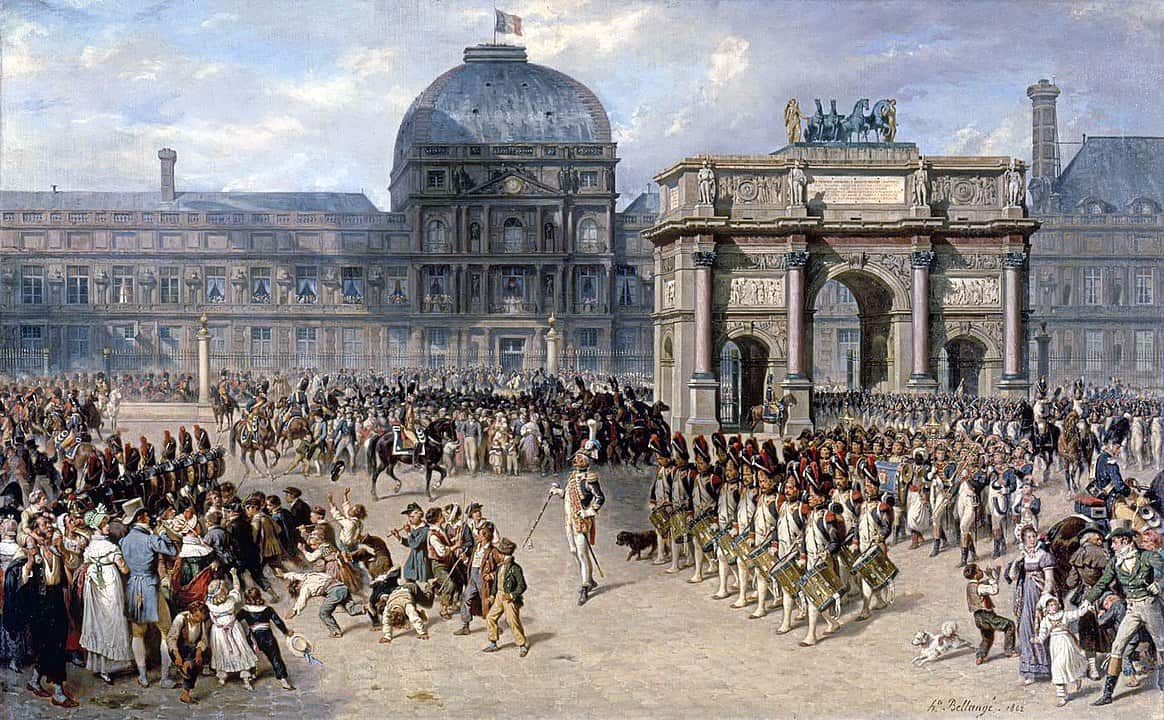
We are in the late 18th or even early 19th century. During this period, the dynamics of the turbulent relationship between Napoleon and Joséphine de Beauharnais are being reversed.
Josephine will become a faithful, devoted wife, a pampering, caring woman, and her lust for debauchery will be replaced by an insatiable lust for wasting money. Meanwhile, the burning flame of love, which burned in Napoleon's heart, will turn into a wonderful friendship with appreciation for Josephine's social skills, which cast a spell on the people of Paris , and made a significant contribution to Napoleon's public relations.
However, Napoleon would ensure that their bedrooms would be located in separate wings of the Tuileries Palace , far from each other, and that a secret corridor would lead to his bedroom, through which a long procession of women would pass.
When word of the parade reaches Josephine, she will cause hysterical scenes of jealousy. Napoleon will respond by saying:
She always thinks I will fall in love seriously. Can't she understand that love is not for me. Love is a passion that makes a person abandon everything for it. I am certainly not the kind of person who would give myself entirely to love. So what does she care, Josephine, that I amuse myself with women for whom I feel no emotion?
And in one of his letters to her he writes:
I don't understand your complaints about the women I correspond with (“correspond” – that's what he calls it). I only love one and that's my little Josephine. She's amiable, she's capricious, and she's easily offended. Her quarrels are as graceful as the rest of her actions. And she, she's always admired, except when she's jealous, when she turns into a little demon….
The women who passed through the secret corridor
When Napoleon and the mistress tidy up the room together
One of the women who will pass through that corridor is a theater actress, young and beautiful. Her name: Marguerite Josephine George Weymer, whom Napoleon will shorten as usual and call her “Mademoiselle George” or “Georgina.” Napoleon’s affection for the actress was part of his affection for the theater.

Napoleon himself had a well-developed dramatic sense, and he even received acting lessons from the greatest of the Parisian actors at the same Talma. And who else but Napoleon would have been the greatest actor on the stage of history. Madame George will describe in her biography the first night of love with Napoleon:
“He said,” she writes:
Come sit next to me. You look tired. Please take off your scarf and hat, let's see you. He undressed me slowly. He played the lady's maid with such gaiety, with such delicacy and modesty, that any woman would lose her head. How could a woman not be charmed by this man.
He was no longer the consul. He was a man in love whose love was not forceful and rude. He hugged me gently and his words were pleasant and modest. With him it was impossible not to experience what he himself was experiencing. I said goodbye to the consul at seven in the morning, ashamed of the mess left after the night. Let me tidy the room, I said. Yes, dear Georgina, I will help you, and he tidied the sofa with me and then said: Goodbye until tomorrow, Georgina.
The celebrated opera singer who replaced Napoleon in Wellington
Another woman who passed through the same corridor was Giuseppina Grassini, a celebrated Italian singer. Napoleon first met her during the First Italian Campaign in Milan. However, he did not pay any attention to her at the time because his heart was entirely devoted to Josephine. He would meet her again, after the Battle of Marengo, during the Second Italian Campaign, and then he would give her not only his heart but his whole being.

She had a wonderful voice, and Napoleon, although he was a fake when he tried to give his voice to the song, was captivated by the magic of music. He would bring her to Paris, where she would continue her glorious career. However, like most of his lovers, she would not remain faithful to him after his fall, and would hasten to enter the bed of his greatest enemy, the Iron Duke, Wellington. She even asked the painter Jacques-Louis David to paint a portrait of Wellington. However, the painter would reply: “Madame, I only paint historical figures.”
The first woman who bore Napoleon a son
We will not review the entire parade of women who passed through that corridor, but one woman is noteworthy – a beautiful brunette, tall with black eyes and a coquettish demeanor. Her name is: Louise Catherine Ele'onore De'nuelle de la Plaigne. And she is noteworthy because she brought Napoleon a child, a son, a son named Le'one

Le'one is indeed half of the name Napole'on, but this son did not inherit half or a thousandth of his father's talent. In his will, Napoleon wrote that he would be happy if his youngest son, Le'one, were to become a judge, if he had the inclination. Le'one knew the legal system well, but not from the right side. He spent most of his life filing frivolous lawsuits against the French government and against his mother for unreasonable financial demands. He died in 1881, having left a negative mark on the great name he bore.
However, the birth of Leon was a defining event for Napoleon, as until then he had harbored doubts about his fertility – his ability to have children. Now it was proven that the reason Josephine was not getting pregnant did not lie with him. This rekindled the thought of divorce, but not for the old reason, which had already been forgotten, but out of Napoleon's belief that only the mixing of the blood of the House of Bonaparte with the blue blood of one of the oldest royal houses of Europe would strengthen his rule and ensure his dynasty for generations.

But the year was 1806. Napoleon was busy defeating the Prussian armies at Vienna and the Russians at Eilau, and the time was not yet ripe for a divorce. Moreover, Napoleon spared Josephine. He said: “She won’t stand it. It will kill her.”
However, the divorce process from Josephine had already begun, and three years later the couple would separate so that Napoleon could marry the daughter of the Austrian Emperor Francis II, but that is a story for another article.
More on the subject
