
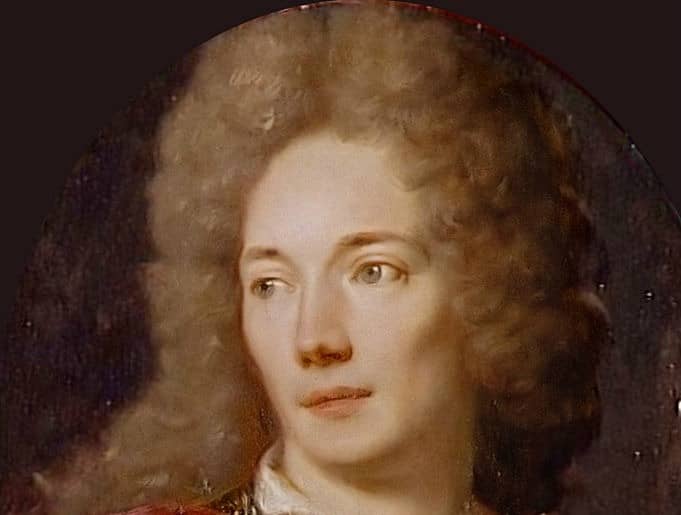
Why did the king's brother wear dresses?
I previously posted about the woman who took Louis XIV’s virginity (much to his mother’s delight). What the article didn’t say was that Louis XIV had a younger brother named Philippe , who later became Duke of Orléans. While, as we’ve seen, Louis XIV’s mother tried to turn him into a womanizer, she tried to turn his younger brother into a…dress wearer.
The reason Anne of Austria tried to feminize Philip was her fear that Philip would rebel against his brother, just as the previous Duke of Orléans, Gaston, brother of Louis XIII, had done. However, if Philip were feminized, he would suffer from a lack of legitimacy to rule, which would greatly reduce the chance that he would challenge the king's authority and prevent a possible civil war.
Indeed, the Queen's upbringing was successful beyond expectations, and Philip, who was indeed a very brave soldier, became an openly homosexual and very feminine in his manner. Thus, the Queen managed to remove a potential political threat from her eldest son.
Monsieur de Choisy decides to become a lady.
Queen Anne of Austria had a good friend named the Countess of Choisy, who decided that in order for her young son François to have a career, he should become the best friend of the Duke of Orléans. The Countess did this by dressing her son in women's clothing and making him a kind of companion to the Duke, who, as mentioned, liked to wear dresses himself.
The Countess' plan was a success and the two children became good friends and loved to walk around dressed in the best dresses of the time. However, while Philippe slowly began to wear men's clothing as he grew older, François, who was handsome and had no facial hair, decided to continue wearing dresses and even adopted a new identity, Mme de Sancy.
His love of women's clothing made Madame de Sensy a kind of fashion "guru" and as a result, many of the Parisian nobility used to bring their daughters to him for advice on how to dress. However, adopting a female identity created two unexpected problems for the master.
The first problem was that his new identity clashed somewhat with the fact that he had chosen a ecclesiastical career and had even received the title of abbot. The second problem was that, although he liked to dress as a woman, he was actually attracted to women, and a few years after moving to the Mouffetard district of Paris, it turned out that he had impregnated one of the young women in the district.
This led to a scandal, which forced him to flee Paris and impersonate an actress, a role he successfully played for about six months. After growing tired of the theatrical world, he decided to adopt a new female identity as the Comtesse des Barres and moved to live near the city of Bourges.

One day, in a literary salon in the town, he met Madame de Coudree, who was known as the greatest matchmaker of her time. Madame de Coudree, who did not know that the Countess de Bar was actually a man, tried to match him with Monsieur de Bergere, the first secretary to the Minister of Finance, Colbert.
Choisy “flowed” with the plan, but Monsieur Bergeret quickly recognized him, as he was informed of his exploits in Paris. After de Choisy’s true identity was discovered, Bergeret took him in for a private conversation and tried to convince de Choisy to abandon his current lifestyle.
At first his arguments did not fall on deaf ears and Mr. Choisy did not give up his female identity. But then Mr. Bergeret pulled out the trump card and told Choisy that the purple robe of the bishop or the red robe of the cardinal would suit the color of his eyes very well and since the priestly vestments of Catholic priests resemble women's clothing, he could both adopt a highly paid career on the side and continue to dress as he pleased. In short, to go with and feel without….
From the Church to the Kingdom of Siam and Back
Thus began de Choisy's impressive ecclesiastical career. In 1676 he joined Cardinal de Bouillon, the king's envoy to the Pope, and served as his assistant. In 1685 he joined the Chevalier de Chaumont and went to Siam (present-day Thailand) with the aim of converting as many natives as possible.
Here too, de Choisy was very successful and managed to convert quite a few of them (and who knows, maybe he taught the Lady Boys a lesson or two along the way). Following his success in Siam, he was accepted into the French Academy in 1687 and wrote several articles on the French language together with Charles Perault, the famous author who wrote, among other things, Sleeping Beauty and Puss in Boots. In 1696, he returned to Siam, this time as ambassador, and after a few years returned to France where he continued an extensive ecclesiastical and literary career.
De Choisy died in Paris at the age of eighty in 1724. Until his last days, and despite his ecclesiastical career, he continued to occasionally dress as a woman because, in his words, “God loves beauty, which creates love, and beauty is the property of woman”…
Want to read about another famous androgynous person?
If you liked this article, I promise you will also really like the article in Belyaev D'On - The Androgynous Man Who Astounded Europe.
More on the subject
FAV